.png)
.png)

En praktisk tjekliste med 7 punkter: Din 2026-guide til elektriske letvægtskørestole i kulfiber, der er designet til at være nemme at rejse med
30. december 2025
Abstrakt
The proliferation of advanced composite materials has catalyzed a significant transformation in the design and functionality of personal mobility devices. This analysis examines the emergence of lightweight carbon fiber electric wheelchairs as a pivotal innovation for enhancing user autonomy, particularly in the context of travel. It explores the technical attributes of carbon fiber, such as its high strength-to-weight ratio and vibration-damping properties, which distinguish these devices from their traditional aluminum or steel counterparts. The investigation extends to an evaluation of battery technology, motor efficiency, portability mechanisms, and ergonomic considerations that collectively define the user experience. By situating these technological advancements within the broader discourse of human capability and freedom, the discussion illuminates how lightweight carbon fiber electric wheelchairs designed for easy travel are not merely assistive tools but enablers of a more engaged and unencumbered life. The objective is to provide a comprehensive understanding of the factors that contribute to their efficacy, empowering users to make informed decisions that align with their aspirations for mobility and independence in 2026.
Vigtige pointer
- Prioritize carbon fiber for its superior strength-to-weight ratio, enhancing portability.
- Verify battery specifications and ensure they are compliant with 2026 airline regulations.
- Evaluate the folding mechanism for ease of use and compact storage dimensions.
- Match motor power and wheel design to your intended travel terrains.
- Consider ergonomic adjustability for comfort during extended periods of use.
- Choose lightweight carbon fiber electric wheelchairs designed for easy travel for optimal freedom.
- Confirm the warranty and after-sales support network before making a purchase.
Indholdsfortegnelse
- The Philosophical Shift: Redefining Freedom with Advanced Mobility
- Point 1: Scrutinizing the Soul of the Machine – Material Composition and Weight
- Point 2: The Heartbeat of Independence – Battery Technology and Travel Range
- Point 3: The Art of Compactness – Portability and Folding Mechanisms
- Point 4: The Engine of Exploration – Motor Power and Performance
- Point 5: The Human-Machine Interface – Ergonomics and Customization
- Point 6: Navigating the World with Confidence – Wheels, Suspension, and Terrain Capability
- Point 7: The Ecosystem of Support – Warranty, Service, and Airline Assistance
- Ofte stillede spørgsmål (FAQ)
- A Final Thought on Embodied Freedom
- Referencer
The Philosophical Shift: Redefining Freedom with Advanced Mobility
The desire to explore, to connect, and to experience the world is a profound aspect of the human condition. It is a yearning not just for a change of scenery, but for the expansion of self that comes from encountering new places, cultures, and ideas. For individuals with mobility limitations, however, this fundamental desire has often been curtailed by the physical and logistical barriers imposed by cumbersome equipment. The very tools meant to enable movement could, paradoxically, become anchors, tethering one to familiar environments and routines. The act of travel, meant to be liberating, could transform into a daunting exercise in planning, physical exertion, and compromise.
From Limitation to Liberation: The Emotional Core of Travel
Imagine the feeling of wanting to join a spontaneous family trip to see the autumn leaves, or accepting a friend’s invitation to explore the historic laneways of a European city. Now, imagine the immediate cascade of calculations that follows: Will my wheelchair fit in the car? Can I manage lifting it? Will the battery last the entire day? Will I be a burden on my travel companions? These questions, born from the practical realities of using a heavy, unwieldy mobility device, can extinguish the spark of excitement, replacing it with anxiety and resignation. This emotional toll is a significant, though often unquantified, aspect of living with a mobility impairment. The limitation is not just physical; it is a restriction on spontaneity, on possibility, and on the capacity to say “yes” to life’s invitations. The freedom to travel is intertwined with the freedom from worry—the worry of being left behind, the worry of equipment failure, and the worry of being defined by one’s physical constraints.
The Role of Technology in Human Flourishing
Here, we can appreciate the profound role of technology not merely as a problem-solver, but as an agent of human flourishing. When technology is thoughtfully designed with a deep understanding of human needs and aspirations, it can restore capabilities and expand the horizons of what is possible. The development of lightweight carbon fiber electric wheelchairs designed for easy travel represents such a technological leap. It is an innovation that addresses not only the functional requirement of mobility but also the emotional need for independence and dignity. By drastically reducing weight without compromising strength, and by integrating user-friendly folding mechanisms and long-range batteries, these devices directly confront the anxieties that have historically plagued accessible travel. They represent a philosophical shift from a model of “making do” to one of “thriving.” The goal is no longer simply to get from point A to point B, but to do so with ease, confidence, and a sense of grace.
Why 2026 is a Pivotal Year for Accessible Travel
The year 2026 stands as a significant milestone in this evolution. Advances in materials science, battery efficiency, and motor technology have converged to produce a new generation of mobility devices that are more capable and accessible than ever before. Public and corporate awareness regarding accessibility has improved, leading to better infrastructure and more accommodating travel policies. Airlines, while still navigating the complexities of accommodating assistive devices, have more standardized procedures in place. In this context, a device like a lightweight carbon fiber electric wheelchair is not an outlier; it is the key that unlocks the full potential of this more accessible world. It empowers the user to take full advantage of the opportunities for travel that now exist, transforming a once-arduous undertaking into a joyful and enriching experience. The choice of a wheelchair becomes more than a practical decision; it becomes an affirmation of one’s right to explore the world on one’s own terms.
Point 1: Scrutinizing the Soul of the Machine – Material Composition and Weight
The essence of a travel-friendly electric wheelchair is captured in a single, potent word: lightweight. This characteristic, however, is not a simple attribute but the outcome of sophisticated material science and engineering. The very substance from which a wheelchair is forged dictates its portability, its durability, and even the quality of the ride it provides. In 2026, the material of choice for premium travel wheelchairs is unequivocally carbon fiber, a composite that has revolutionized industries from aerospace to competitive sports. To understand why, we must look beyond the marketing claims and examine the fundamental properties of the materials themselves.
The Miracle of Carbon Fiber: More Than Just a Material
What exactly is carbon fiber? Imagine weaving threads that are thinner than a human hair, yet individually stronger than steel. Now, imagine bundling millions of these filaments together into a “tow,” and then weaving these tows into a fabric. This fabric is then impregnated with a resin, typically epoxy, and molded into the desired shape under heat and pressure. The result is a composite material—carbon fiber reinforced polymer (CFRP)—that possesses an extraordinary combination of properties.
Its most celebrated feature is its high strength-to-weight ratio. A component made from carbon fiber can be as strong as a steel equivalent while weighing a fraction of the amount. This is not magic; it is a matter of physics. The strength comes from the incredibly strong carbon-carbon bonds within the fibers, while the low weight is due to carbon being a very light element. For a wheelchair user, this translates into a tangible, life-altering benefit: a chair that can be lifted into a car trunk or carried up a flight of stairs without requiring Herculean strength or the assistance of multiple people. This single factor can be the difference between independent travel and being homebound.
Comparative Analysis: Carbon Fiber vs. Traditional Metals
To truly appreciate the advantages of carbon fiber, a direct comparison with the materials traditionally used for wheelchair frames—steel and aluminum—is illuminating.
| Funktion | Kulfiber | Aluminum Alloy | Stål |
|---|---|---|---|
| Vægt | Very Low (Typically 12-18 kg for a full chair) | Low to Medium (Typically 18-25 kg) | High (Typically 25-40 kg) |
| Styrke-til-vægt-forhold | Højeste | Medium | Lav |
| Modstandsdygtighed over for udmattelse | Excellent; less prone to cracking over time | Good, but can fatigue with repeated stress cycles | Good, but susceptible to rust and fatigue |
| Dæmpning af vibrationer | Excellent; absorbs bumps for a smoother ride | Poor; transmits vibrations to the user | Poor; transmits vibrations |
| Modstandsdygtighed over for korrosion | Excellent; does not rust or corrode | Good, but can corrode in saline environments | Poor; requires protective coatings to prevent rust |
| Omkostninger | Høj | Medium | Lav |
As the table demonstrates, while steel is strong and inexpensive, its weight makes it impractical for a travel wheelchair. An aluminum electric wheelchair offers a significant weight reduction and has been the standard for lightweight chairs for many years. However, carbon fiber surpasses aluminum in every performance metric except for initial cost. The investment in a lightweight carbon fiber electric wheelchair designed for easy travel is an investment in superior durability, a more comfortable ride, and, most importantly, unparalleled ease of handling. The difference of a few kilograms may seem trivial on paper, but it is deeply felt at the end of a long day of travel, when lifting the chair one last time is the final hurdle before resting.
The Tangible Experience of “Lightweight”: Lifting, Storing, and Daily Use
Let’s move from the abstract world of material properties to the concrete reality of daily use. Consider the simple act of putting a wheelchair in a car. With a steel chair weighing upwards of 30 kg, this is often a two-person job, requiring coordination and physical strain. An aluminum model at around 20 kg is more manageable for a single, able-bodied person but can still be challenging for an older individual or someone with reduced strength.
Now picture a carbon fiber wheelchair weighing around 14 kg. This is a weight that is comparable to a piece of carry-on luggage or a large bag of groceries. It transforms the act of loading the chair from a major physical task into a manageable lift. This newfound ease extends to every aspect of travel. It means navigating train stations without dreading the gap between the platform and the train. It means a travel companion can easily carry the chair up the steps to a charming, non-accessible hotel. It means storing the chair in the tight confines of a cruise ship cabin is no longer a game of Tetris. This is the practical embodiment of freedom—the removal of physical obstacles that allows for a more fluid and spontaneous engagement with the world.
Beyond Weight: Durability, Vibration Dampening, and Longevity
The benefits of carbon fiber extend well beyond its low weight. One of its less-discussed but equally valuable properties is its excellent vibration damping. Metal frames, being stiff and resonant, tend to transmit every bump and crack in the pavement directly to the user’s body. Over the course of a day exploring a city, this constant, low-level vibration can lead to significant fatigue and discomfort. Carbon fiber, by its nature as a composite, absorbs and dissipates these vibrations, resulting in a noticeably smoother and less fatiguing ride. It is a subtle difference that has a major impact on overall energy levels and enjoyment.
Furthermore, carbon fiber has exceptional fatigue resistance. Metals can develop microscopic cracks over time from repeated stress, which can eventually lead to failure. Carbon fiber is far more resilient to this type of wear and tear, meaning the frame is likely to maintain its structural integrity for much longer. When you are investing in a mobility device that is central to your quality of life, this assurance of long-term durability is invaluable. It is the confidence that your chair, your partner in exploration, will not fail you when you are far from home. This commitment to quality and longevity is a hallmark of premium manufacturers like carbon fiber electric wheelchair wholesale, who understand that a wheelchair is more than just a product; it is a lifeline.
Point 2: The Heartbeat of Independence – Battery Technology and Travel Range
If the frame is the skeleton of an electric wheelchair, the battery is its heart. It is the source of power that animates the machine, providing the energy needed to explore, to participate, and to live a full life. The evolution of battery technology has been a driving force behind the feasibility of lightweight, travel-friendly wheelchairs. In 2026, the conversation is dominated by lithium-ion technology, but a nuanced understanding of battery specifications and real-world performance is necessary for making an informed choice. The goal is to find a power source that not only meets your daily needs but also complies with the strict regulations governing air travel.
Understanding Lithium-Ion: The Power Behind the Freedom
For decades, electric wheelchairs relied on heavy, cumbersome sealed lead-acid (SLA) batteries. While reliable, they were a major contributor to the overall weight of the chair and had limited energy density. The advent of lithium-ion (Li-ion) batteries changed everything. Originally developed for consumer electronics like laptops and phones, Li-ion technology offers a much higher energy density, meaning it can store more energy in a smaller, lighter package.
A Li-ion battery for a wheelchair can be up to 75% lighter than an SLA battery of equivalent capacity. This weight saving is a primary enabler of the sub-15 kg carbon fiber wheelchairs we see today. Beyond weight, Li-ion batteries offer other significant advantages: they have a longer lifespan (more charge-recharge cycles), they hold their charge better when not in use, and they do not suffer from the “memory effect” that plagued older battery chemistries. This means you can top up the charge whenever convenient without degrading the battery’s long-term health. For a traveler, this flexibility is a tremendous asset, allowing for opportunistic charging during a lunch stop or at a coffee shop.
Decoding Battery Specifications: Amp-Hours, Voltage, and Watt-Hours
When comparing different lightweight carbon fiber electric wheelchairs designed for easy travel, you will encounter a series of technical specifications related to the battery. Understanding these terms is key to predicting a chair’s performance.
- Voltage (V): Think of voltage as the electrical pressure. Most lightweight electric wheelchairs operate on a 24V system, which provides a good balance of power and efficiency.
- Amp-Hours (Ah): This is a measure of the battery’s capacity. It tells you how much current the battery can deliver over a certain period. A higher Ah rating generally means a longer potential range, as the battery holds more “fuel.” A typical travel wheelchair might have a battery with a capacity between 6Ah and 12Ah.
- Watt-Hours (Wh): This is arguably the most important metric, as it represents the total amount of energy stored in the battery. It is calculated by multiplying the voltage by the amp-hours (V x Ah = Wh). A 24V, 10Ah battery, for example, has a capacity of 240Wh. This figure is what airlines use to determine whether a battery is permitted for travel.
It is common for manufacturers to offer more than one battery with a chair. You might have a smaller, lighter battery for daily errands and a larger capacity battery for longer excursions. This modularity allows you to tailor the chair’s weight and range to the specific demands of the day.
The Real-World Range Equation: Factors That Influence Your Journey
Manufacturers will always provide an estimated maximum range for their wheelchairs, often something like “up to 15 kilometers.” It is vital to understand that this figure is an ideal-case scenario, typically measured on a flat, smooth surface with a lightweight user at a steady speed. The actual range you experience will be influenced by a host of real-world factors:
- Brugervægt: A heavier user requires more energy to move, which will reduce the range.
- Terræn: Traveling uphill, over soft surfaces like grass or thick carpet, or on rough pavement requires significantly more power than gliding on a smooth, level floor. The charming but uneven cobblestone streets of an old city will drain a battery much faster than the polished floors of a museum.
- Speed and Driving Style: Frequent stops and starts, along with driving at top speed, consume more energy than maintaining a moderate, steady pace.
- Tire Pressure: Under-inflated tires increase rolling resistance and can noticeably decrease your range.
- Temperatur: Batteries perform less efficiently in very cold weather, which can temporarily reduce their capacity and your travel distance.
A prudent approach is to consider the manufacturer’s stated range as an optimistic ceiling. If you anticipate a day of varied terrain and extensive travel, it may be wise to carry a spare battery or plan for a midday charging opportunity. Thinking about your typical day can help. Do you need to cover long distances, or is your use more about navigating smaller spaces like shops and restaurants? Answering this question will guide you toward the right battery configuration for your lifestyle.
Air Travel Compliance in 2026: Navigating FAA and IATA Regulations
For many, the ultimate test of a travel wheelchair is its ability to be taken on an airplane. The regulations governing the transport of lithium-ion batteries, set by bodies like the Federal Aviation Administration (FAA) in the US and the International Air Transport Association (IATA) globally, are strict and designed for safety. As of 2026, the rules are well-established but must be followed precisely.
- Installed Batteries: A lithium-ion battery that is installed in the wheelchair is generally permitted, provided its capacity does not exceed 300 Watt-hours (Wh). The user must be able to disconnect the battery or otherwise isolate the power to prevent accidental activation during the flight.
- Spare Batteries: You are typically allowed to carry up to two spare lithium-ion batteries. Each spare battery must not exceed 160Wh. These spare batteries must be carried in your carry-on luggage, not in your checked baggage. The terminals must be protected from short-circuiting, usually by taping them over or placing each battery in a separate protective pouch.
This is why the Watt-hour (Wh) rating is so important. Before purchasing any lightweight carbon fiber electric wheelchair designed for easy travel, you must verify that its batteries are compliant. A reputable manufacturer will clearly state the Wh rating and often provide a certificate of compliance that you can show to airline staff. For example, a chair with a single 240Wh battery (24V x 10Ah) is well within the 300Wh limit for an installed battery. If you wanted to bring a spare, it would need to be 160Wh or less (e.g., a 24V, 6.6Ah battery). Always contact your airline well in advance of your flight to declare your device and confirm their specific procedures. This proactive communication can prevent stressful and potentially travel-disrupting issues at the airport.
Point 3: The Art of Compactness – Portability and Folding Mechanisms
A wheelchair may be constructed from the lightest materials and powered by the most advanced battery, but if it cannot be made compact for transport, its utility for travel is severely diminished. The ability to quickly and easily fold a wheelchair into a manageable size is a cornerstone of its portability. This is not merely a matter of convenience; it is a fundamental design feature that impacts every transition point in a journey—from leaving the house to boarding a flight to hailing a cab. The ingenuity of a folding mechanism lies in its ability to balance structural integrity when unfolded with effortless collapse when needed.
One-Step vs. Multi-Step Folding: A Matter of Convenience
As you explore the market for foldable electric wheelchairs, you will encounter various folding designs. These can generally be categorized into one-step and multi-step processes.
- One-Step Folding: These are often the most desirable for travelers. As the name implies, the chair collapses in a single, fluid motion. This might involve pulling a lever or handle, after which the frame folds in on itself, much like a baby stroller. Some advanced models even feature automatic or remote-controlled folding, which reduces the physical effort to nearly zero. The primary advantage is speed and simplicity. When a taxi arrives or it is time to board a train, you can fold the chair in seconds without any complex sequence of actions.
- Multi-Step Folding: These designs require a series of actions to collapse the chair. This might involve removing the battery, folding down the backrest, detaching the joystick, and then folding the frame. While these chairs can still become very compact, the process is more time-consuming and can be challenging for users with limited dexterity or strength. It also introduces the risk of misplacing a detached component, such as the joystick or a locking pin, during the haste of travel.
For the frequent traveler, the elegance of a one-step folding mechanism cannot be overstated. It minimizes the time spent managing equipment and maximizes the time spent enjoying the destination. When evaluating a chair, it is wise to practice the folding and unfolding process yourself. Is it intuitive? Does it require significant force? Can you do it without assistance? The answers to these questions will reveal how a chair will perform in the real, often hurried, world of travel.
Evaluating Folded Dimensions: The Trunk Test and Storage Reality
Once folded, the chair’s dimensions become the next critical factor. A compact, rectangular shape is generally preferable to an irregular one, as it is easier to pack and store. Manufacturers will provide the folded dimensions (Length x Width x Height), and these numbers should be carefully considered in relation to your specific needs.
The most common and practical evaluation is the “trunk test.” Measure the dimensions of your car’s trunk, paying attention to the opening height, and compare these to the folded dimensions of the wheelchair. Will it fit easily, or will it be a tight squeeze? Is there room left over for luggage? If you frequently travel in smaller cars or use ride-sharing services, a more compact folded size becomes even more valuable.
Beyond the car trunk, consider other storage scenarios. Will it fit in the closet of a hotel room or a cruise ship cabin? Can it be tucked away in a restaurant without obstructing a walkway? A chair that folds into a slim, upright profile can often be stored more easily than one that folds into a flat but wide shape. Some models are even designed to be tilted and rolled like a piece of luggage when folded, a clever feature that further enhances their portability in large spaces like airports.
The Human-Centric Design of a Truly Portable Wheelchair
The design of a truly portable wheelchair extends beyond simple mechanics; it incorporates an understanding of the human body and the ergonomics of lifting and handling. A well-designed chair will have integrated handles or specific gripping points that make it easier to lift once folded. The weight should be balanced, so it does not feel awkward or unwieldy to carry.
Consider the locking mechanism. When folded, does the chair lock securely in place? A chair that can accidentally start to unfold while being lifted is not only frustrating but also dangerous. A positive, audible click or a secure latch provides the confidence that the chair will remain in its compact state until you are ready to unfold it. These small details reflect a manufacturer’s commitment to a user-centric design philosophy. They show an awareness that the interaction with the wheelchair does not end when the user gets out of the seat; the experience of handling the object is just as important for a seamless travel experience.
Case Study: A Weekend Trip with a Foldable Electric Wheelchair
To make these concepts more concrete, let’s imagine a weekend trip for two people, one of whom uses a lightweight carbon fiber electric wheelchair.
- Departure: The chair, weighing 15 kg, is easily folded with a single pull of a lever. It is lifted into the trunk of a standard sedan, leaving ample space for two weekend bags.
- Hotel Arrival: At the hotel, the chair is unfolded in seconds in the lobby. The user drives it to the elevator and up to the room. The companion brings the luggage. The process is smooth and independent.
- Sightseeing: The day is spent exploring a mix of museums and parks. The chair’s long-range battery handles the varied distances with power to spare. Its narrow profile allows for easy navigation through shop aisles. When encountering a restaurant with a single step at the entrance, the companion can easily lift the front wheels over the obstacle.
- Evening: For dinner at a small bistro, the chair is folded and tucked beside the table. It takes up no more space than a folded stroller would, causing no inconvenience to staff or other patrons.
- Return: The journey home is just as effortless. The chair is folded at the car, loaded into the trunk, and is ready to be unfolded upon arrival back home.
In this scenario, the Sammenklappelig elektrisk kørestol is not a source of friction or difficulty. It is a silent, efficient partner that facilitates the experience rather than complicating it. This is the promise of a well-designed, portable mobility device. It fades into the background, allowing the user’s abilities, not their limitations, to take center stage.
Point 4: The Engine of Exploration – Motor Power and Performance
The motors are the muscles of an electric wheelchair. They convert the battery’s electrical energy into the mechanical force that turns the wheels. The quality, type, and power of these motors have a direct and profound impact on the chair’s performance, influencing its speed, its ability to climb inclines, its responsiveness, and even the ambient noise it creates. In 2026, the technology of choice is the brushless DC motor, a sophisticated piece of engineering that offers significant advantages for a travel wheelchair.
Brushed vs. Brushless Motors: A 2026 Perspective
For many years, the standard for electric wheelchairs was the brushed DC motor. These motors work by using physical “brushes” to deliver electrical current to the rotating part of the motor (the rotor). While effective, this design has inherent drawbacks. The brushes wear down over time and require periodic replacement. The friction between the brushes and the commutator creates heat, reduces efficiency, and generates electromagnetic interference.
The brushless DC motor represents a major technological advancement. In a brushless design, the configuration is inverted: the permanent magnets are on the rotor, and the electromagnets are on the stationary part of the motor (the stator). An electronic controller precisely manages the flow of electricity to the stator coils, creating a rotating magnetic field that pulls the rotor around. This design eliminates the physical brushes and their associated problems.
The benefits for a wheelchair user are numerous:
- Higher Efficiency: Less energy is lost to friction, meaning more of the battery’s power is converted into motion. This can contribute to a longer travel range.
- Greater Reliability and Lifespan: With no brushes to wear out, brushless motors are virtually maintenance-free and have a much longer operational life. This is a source of great peace of mind when traveling.
- Higher Power-to-Weight Ratio: Brushless motors can generate more power for their size and weight, a perfect attribute for a lightweight wheelchair.
- Quieter Operation: The absence of brush friction results in a significantly quieter motor, allowing for a more discreet and pleasant user experience.
While brushed motors can still be found on some older or entry-level models, by 2026, brushless motors have become the undisputed standard for any high-quality lightweight carbon fiber electric wheelchair designed for easy travel.
| Motor Type | Efficiency | Vedligeholdelse | Levetid | Noise Level | Omkostninger |
|---|---|---|---|---|---|
| Brushless DC | Høj | Very Low (None) | Very Long | Meget lav | Higher |
| Brushed DC | Medium | Periodic Brush Replacement | Limited by Brush Life | Moderat | Lower |
Torque, Speed, and Terrain: Matching Your Motor to Your Ambitions
When looking at motor specifications, you will often see a power rating in Watts (W), for example, “2 x 250W”. This indicates that the chair has two motors, one for each drive wheel, each with a peak power output of 250 Watts. While this number gives a general idea of the motor’s capability, the concepts of torque and speed are more descriptive of the actual user experience.
- Torque: This is the rotational force the motor can produce. It is what gives the wheelchair its “pushing power.” High torque is essential for starting from a standstill, climbing inclines, and navigating over obstacles or soft surfaces. A chair with insufficient torque will feel sluggish and may struggle on ramps or thick carpets.
- Top Speed: This is the maximum velocity the chair can achieve on a flat surface. Most electric wheelchairs have a top speed of around 6-8 km/h (4-5 mph), which is a brisk walking pace. While a high top speed can be useful for covering distance in open areas, torque is generally more important for the varied conditions encountered during travel.
A well-engineered wheelchair will have a drivetrain (the combination of motor and gearbox) that is optimized to provide a good balance of both torque and speed. For a travel wheelchair, the emphasis should be on having enough torque to confidently handle accessibility ramps, varied outdoor terrain, and unexpected inclines. Imagine trying to get up the ramp to a historic monument or navigating a grassy park; in these moments, torque is what gets you there.
The Symphony of Silence: Why Motor Noise Matters
The auditory experience of using an electric wheelchair is often overlooked but contributes significantly to the quality of life. Older, brushed motors can produce a noticeable whine or hum that is always present when the chair is in motion. This constant noise can be fatiguing for the user and can make it difficult to hold a conversation with someone walking alongside. It also draws attention, which can make a user feel self-conscious in quiet environments like a library, a church, or a museum.
The near-silent operation of modern brushless motors is a subtle but profound improvement. It allows the user to move through the world more discreetly, to better hear their surroundings, and to engage more easily in social interactions. The silence of the machine allows the sounds of life—conversation, nature, music—to come to the forefront. It is a form of sensory freedom that complements the physical freedom the chair provides.
Intelligent Braking Systems: Safety in Motion and at Rest
The motors in an electric wheelchair are also integral to its braking system. Modern chairs use electromagnetic brakes, which are a fail-safe design. When the motors are engaged, an electromagnet holds the brakes open, allowing the wheels to turn. The moment the joystick is released or power is cut, the electromagnet disengages, and powerful springs automatically apply the brakes, bringing the chair to a smooth and secure stop.
This system has two key safety benefits:
- Automatic Parking Brake: The chair will not roll away, even when stopped on a steep incline. This provides a huge sense of security when navigating ramps or hilly areas.
- Regenerative Braking: Many advanced systems use the motors to help slow the chair down when going downhill or decelerating. The motors act as generators, converting the chair’s momentum back into a small amount of electrical energy that is fed back into the battery. This not only improves braking control but can also slightly extend the battery’s range, a concept borrowed from electric and hybrid cars.
When considering a wheelchair, test its braking. Does it stop smoothly and predictably? Does it feel secure when you release the joystick on an incline? A confident braking system is non-negotiable for safe and stress-free travel.
Point 5: The Human-Machine Interface – Ergonomics and Customization
A wheelchair is more than a machine; it is an extension of the user’s body. As such, the way it fits and interacts with the user is of paramount importance. Ergonomics—the science of designing things to fit the human body—is central to the comfort, health, and usability of a wheelchair. For a traveler who may be spending many hours a day in their chair, proper ergonomic design is not a luxury; it is a necessity. It prevents discomfort, reduces fatigue, and promotes good posture and skin health. A well-fitted chair feels less like a piece of equipment and more like a part of oneself.
The Importance of a Perfect Fit: Seat Dimensions and Adjustability
People come in all shapes and sizes, and a one-size-fits-all approach is inadequate for a device as personal as a wheelchair. The key dimensions to consider are the seat width, seat depth, and backrest height.
- Seat Width: The seat should be wide enough to accommodate the user’s hips without pressure, but not so wide that it becomes difficult to reach the wheels (on a manual chair) or that it encourages leaning to one side. A little extra space, perhaps an inch on either side, is often recommended to accommodate bulky clothing in colder climates.
- Seat Depth: Proper seat depth is vital for distributing weight and providing thigh support. The seat should end about two to three finger-widths behind the bend of the knee. A seat that is too shallow fails to support the thighs, concentrating pressure on the buttocks. A seat that is too deep can press against the back of the knees, cutting off circulation and causing discomfort.
- Backrest Height: The ideal backrest height depends on the user’s level of trunk control. A lower backrest allows for greater freedom of movement for the shoulders and arms, which is good for active users. A higher backrest provides more support for individuals who need it.
Many high-quality lightweight carbon fiber electric wheelchairs designed for easy travel offer some degree of adjustability in these areas. Look for models that provide options for different seat sizes or have features like adjustable-tension backrests that can be contoured to the user’s spine. This ability to tailor the fit is a hallmark of a premium product.
Cushioning Technology: Pressure Relief for Long Journeys
The seat cushion is the single most important component for comfort and pressure management. Sitting for extended periods puts pressure on the skin and underlying tissues, particularly over bony areas like the “sit bones” (ischial tuberosities). Unrelieved pressure can restrict blood flow, leading to discomfort, pain, and in the worst cases, dangerous pressure sores.
Modern wheelchair cushions use a variety of advanced materials to combat this issue:
- High-Density Foam: Provides a stable base and good support. Often used in combination with other materials.
- Memory Foam: Conforms to the user’s shape to distribute pressure more evenly.
- Gel Inserts: A fluid-like gel is excellent at redistributing pressure away from high-risk areas.
- Air Cell Cushions: A matrix of interconnected air cells can be inflated to precisely match the user’s contour, offering the highest level of pressure relief.
For travel, a good cushion needs to be both supportive and lightweight. Many manufacturers, including those producing top-tier Elektrisk kørestol i kulfiber models, invest heavily in cushion design, often using a hybrid approach that combines layers of different materials to achieve the optimal balance of comfort, pressure relief, and stability. The cushion cover is also important. It should be made from a breathable, stretchable material to reduce shear forces on the skin and to manage heat and moisture.
Intuitive Controls: Joystick Sensitivity and User Programming
The joystick is the user’s primary connection to the chair, their means of directing its every move. The responsiveness and programmability of the control system can dramatically alter the driving experience.
- Joystick Sensitivity: An intuitive joystick provides a direct and proportional response. Small movements should result in slow, precise maneuvers, while larger movements should produce more speed. The joystick should feel natural and require minimal effort to operate. Some users may prefer a very sensitive controller, while others, perhaps those with tremors, might need a controller with dampened sensitivity to filter out unintentional movements.
- Programmable Parameters: Advanced control systems allow for the customization of various driving parameters. A technician or the user themselves can often adjust things like the maximum speed, the rate of acceleration and deceleration, and the turning speed. This allows the chair’s performance to be perfectly matched to the user’s skill level and environment. For example, you might have a program for “indoor use” with lower speed and acceleration for safety in crowded spaces, and an “outdoor use” program with higher speed for covering distance.
The ability to fine-tune the controls empowers the user to feel truly in command of the device. It transforms the act of driving from a conscious effort into an intuitive extension of one’s will, much like walking.
A Look at RICHALL Medical’s Approach to User-Centric Design
Leading manufacturers in the mobility space, such as the team at kulfiber elektrisk kørestol mærke, place a strong emphasis on these ergonomic and user-centric details. Their design process often involves extensive consultation with wheelchair users and physical therapists to understand the real-world challenges and needs of their customers. This leads to the inclusion of thoughtful features that might not be immediately obvious but make a significant difference in daily life. Examples include swing-away armrests that make it easier to transfer in and out of the chair or to pull up close to a table, or easily accessible battery charging ports. When a company focuses on the human experience of using their product, the result is a device that is not just functional, but genuinely empowering.
Point 6: Navigating the World with Confidence – Wheels, Suspension, and Terrain Capability
A wheelchair’s ability to handle different surfaces—from the smooth tile of an airport terminal to the bumpy cobblestones of a historic street—is determined by the design of its wheels and suspension system. These components are the chair’s interface with the ground, and their characteristics dictate the smoothness of the ride, the stability of the chair, and the range of environments it can confidently access. For a traveler, versatility is key. A chair that performs well in a variety of conditions provides the freedom to explore without being limited to perfectly paved surfaces.
Wheel Size and Material: A Comparative Guide
Electric wheelchairs have two types of wheels: smaller front wheels (casters) that pivot for steering, and larger rear wheels that are driven by the motors. The size and material of these wheels play a crucial role.
- Drive Wheels (Rear): The drive wheels on most lightweight travel wheelchairs are typically between 8 and 12 inches in diameter.
- Larger Wheels (10-12 inches): These are generally better for outdoor use. Their larger circumference allows them to roll over obstacles like cracks, thresholds, and uneven ground more easily. They provide a smoother ride on bumpy surfaces.
- Smaller Wheels (8-9 inches): These can provide a slightly smaller turning radius, which is an advantage for maneuvering in tight indoor spaces. However, they are more likely to get caught in small gaps or struggle with obstacles.
- Caster Wheels (Front): These are usually smaller, often around 6 to 8 inches. Larger casters are better at preventing the chair from getting stuck on small bumps and contribute to a more stable ride.
- Tire Material:
- Solid/Foam-Filled Tires: The vast majority of travel wheelchairs use solid or foam-filled tires. Their primary advantage is that they are puncture-proof. For a traveler, this is a massive benefit, eliminating the risk of a flat tire derailing a trip far from home. They are also maintenance-free.
- Pneumatic (Air-Filled) Tires: While they offer the smoothest possible ride by absorbing small vibrations, they are susceptible to punctures and require regular pressure checks. For this reason, they are less common on chairs designed specifically for travel.
For most travelers, a combination of larger (10-12 inch) solid rear tires and larger (7-8 inch) solid front casters offers the best blend of all-terrain capability, ride comfort, and maintenance-free reliability.
| Wheel & Tire Feature | Primary Advantage | Best Use Case |
|---|---|---|
| Large Drive Wheels (10-12″) | Smoother ride, better obstacle clearance | Outdoor, varied terrain |
| Small Drive Wheels (8-9″) | Tighter turning radius | Indoor, smooth surfaces |
| Solid/Foam-Filled Tires | Puncture-proof, no maintenance | Travel, general use |
| Pneumatic (Air-Filled) Tires | Superior ride comfort | Users prioritizing comfort over reliability |
The Role of Suspension in Rider Comfort and Chair Stability
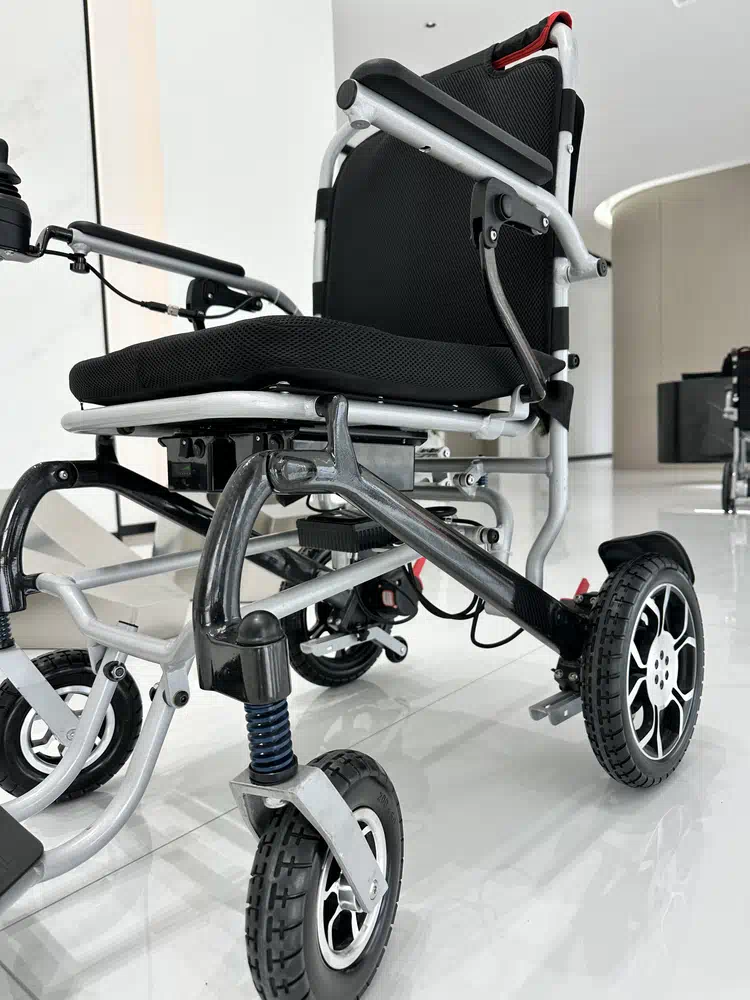
Suspension is a feature that can dramatically improve the quality of a wheelchair’s ride. While once reserved for heavy-duty outdoor models, some advanced lightweight travel wheelchairs are now incorporating simple yet effective suspension systems. These systems, often consisting of springs or polymer dampers located near the wheels, allow the wheels to move up and down independently to absorb the shock of bumps and uneven terrain.
The effect is twofold. First, it isolates the user from jarring impacts, reducing fatigue and improving comfort, particularly for individuals with back pain or sensitivity to vibration. Second, it helps to keep all wheels in contact with the ground on uneven surfaces, which improves the chair’s stability and traction. While a lack of suspension might be acceptable for a chair used exclusively as an indendørs elektrisk kørestol, for any amount of outdoor use, a suspension system is a highly desirable feature. It can make the difference between a jarring, unpleasant ride and a comfortable, confident journey.
From Cobblestones to Carpets: Assessing True All-Terrain Performance
The term “all-terrain” can be misleading. A lightweight carbon fiber electric wheelchair designed for easy travel is not going to conquer mountain trails. Its purpose is to capably handle the common variety of surfaces one encounters during travel: sidewalks, paved paths, ramps, grass, firm gravel, and indoor flooring.
True all-terrain performance is a synergy of several factors we have discussed:
- Motor Torque: The power to push through resistant surfaces like thick carpet or a grassy lawn.
- Hjulstørrelse: Large enough wheels to roll over small obstacles without getting stuck.
- Ground Clearance: Sufficient space between the ground and the lowest part of the chair’s frame (usually the motor housing) to avoid getting hung up on thresholds or curbs.
- Ophængning: The ability to absorb bumps and maintain traction on uneven ground.
When evaluating a chair, think about the most challenging terrain you are likely to encounter. Will you be navigating the historic, uneven streets of Rome? Or perhaps the grassy expanses of a national park? Be realistic about a lightweight chair’s capabilities, but look for one that provides the confidence to venture off the perfectly paved path. This is often where the most memorable travel experiences are found.
The Difference Between an Indoor Electric Wheelchair and an Outdoor Model
The distinction between an indoor and outdoor wheelchair is becoming more fluid with modern designs, but some general principles hold. A dedicated udendørs elektrisk kørestol is typically larger, heavier, with very large, air-filled tires, powerful motors, and a sophisticated suspension system. They offer superior comfort and capability on rough terrain but are not practical for travel or indoor use.
Conversely, a dedicated indoor model will prioritize a very small footprint and a tight turning radius above all else, often at the expense of outdoor performance.
The beauty of the modern lightweight carbon fiber electric wheelchair designed for easy travel is that it occupies a versatile middle ground. It seeks to provide excellent indoor maneuverability thanks to its compact size and responsive controls, while also offering enough power, wheel size, and durability to be a confident companion for most outdoor travel situations. It is the jack-of-many-trades that the modern traveler needs.
Point 7: The Ecosystem of Support – Warranty, Service, and Airline Assistance
The purchase of a high-quality electric wheelchair is a significant investment, not just financially, but in one’s quality of life and independence. The relationship with the manufacturer and dealer does not end at the point of sale; it is an ongoing partnership. A robust support ecosystem, encompassing a comprehensive warranty, responsive customer service, and readily available parts, is just as important as the physical attributes of the chair itself. This support network provides the peace of mind that if something goes wrong, especially when far from home, help is available.
Deconstructing the Warranty: What to Look for in Frame, Motor, and Electronics Coverage
A warranty is a manufacturer’s promise regarding the quality and durability of their product. When examining the warranty for an electric wheelchair, it is important to look at the details, as coverage often varies for different components.
- Frame: The wheelchair frame is its structural backbone. A manufacturer confident in their materials and workmanship will offer a long warranty on the frame, often several years or even a lifetime. For a carbon fiber frame, look for a warranty of at least 3-5 years, as this reflects confidence in the material’s longevity.
- Motors and Drivetrain: The motors, gearbox, and brakes are complex mechanical components. A typical warranty for these parts is 1-2 years.
- Electronics: This includes the joystick (controller), the control module, and the battery charger. These components are also usually covered for 1-2 years.
- Batteries: Batteries are considered a consumable item, and their lifespan is affected by usage. As such, they typically have a shorter warranty, often between 6 months and 1 year.
- Wear-and-Tear Items: Components like tires, armrest pads, and seat cushions are subject to normal wear and are usually not covered by the warranty unless there is a clear manufacturing defect.
Read the fine print. Does the warranty cover both parts and labor? Is the service provided by a local dealer, or would you need to ship the chair or component for repair? A clear, comprehensive warranty from a reputable company is a strong indicator of a product built to last.
The Value of Responsive Customer Service and Parts Availability
A warranty is only as good as the service that backs it up. Before purchasing, investigate the manufacturer’s reputation for customer support. Can you easily reach a knowledgeable representative by phone or email? Do they have a network of authorized dealers and service technicians in your country or region?
This becomes particularly important when traveling. If a joystick fails or a battery charger is lost during a trip, you need to know that you can get a replacement quickly. A manufacturer with a global presence or a strong international dealer network can be a huge asset. The ability to source a part in London or Sydney with the same ease as in your hometown provides an invaluable layer of security. This is another area where established brands like those featured at a comprehensive provider often excel, having built up the infrastructure to support their customers wherever they may be.
Preparing for Air Travel: A Step-by-Step Guide for Wheelchair Users
Traveling by air with an electric wheelchair requires proactive planning but can be a smooth process if you follow the right steps.
- At Time of Booking: Inform the airline that you will be traveling with a personal electric wheelchair. Provide them with the make and model.
- At Least 48 Hours Before Flight: Call the airline again to confirm the details. You will need to provide the wheelchair’s dimensions, weight, and, most importantly, the type and Watt-hour (Wh) rating of its batteries. Have your battery compliance certificate ready if needed.
- Prepare Your Wheelchair: Ensure the chair is clean. Fully charge the batteries. Print a copy of the user manual, especially the pages detailing how to disengage the motors (for manual pushing) and disconnect the battery. Attach a laminated tag to the wheelchair with your name, contact information, and these instructions clearly written.
- At the Airport: Arrive early. At the check-in counter, reconfirm the arrangements. You will typically be able to use your wheelchair all the way to the gate.
- At the Gate: Airline staff will take your wheelchair to be stowed in the aircraft’s hold. This is the most critical point. Politely and clearly reiterate the instructions for handling your chair. If you have any removable parts, such as the cushion or joystick, it is highly recommended that you take these with you into the cabin to prevent loss or damage.
- Upon Arrival: Your wheelchair will usually be brought to the gate upon landing. If not, it will be available at baggage claim. Before you leave the area, thoroughly inspect the chair for any damage. If you find any, report it to the airline’s baggage service office immediately and file a report before leaving the airport.
While this process may seem involved, it is the best way to ensure the safe transport of your vital mobility equipment.
Building a Relationship with Your Mobility Provider
Choosing a local or national dealer with a strong reputation is a wise strategy. They can assist with the initial setup and fitting of the chair, handle any warranty claims, and perform routine maintenance. This relationship provides a single point of contact for all your needs. They can become a trusted advisor, helping you choose accessories, navigate travel regulations, and keep your chair in optimal condition for years to come. This human connection and long-term support are the final, crucial elements in the ecosystem that enables true travel freedom.
Ofte stillede spørgsmål (FAQ)
How much do lightweight carbon fiber electric wheelchairs typically weigh in 2026?
In 2026, a high-quality lightweight carbon fiber electric wheelchair designed for easy travel typically weighs between 12 kg and 18 kg (approximately 26 to 40 pounds) without the batteries. The batteries themselves usually add another 1.5 to 3 kg per unit.
Can I take a carbon fiber electric wheelchair on any airline?
Yes, provided the wheelchair’s batteries comply with IATA and FAA regulations. The installed battery must not exceed 300 Wh, and any spare batteries must not exceed 160 Wh each and must be carried in your carry-on luggage. Always confirm with your specific airline well in advance of your travel date.
Is carbon fiber durable enough for a wheelchair frame?
Absolutely. Carbon fiber has an exceptional strength-to-weight ratio and is highly resistant to fatigue and corrosion. It is the same material used in high-performance applications like aerospace, Formula 1 racing, and professional cycling, making it more than durable enough for the demands of a wheelchair frame.
What is the typical travel range on a single charge?
The range varies depending on factors like battery capacity, user weight, and terrain. Most lightweight travel models offer a range of 10 to 20 kilometers (6 to 12 miles) per battery. Many users opt to carry a spare battery for longer days of exploration.
How does a carbon fiber wheelchair’s ride compare to an aluminum one?
A carbon fiber wheelchair generally offers a more comfortable ride. The composite material has natural vibration-damping properties, meaning it absorbs more of the small bumps and shocks from the pavement, transmitting less of it to the user. This results in a smoother, less fatiguing experience.
A Final Thought on Embodied Freedom
Choosing a wheelchair for travel is a decision that transcends mere mechanics and specifications. It is an act of claiming one’s place in the world, an affirmation of the right to move, to explore, and to experience life to its fullest. The technological advancements embodied in the modern lightweight carbon fiber electric wheelchair represent a profound shift in what is possible. They offer a response to the quiet frustrations and logistical hurdles that have for too long constrained the ambitions of travelers with mobility impairments.
This is not just about a lighter frame or a longer-lasting battery. It is about the restoration of spontaneity—the ability to say “yes” to a last-minute adventure without a cascade of anxious calculations. It is about the conservation of energy—not just electrical energy in a battery, but the user’s precious physical and emotional energy, saving it for the experiences at the destination rather than expending it on the journey itself. It is about dignity—the dignity of handling one’s own equipment, of moving through public spaces with quiet confidence, and of participating on equal terms with travel companions.
The fusion of material science, ergonomic design, and intelligent power systems has created a tool that feels less like a medical device and more like a trusted partner in exploration. It is a testament to what can be achieved when technology is guided by a deep empathy for the human experience. In embracing such a device, one is not simply purchasing a piece of equipment; one is investing in a future of richer experiences, broader horizons, and a more profound sense of embodied freedom.
Referencer
- Made-in-China.com. (n.d.). Zhejiang Ruichuan Medical Technology Co., Ltd: Electric Wheelchair. Retrieved from https://electricwheelchair.en.made-in-china.com/
- Richall Medical. (2025). Best carbon fiber folding wheelchair for travel.
- Richall Medical. (n.d.-a). Electric wheelchair.
- Richall Medical. (n.d.-c). RICHALL: Leading carbon fiber electric wheelchair supplier. Retrieved from https://www.richallmed.com/