.png)
.png)

An Expert 2025 Guide: 7 Factors for Your Matrix Ultra Carbon Fiber Wheelchair
December 12, 2025
Abstract
The evolution of mobility aids has reached a significant inflection point with the application of advanced composite materials. This analysis examines the rise of the carbon fiber electric wheelchair, a device that represents a paradigm shift from traditional aluminum and steel models. It investigates the material science of carbon fiber, tracing its journey from aerospace to assistive technology and detailing the properties that make it uniquely suited for this application: a high strength-to-weight ratio, inherent vibration dampening, and exceptional durability. The discourse evaluates the tangible benefits for the user, including enhanced portability, reduced physical strain for both users and caregivers, improved energy efficiency, and greater potential for ergonomic customization. By deconstructing the key factors—weight, performance, customization, powertrain, aesthetics, cost, and manufacturer support—this document provides a comprehensive framework for understanding the value proposition of a modern matrix ultra carbon fiber wheelchair. It posits that these devices are not merely functional aids but are transformative tools that can profoundly enhance user autonomy, social participation, and overall quality of life.
Key Takeaways
- Evaluate a wheelchair’s material for its impact on daily portability and ease of transport.
- Consider the long-term value of durability and vibration dampening for comfort and health.
- Prioritize ergonomic customization to ensure proper posture and reduce secondary health risks.
- Assess the powertrain’s efficiency for optimal range and performance in a carbon fiber electric wheelchair.
- Understand that a higher initial cost can translate to lower total ownership costs over time.
- Choose a manufacturer with robust after-sales support and a commitment to quality.
Table of Contents
- The Material Revolution: Understanding the Essence of Carbon Fiber
- Factor 1: Weight and Portability – The Freedom of Lightness
- Factor 2: Performance and Durability – An Investment in Resilience
- Factor 3: Customization and Ergonomics – Tailoring the Chair to the Body
- Factor 4: The Electric Powertrain – Intelligence in Motion
- Factor 5: Aesthetics and Design – The Expression of Self
- Factor 6: Cost-Benefit Analysis – The True Price of Independence
- Factor 7: The Manufacturer’s Ecosystem – Support Beyond the Sale
- FAQ
- Conclusion
- References
The Material Revolution: Understanding the Essence of Carbon Fiber
The story of personal mobility is, in many ways, the story of materials. For decades, the framework of a wheelchair was a given—a predictable landscape of steel and, later, aluminum tubes welded into a familiar form. These materials served their purpose, offering strength and structure, but they also imposed inherent limitations of weight and rigidity. Imagine trying to build a modern aircraft with the materials of a 19th-century bridge; the fundamental physics would constrain its potential. A similar constraint has long defined the world of assistive devices. Now, in 2025, we are witnessing a profound departure from that tradition, led by a material that feels almost alchemical in its properties: carbon fiber.
From Aerospace to Personal Mobility: A Brief History
Carbon fiber is not new, but its application in personal mobility devices on a mass scale is a relatively recent phenomenon. Its genesis lies in the demanding world of aerospace and Formula 1 racing, where every gram of weight saved translates directly into performance gains and fuel efficiency (Mallick, 2007). In those arenas, engineers needed a material that was stronger than steel yet lighter than aluminum. They found their answer in carbon fiber reinforced polymer (CFRP).
Think of it like this: individual carbon atoms are linked together in crystals that are mostly aligned parallel to the long axis of a fiber, much like a microscopic rope. Thousands of these incredibly thin fibers, each far finer than a human hair, are then twisted together to form a yarn. This yarn can be woven into a fabric-like mat. To give it a solid, permanent shape, this fabric is laid into a mold and impregnated with a rigid epoxy resin. The result is a composite material where the carbon fibers provide the immense tensile strength and the resin provides the compressive strength and protects the fibers, holding them in their precise orientation. This transition from high-stakes racing to the realm of the carbon fiber electric wheelchair democratizes a technology once reserved for the elite, placing its benefits directly into the hands of those who need it most for daily independence.
The Science of Strength: How Carbon Fiber Weaves Its Magic
What makes a matrix ultra carbon fiber wheelchair so different from its metal counterparts? The secret lies at the atomic level. Unlike metals, which are isotropic (having uniform properties in all directions), carbon fiber composites are anisotropic. This means their strength can be directional. Engineers can strategically layer the woven sheets of carbon fiber in different orientations to provide maximum strength and stiffness exactly where it is needed—for instance, to support the main axle or the backrest supports—while using less material in areas under lower stress.
This is a fundamental departure from working with metal tubes, where the tube must be the same thickness all the way around, leading to a great deal of “wasted” weight in non-critical areas. A carbon fiber frame is a meticulously engineered sculpture, with every curve and contour optimized for the forces it will experience. This intelligent design is what allows a carbon fiber frame to be both impossibly light and astonishingly strong, defying the intuitive sense that equates weight with durability.
Beyond the Hype: Distinguishing Medical-Grade Carbon Fiber
Not all carbon fiber is created equal. The term is often used as a catch-all, but the quality, weave pattern, and type of resin used can vary dramatically. The carbon fiber used in a decorative car trim piece is vastly different from that used in the wing of a passenger jet or, more to the point, in a medical device.
For a product like a carbon fiber electric wheelchair, manufacturers must use medical-grade composites that have undergone rigorous testing for fatigue resistance, impact strength, and biocompatibility. The manufacturing process is also far more controlled. It often involves high-pressure autoclaves (essentially industrial pressure cookers) to ensure the resin fully permeates the fibers and that no microscopic voids or imperfections exist that could become a point of failure over time. When you are considering such a device, you are not just buying a material; you are investing in a complex manufacturing process that ensures safety and reliability, a process refined by expert mobility aid manufacturers like electric wheel chair.
Factor 1: Weight and Portability – The Freedom of Lightness
If there is one single attribute that defines the carbon fiber revolution, it is the dramatic reduction in weight. This isn’t merely an incremental improvement; it is a categorical change that redefines the user’s relationship with their environment and their own sense of capability. The weight of a wheelchair is a constant, gravitational tether, and reducing it is a form of liberation.
A Quantitative Comparison: Carbon Fiber vs. Aluminum and Steel
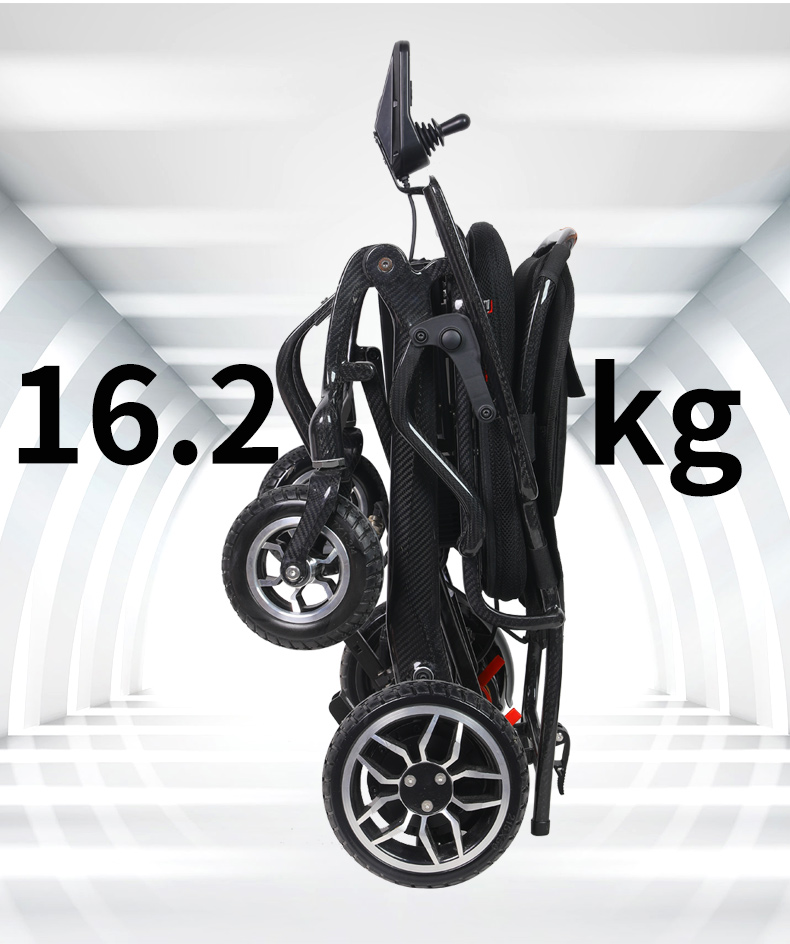
To truly grasp the difference, we must look at the numbers. A traditional steel power wheelchair can easily weigh upwards of 90 kg (200 lbs). Aluminum models improved on this, often bringing the weight down into the 25-40 kg (55-90 lbs) range. A modern matrix ultra carbon fiber wheelchair, even with its motors and battery, can weigh as little as 12-15 kg (26-33 lbs).
| Material Property | Steel | 6061 Aluminum Alloy | Carbon Fiber Composite |
|---|---|---|---|
| Density (g/cm³) | ~7.85 | ~2.70 | ~1.60 |
| Tensile Strength (MPa) | ~400 | ~310 | 1500 – 5000+ |
| Stiffness (GPa) | ~200 | ~69 | 150 – 500+ |
| Strength-to-Weight Ratio | Low | Medium | Very High |
| Vibration Damping | Poor | Fair | Excellent |
This table illustrates not just the lower density of carbon fiber, but its vastly superior strength-to-weight ratio. It can be multiple times stronger than steel while being a fraction of the weight. This is the core scientific principle that enables the creation of such a lightweight yet robust device.
The Psychology of Portability: Reducing Caregiver Strain and Enhancing Spontaneity
The practical implications of this weight reduction are immense. Consider the simple act of going out. With a heavy wheelchair, this often becomes a planned logistical operation. Can the caregiver lift the chair into the car trunk? Will it require two people? Is the destination truly accessible, or will we face an unexpected curb or step that requires lifting the chair? These questions create a background hum of anxiety that can discourage spontaneous outings.
A lightweight carbon fiber electric wheelchair dissolves much of this anxiety. A user or a single caregiver can often lift the chair into a vehicle without significant strain. This reduces the risk of injury to caregivers and fosters a greater sense of independence for the user. It transforms the question from “Can we manage this?” to “Where do we want to go?” The psychological barrier is lowered, and the world of possibilities expands. Spontaneity returns. A last-minute decision to visit a friend, go to a park, or browse a shop becomes a simple choice rather than a complex project.
Navigating Life’s Spaces: Implications for Travel, Home, and Community
The benefit extends to all facets of life. At home, a lighter chair is easier to maneuver in tight spaces, around furniture, and through doorways. For those living in multi-level homes, a foldable carbon fiber model can be carried upstairs, opening up parts of the home that were previously off-limits.
For travel, the difference is night and day. Many ultra-lightweight carbon fiber electric wheelchairs are designed to be airline-compliant, folding down into a compact form that can be checked as luggage or even, in some cases, brought into the cabin. This removes one of the greatest sources of stress for wheelchair users who wish to fly. The confidence of knowing your mobility device is light, manageable, and travel-ready empowers users to explore the world with a freedom that was previously unimaginable for many. Exploring the options in a comprehensive resource can be a great first step, and a well-curated carbon fiber wheelchair can illuminate the best choices available.
Factor 2: Performance and Durability – An Investment in Resilience
While lightness is the most immediately obvious benefit of a carbon fiber wheelchair, the material’s impact on performance and long-term durability is just as profound. A well-constructed carbon fiber frame is not a fragile, high-maintenance object; it is a resilient and high-performance piece of engineering that pays dividends in comfort and longevity.
The Physics of Propulsion: Energy Transfer and Efficiency
Every time a manual wheelchair user pushes on their handrims, or an electric wheelchair’s motor turns, energy is expended. In a heavy, flexible frame, a significant portion of that energy is lost. It gets absorbed by the frame flexing and twisting, or simply wasted in moving the excess mass.
A stiff carbon fiber frame provides near-instantaneous energy transfer. Think of the difference between trying to paddle a canoe with a pool noodle versus a rigid carbon fiber paddle. With the noodle, your energy dissipates as it bends; with the paddle, your effort is transferred directly to the water. Similarly, in a matrix ultra carbon fiber wheelchair, the user’s push or the motor’s torque is translated almost entirely into forward motion. For manual users, this means less fatigue over the course of a day. For electric users, it means greater efficiency, which translates directly into longer battery life and increased range from the same size battery.
The Unseen Comfort: Vibration Dampening
One of the most underestimated and misunderstood benefits of carbon fiber is its natural ability to dampen vibrations. Metal frames, particularly aluminum, tend to transmit every bump and crack in the pavement directly up into the user’s body. This high-frequency “road buzz” can be incredibly fatiguing over time and can exacerbate chronic pain conditions (Wolf et al., 2007).
Carbon fiber composites have intrinsic damping properties. The layers of fiber and resin work together to absorb and dissipate these vibrations rather than transmitting them. The ride quality is noticeably smoother, quieter, and more comfortable. It is a subtle but constant benefit that reduces the cumulative physical toll of a full day of activity, leaving the user with more energy for the things that matter. This is not a luxury feature; it is a crucial ergonomic benefit with real health implications.
| User Need | Traditional Aluminum Wheelchair | Carbon Fiber Electric Wheelchair | Impact on User Experience |
|---|---|---|---|
| Daily Commuting | Heavier, transmits more vibration, leading to fatigue. | Lighter, smoother ride, conserves user energy. | Arrive with less fatigue and pain. |
| Air Travel | Often heavy, bulky, and difficult to gate-check. | Ultra-lightweight and compact folding for easy transport. | Reduced travel stress and greater independence. |
| Caregiver Assistance | Can be dangerously heavy to lift, risking injury. | Easily lifted by one person into a car. | Increased safety for caregivers and more frequent outings. |
| Indoor Maneuverability | Wider turning radius, can be cumbersome in tight spaces. | Often more compact with a tighter turning radius. | Easier navigation within the home and office. |
| Long-Term Health | Can contribute to repetitive strain injuries and vibration-related pain. | Reduces strain and vibration, promoting better posture. | Potential for fewer secondary health complications. |
Long-Term Value: Assessing Durability and Resistance to Environmental Factors
There is a common misconception that carbon fiber is brittle. While it can be damaged by a sharp, focused impact, a well-designed frame is incredibly resilient to the stresses of daily use. It has exceptional fatigue resistance, meaning it can withstand millions of cycles of loading and unloading without developing the micro-cracks that can lead to failure in metal frames.
Furthermore, carbon fiber does not rust or corrode like steel, nor is it susceptible to the same type of oxidation that can affect aluminum over time. It is largely impervious to water, salt, and most chemicals. This means a carbon fiber electric wheelchair maintains its structural integrity and its aesthetic appearance for far longer, making it a sound long-term investment. It is built not just for the present, but to endure years of active use.
Factor 3: Customization and Ergonomics – Tailoring the Chair to the Body
A wheelchair should not be a static object that the user must adapt to. It should be a dynamic extension of the user’s own body, meticulously tailored to their unique physical needs, measurements, and functional goals. The use of carbon fiber has unlocked new possibilities in achieving this ideal level of customization and ergonomic support.
The Philosophy of Fit: Why One-Size-Fits-All Fails
The negative consequences of a poorly fitting wheelchair are well-documented and severe. A seat that is too wide fails to provide proper pelvic support, leading to poor posture and instability. A seat that is too deep can cause pressure behind the knees and encourage a slouched, sacral-sitting posture. Incorrect backrest height or angle can lead to shoulder pain and repetitive strain injuries from inefficient propulsion (Frank & Abel, 2000). Over time, these issues can lead to pressure sores, spinal deformities, and chronic pain.
A truly ergonomic wheelchair is one that is configured to the individual. This means achieving precise seat-to-floor heights, seat depths and widths, backrest angles, and footplate positions. This philosophy of “prescriptive seating” is the gold standard in rehabilitation, and advanced materials are making it more achievable than ever.
Adjustability in Carbon Fiber Frames: Seating, Backrests, and Footplates
The moldable nature of carbon fiber allows designers to create frames with integrated adjustability in ways that are difficult or heavy to achieve with metal. Instead of clunky, welded brackets, adjustment mechanisms can be elegantly built into the composite structure itself.
For example, a matrix ultra carbon fiber wheelchair might feature a sliding seat pan that allows for fine-tuning of the center of gravity, which dramatically affects stability and maneuverability. The backrest might offer not just angle adjustment but also height and tension adjustment in the upholstery to perfectly match the user’s spinal curvature. Footplates can be designed with a wide range of height, angle, and depth adjustments to ensure proper support for the lower limbs. This level of built-in adjustability means the chair can not only be set up perfectly from day one but can also be adapted over time if the user’s needs change.
The Matrix Ultra Approach: Integrating Ergonomics into Design
Leading designs, such as those envisioned for a Matrix Ultra model, take this a step further by integrating ergonomics from the very first design sketch. The shape of the frame itself is contoured to support the body and facilitate movement. The side guards might be shaped to allow for closer access to tables and desks. The front of the frame might be tapered to provide more room for the user to tuck their feet under, making transfers easier and safer.
The material allows for organic, flowing shapes that are not just aesthetically pleasing but also highly functional. It enables a holistic design where the frame, the seating system, and the user’s body are considered as a single, integrated system. This is a far cry from the traditional approach of simply attaching a seating system to a generic frame. It is a user-centric design philosophy made possible by the unique properties of carbon fiber.
Factor 4: The Electric Powertrain – Intelligence in Motion
A carbon fiber electric wheelchair is a marriage of two advanced technologies: material science and mechatronics. The frame provides the lightweight, resilient chassis, while the electric powertrain provides the motive force. In 2025, these powertrains are more intelligent, efficient, and integrated than ever before.
Motors and Battery Technology in 2025
The heavy, inefficient brushed motors of the past have been almost entirely replaced by lightweight, high-torque brushless DC motors. These motors have no brushes to wear out, making them virtually maintenance-free. They are also significantly more efficient, converting a higher percentage of electrical energy into rotational force. This efficiency is critical in a lightweight wheelchair, as it helps to maximize the range from the battery.
Battery technology has also seen tremendous advances. The standard is now high-density Lithium-ion (Li-ion) battery packs, similar to those found in electric vehicles and smartphones. These batteries offer the best energy-to-weight ratio available, allowing for a substantial range without adding excessive weight. Modern battery management systems (BMS) protect the cells from overcharging, over-discharging, and overheating, dramatically extending their lifespan and ensuring safety. Many are designed to be easily removable and are certified for air travel, further enhancing the user’s freedom.
Controller Systems and User Interface (UI) Innovations
The joystick and controller are the user’s primary interface with the chair, and they have become increasingly sophisticated. Modern controllers use advanced algorithms to provide smooth acceleration, intuitive control, and customizable performance profiles. A user might have a “turtle mode” for navigating crowded indoor spaces, a “standard mode” for everyday use, and a “sport mode” with higher acceleration and top speed for outdoor travel.
Some advanced systems even incorporate gyroscopic sensors to improve traction control and stability on uneven surfaces. The user interface is often a full-color LCD screen that provides clear information on speed, battery level, and drive mode. Some chairs even offer Bluetooth connectivity, allowing users to connect to a smartphone app for advanced diagnostics, customization, and even remote control of the chair for short distances (e.g., bringing it to your bedside from across the room).
Balancing Power with Weight in a Carbon Fiber Electric Wheelchair
The ultimate engineering challenge in a carbon fiber electric wheelchair is achieving the perfect balance. How do you provide robust motors and a long-range battery without compromising the ultra-lightweight nature of the carbon fiber frame? This is where clever design and integration come into play.
Engineers use compact, hub-mounted motors that are integrated directly into the wheel, eliminating the need for a heavy gearbox and drivetrain. Battery packs are designed to be slim and are often mounted low in the frame to improve the center of gravity and stability. The frame itself is designed to protect these components while also acting as a heat sink. The result is a seamless integration where the frame and the powertrain work in harmony, creating a device that is both powerful and light, a true synthesis of form and function.
Factor 5: Aesthetics and Design – The Expression of Self
For too long, assistive devices have been designed with a purely clinical focus, often ignoring the emotional and psychological impact of their appearance. A wheelchair is not just a medical tool; it is a constant companion and a part of the user’s public identity. The aesthetic design of a chair has a profound influence on the user’s self-perception and how they are perceived by others.
The Visual Language of Carbon Fiber
Carbon fiber has a distinct and modern visual language. The visible weave of the fabric, often protected under a clear gloss or matte finish, speaks of high technology and performance. It has cultural associations with precision engineering, luxury sports cars, and high-end sporting equipment. This aesthetic stands in stark contrast to the utilitarian look of painted metal tubes.
A matrix ultra carbon fiber wheelchair does not look like a traditional piece of medical equipment. It looks like a piece of sophisticated personal technology. This visual shift can be incredibly empowering. It can help to change the narrative from one of disability to one of capability and style. It allows the user to present themselves to the world with a device that reflects a modern, active identity.
Moving Beyond a Medical Device: Personalization and Style
The customizability of carbon fiber extends to its appearance. Because the frame is created in a mold, designers have immense freedom to create sleek, organic, and minimalist shapes that would be impossible with metal. The frame can be finished in a classic clear coat to show off the carbon weave, or it can be painted in a vast array of custom colors and finishes.
This allows the user to personalize their chair to match their own style. It becomes an act of self-expression, much like choosing a pair of glasses or a watch. This choice is a powerful act of agency. It asserts that the user is not defined by their device, but rather that the device is an accessory that they have chosen to fit their life and their personality. Reputable manufacturers understand this and offer a range of aesthetic options, recognizing that the user’s emotional connection to their chair is a vital part of its overall function.
How Design Influences Social Perception and User Confidence
The impact of this design philosophy extends outward, influencing social interactions. A beautifully designed, modern wheelchair can be a conversation starter. It can shift the focus of an initial interaction from the user’s disability to the impressive technology of their chair. This can help to break down social barriers and foster more natural and equitable interactions.
For the user, this can lead to a significant boost in confidence. Feeling good about the appearance of your wheelchair can make you more likely to engage with your community, attend social events, and pursue professional and personal goals. It is a virtuous cycle: a well-designed chair enhances confidence, which encourages greater participation in life, which in turn reinforces a positive self-image. The importance of aesthetics, therefore, is not about vanity; it is about dignity, identity, and the promotion of a full and engaged life.
Factor 6: Cost-Benefit Analysis – The True Price of Independence
It is an undeniable fact that a carbon fiber electric wheelchair represents a significant financial outlay, often costing several times more than a comparable aluminum model. This can be a major barrier, and it is crucial to approach the cost with a clear and rational analysis, looking beyond the initial price tag to the total cost of ownership and the non-monetary value it provides.
Deconstructing the Price Tag: Manufacturing, R&D, and Materials
Why the high cost? The raw material itself, aerospace-grade carbon fiber pre-impregnated with high-performance resin, is expensive. But the largest cost driver is the manufacturing process. Unlike welding metal tubes, which can be automated, laying up a carbon fiber frame is an incredibly labor-intensive process. Skilled technicians must carefully place each layer of carbon fabric into the mold by hand, ensuring the orientation of the fibers is perfect.
The curing process, often involving expensive autoclaves and precise temperature controls, is also costly and time-consuming. Finally, the research and development (R&D) required to design, engineer, and test these frames to meet stringent medical device standards is a massive investment for manufacturers. The price reflects this combination of expensive materials, skilled labor, and extensive R&D.
Calculating the Total Cost of Ownership: Maintenance, Longevity, and Health Benefits
A simple price comparison is misleading. A more accurate financial assessment involves calculating the Total Cost of Ownership (TCO) over the lifespan of the chair.
- Longevity: Due to its superior fatigue resistance and immunity to corrosion, a well-made carbon fiber frame can last significantly longer than a metal one. Buying one carbon fiber chair that lasts ten years may be cheaper than buying two or three aluminum chairs over the same period.
- Maintenance: With no paint to chip and no metal to rust, the frame itself requires very little maintenance. The durability of the composite reduces the likelihood of frame-related repairs.
- Health Benefits: This is the most significant, though hardest to quantify, part of the TCO. The ergonomic benefits of a custom-fit, vibration-dampening chair can reduce the risk of costly secondary health complications like pressure sores, chronic pain, and repetitive strain injuries. The financial and quality-of-life cost of treating just one of these conditions can easily exceed the price difference of the chair.
- Portability Benefits: The reduced risk of injury to caregivers from lifting a heavy chair also has a real, though indirect, economic value.
When viewed through this lens, the higher initial cost begins to look more like a strategic investment in long-term health, durability, and quality of life.
Navigating Funding and Insurance in Different Regions (US, Europe, Australia)
Obtaining funding for a high-end wheelchair can be a challenging process, and it varies significantly by country.
- United States: In the US, Medicare and private insurers often use a “least costly alternative” model, which can make it difficult to get a carbon fiber chair approved if a cheaper aluminum model is deemed “sufficient.” The process typically requires a detailed letter of medical necessity from a physician and physical therapist, explicitly outlining why the unique features of the carbon fiber chair (e.g., ultra-lightweight for independent transport, vibration damping for pain management) are medically essential and not just a convenience.
- Europe: Many European countries, particularly in Scandinavia and Germany, have more comprehensive public health systems that may be more willing to fund advanced technology if a clear functional benefit can be demonstrated. The process still requires thorough documentation from a clinical team.
- Australia: Australia’s National Disability Insurance Scheme (NDIS) is a goal-oriented system. If the user can demonstrate how a carbon fiber electric wheelchair will help them achieve their stated goals (e.g., entering the workforce, living independently, participating in the community), there is a good chance it can be funded. The focus is on enablement and long-term outcomes.
Regardless of location, successfully navigating these systems requires persistence, strong clinical advocacy, and a clear articulation of how the chair’s specific features translate into tangible medical and functional gains.
Factor 7: The Manufacturer’s Ecosystem – Support Beyond the Sale
A wheelchair is not a one-time purchase; it is a long-term relationship with a product and the company that stands behind it. The quality of the manufacturer’s ecosystem—their warranty, customer service, parts availability, and commitment to innovation—is as important as the quality of the chair itself.
Evaluating Warranty, Customer Service, and Parts Availability
Before investing in a matrix ultra carbon fiber wheelchair, it is vital to scrutinize the manufacturer’s support structure.
- Warranty: What does the warranty cover, and for how long? A reputable manufacturer will typically offer a lifetime warranty on the frame, reflecting their confidence in its durability. Warranties on electronic components and batteries will be shorter, but should be clearly stated.
- Customer Service: Is the company accessible? Do they have a responsive and knowledgeable support team that can answer questions and troubleshoot problems? Look for companies with a strong presence in your region, either directly or through a network of trusted dealers.
- Parts Availability: A wheelchair has wearable parts—tires, batteries, armrest pads. How easy is it to get replacements? A company with a well-managed supply chain can ensure that you are not left stranded for weeks waiting for a critical part.
The Role of R&D and Continuous Improvement
A company’s commitment to research and development is a strong indicator of its quality and long-term viability. Does the company actively invest in improving its products? Do they listen to user feedback and incorporate it into new designs? A company like carbon fiber electric wheelchair, which highlights its dedicated R&D building and technical team, demonstrates a commitment to not just selling products, but advancing the field of mobility technology (Richall Medical, n.d.). This forward-thinking approach suggests that the company will continue to support and innovate for its customers in the years to come.
Understanding the Supply Chain and Manufacturing Standards
Knowing where and how your chair is made matters. A manufacturer that controls its own design, production, and quality control has a significant advantage. They can ensure that every component meets their exacting standards, from the grade of carbon fiber used to the final assembly. This vertical integration leads to a more reliable and consistent product. When a company can confidently state that it “strictly implements national industry standards and abides by every production process,” it provides a level of assurance that is critical when purchasing a device so essential to your daily life. It is the foundation of trust between the user and the manufacturer.
FAQ
Is a carbon fiber wheelchair really worth the higher initial cost?
For many users, the answer is yes. The decision depends on a cost-benefit analysis that goes beyond the sticker price. If the ultra-lightweight nature allows you or a caregiver to lift the chair into a car, enabling more frequent outings and greater independence, the value is immense. If the vibration-dampening qualities reduce chronic pain and fatigue, the improvement in quality of life can be priceless. The extended durability and potential to prevent costly secondary health issues also make it a sound long-term investment.
How do I care for and maintain a carbon fiber frame?
Carbon fiber frames are surprisingly low-maintenance. The best practice is to simply keep the frame clean with a soft cloth and mild soap and water. Avoid harsh abrasive cleaners or solvents. It is good practice to periodically inspect the frame for any deep scratches or gouges that go through the top layer of resin, particularly after a significant impact. While highly durable, a sharp, focused blow can damage the composite. Most manufacturers can provide guidance on assessing and repairing any potential damage.
Can a carbon fiber electric wheelchair handle rough terrain?
Yes, to a degree. The inherent strength and vibration-dampening properties of carbon fiber make it well-suited for handling varied terrain like park paths, cobblestones, or uneven sidewalks. The ride will be noticeably smoother than on a metal-framed chair. However, most ultra-lightweight folding models are designed for urban and suburban environments, not for extreme off-roading. They typically have smaller wheels and are not a replacement for a dedicated, heavy-duty all-terrain power wheelchair.
What is the typical battery life and range for a model like the Matrix Ultra?
The range of a carbon fiber electric wheelchair depends on several factors, including battery capacity, user weight, terrain, and speed. As of 2025, with efficient brushless motors and high-density lithium-ion batteries, a typical range is between 15 to 25 kilometers (9 to 15 miles) on a single charge. Some models with optional larger batteries can extend this further. The key advantage is that the lightweight frame allows for a greater range from a smaller, lighter battery compared to a heavier aluminum chair.
Are there weight limits for carbon fiber wheelchairs?
Yes, every wheelchair has a specified maximum user weight capacity, and carbon fiber models are no exception. These limits are determined through rigorous safety testing. Standard models typically support users up to 120-135 kg (265-300 lbs). Bariatric or heavy-duty versions may be available for heavier users, but it is crucial to check the specifications of the exact model you are considering to ensure it is safe and appropriate for your needs.
How does the folding mechanism work on these lightweight models?
Most lightweight carbon fiber electric wheelchairs feature a simple and intuitive folding mechanism. Often, it is a “one-step” process that involves pulling a lever or a strap located on the seat. This allows the frame to collapse horizontally, much like a child’s stroller. The design prioritizes ease of use, allowing many users to fold or unfold the chair independently in just a few seconds, which is a key feature for portability and storage.
Conclusion
The emergence of the matrix ultra carbon fiber wheelchair is more than an incremental update; it constitutes a re-imagining of what a personal mobility device can be. By dissecting the seven critical factors—the revolutionary lightness that grants portability, the resilient performance that ensures comfort and longevity, the deep customization that protects the body, the intelligent powertrain that provides efficient motion, the expressive aesthetics that restore identity, the true cost that represents an investment in life, and the manufacturer’s ecosystem that guarantees support—a clear picture emerges. We see a tool that moves beyond mere function to actively enhance human capability and dignity. The choice of a wheelchair is a deeply personal one, a decision that shapes the boundaries of one’s world. The promise of carbon fiber is the expansion of those boundaries, offering a future with fewer physical and psychological barriers, a future where independence, spontaneity, and a full engagement with the world are not aspirations, but daily realities.
References
Frank, A. O., & Abel, E. (2000). Wheelchair prescription. Spinal Cord, 38(12), 707–715. https://doi.org/10.1038/sj.sc.3101082
Mallick, P. K. (2007). Fiber-reinforced composites: Materials, manufacturing, and design (3rd ed.). CRC Press.
Richall Medical. (n.d.). About RC. Retrieved February 14, 2025, from https://www.richallmed.com/about-RC.html
Richall Medical. (n.d.). Carbon Fiber Electric Wheelchair. Retrieved February 14, 2025, from https://www.richallmed.com/Carbon-Fiber-Electric-Wheelchair-pl68173967.html
Wolf, E. J., Cooper, R. A., Pearlman, J. L., & Kelleher, A. (2007). Whole-body vibration exposures in manual and power wheelchair users. Journal of Spinal Cord Medicine, 30(3), 241–247. https://doi.org/10.1080/10790268.2007.11753932