.png)
.png)

Expert 5-Point Checklist: Choosing Your Matrix Carbon Fiber Wheelchair in 2025
December 10, 2025
Abstract
The evolution of personal mobility aids has reached a significant inflection point with the advent of advanced composite materials. This analysis examines the emergence and impact of the matrix carbon fiber wheelchair, a device that represents a paradigm shift from traditional aluminum or steel-framed chairs. By leveraging carbon fiber reinforced polymer (CFRP), these wheelchairs offer an unparalleled combination of low weight, high tensile strength, and exceptional durability. The investigation delves into the material science underpinning these properties, exploring how the arrangement of carbon fibers within a polymer matrix creates a structure that is both robust and remarkably light. It further assesses the practical implications for users, including enhanced portability, reduced physical strain, and greater independence. The discussion also covers the technological integration within these modern devices, such as efficient brushless motors and airline-approved lithium-ion batteries, which collectively redefine the user’s experience. This document provides a comprehensive framework for understanding the benefits, technical specifications, and long-term value proposition of the carbon fiber electric wheelchair in 2025.
Key Takeaways
- Carbon fiber’s strength-to-weight ratio makes wheelchairs significantly easier to lift and transport.
- The material is highly resistant to corrosion and fatigue, offering superior long-term durability.
- Folding mechanisms in carbon fiber wheelchairs are often designed for compact, one-click operation.
- A lightweight frame improves battery efficiency, extending the travel range on a single charge.
- Choosing a carbon fiber electric wheelchair is an investment in greater daily independence.
- Advanced models feature brushless motors for quieter, more reliable, and efficient performance.
- Airline-approved lithium batteries make many carbon fiber models ideal for frequent travelers.
Table of Contents
- The Material Revolution in Personal Mobility
- Point 1: Deconstructing Weight and Portability – The Freedom of Lightness
- Point 2: Power and Performance – The Heart of the Machine
- Point 3: Design, Ergonomics, and Customization – A Chair That Fits You
- Point 4: Durability, Maintenance, and Long-Term Value
- Point 5: The Financial and Lifestyle Investment – Making an Informed Decision
- Frequently Asked Questions (FAQ)
- Conclusion
- References
The Material Revolution in Personal Mobility
The story of the wheelchair is a narrative of human ingenuity striving to restore and enhance personal freedom. For decades, the fundamental design, while evolving, remained constrained by the physical properties of its core materials—primarily steel and later, aluminum. These materials, while functional, imposed a trade-off between strength and weight. A sturdy chair was often a heavy chair, creating a secondary layer of challenge for the user or their caregivers. Lifting a 25-kilogram (55-pound) device into the trunk of a car is not a trivial task; it is a physical barrier that can circumscribe one’s world, making spontaneous trips or travel a logistical hurdle.
We now stand at the cusp of a profound material revolution in personal mobility, one that challenges these long-held compromises. The protagonist of this new chapter is carbon fiber reinforced polymer (CFRP), a material born from the demanding worlds of aerospace engineering and Formula 1 racing. Its introduction into the domain of medical devices is not merely an upgrade; it is a re-imagining of what a mobility aid can be. When we speak of a matrix carbon fiber wheelchair, we are referring to a sophisticated composite. Picture countless microscopic, yet incredibly strong, strands of carbon woven together and then suspended in a hardened polymer resin—the “matrix.” This matrix holds the fibers in place, protects them, and transfers the load among them. The result is a unified material that is stronger than steel but possesses a fraction of the weight (Kopeliovich, 2020).
The purpose here is to move beyond a simple recitation of features. It is to build a deeper understanding, to cultivate an empathetic perspective on how this technology intersects with the lived experience of mobility impairment. Choosing a wheelchair is an act of profound personal significance. It is a decision about capability, about the boundaries of one’s daily life, and about one’s identity. Our exploration will follow a structured five-point checklist, designed to illuminate the path for anyone considering an investment in a carbon fiber electric wheelchair. We will deconstruct its properties, examine its performance, and consider its place in your life, not as a piece of equipment, but as a partner in the pursuit of a life lived with fewer limitations.
Point 1: Deconstructing Weight and Portability – The Freedom of Lightness
The most immediate and perhaps most celebrated characteristic of a matrix carbon fiber wheelchair is its astonishing lack of heft. To appreciate the magnitude of this achievement, one must first grasp the science that makes it possible. It is a testament to the elegance of materials engineering, where microscopic structure dictates macroscopic performance.
Understanding the Science of Carbon Fiber Composites
At its core, carbon fiber is composed of carbon atoms bonded together to form long chains. These chains are bundled into fibers thinner than a human hair, which are then woven into a fabric-like textile. This textile on its own is flexible. Its legendary rigidity and strength emerge only when it is layered and infused with a polymer resin (like epoxy) that, upon curing, hardens into a solid matrix.
Think of it like reinforced concrete. The steel rebar provides tensile strength, while the concrete provides compressive strength and holds the rebar in a fixed shape. In a carbon fiber composite, the carbon fibers are the “rebar,” providing immense strength and stiffness, while the polymer matrix is the “concrete,” binding everything into a cohesive, load-bearing structure.
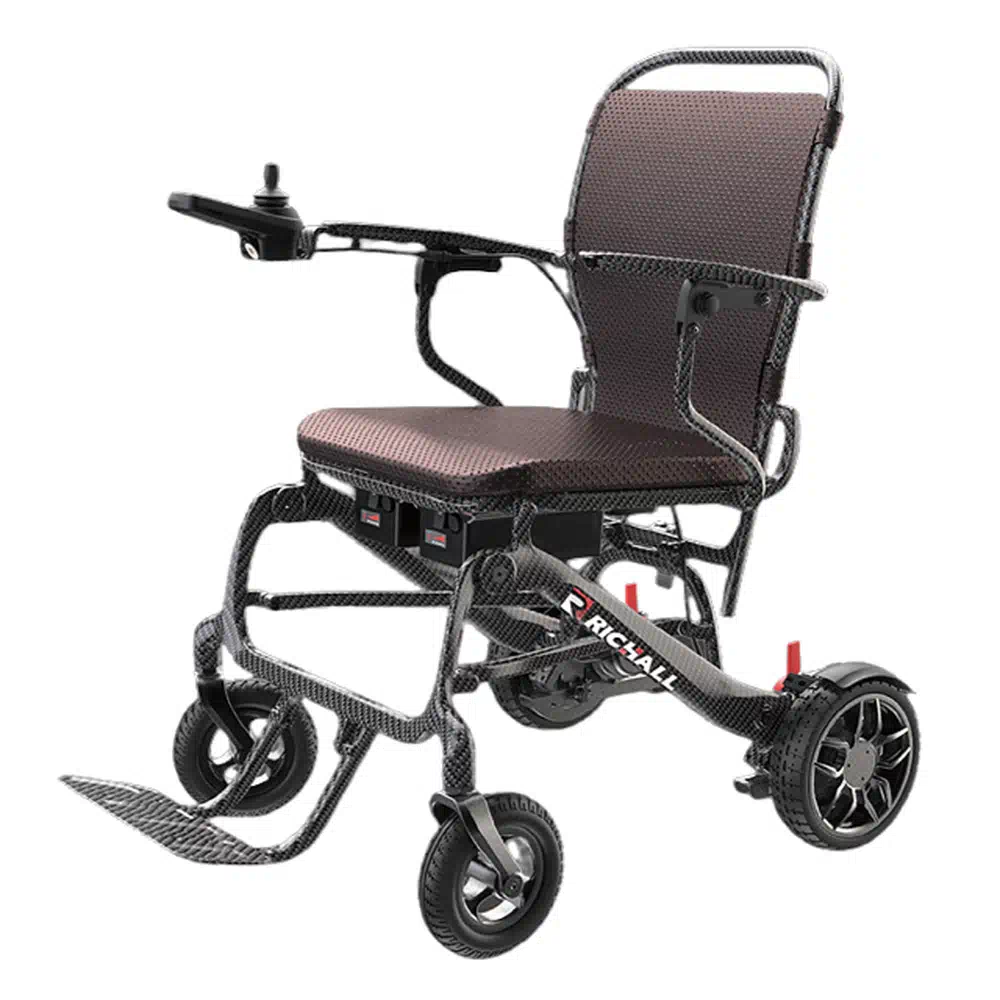
Engineers can precisely control the properties of the final component by orienting the layers of carbon fiber fabric in different directions. This process, known as the layup schedule, allows them to maximize strength exactly where it is needed—for instance, along the main tubes of the wheelchair frame—while minimizing material and weight elsewhere. It is a level of design precision that is simply not possible with isotropic materials like aluminum or steel, which have uniform properties in all directions. This meticulous engineering is why a carbon fiber frame can so effectively resist the complex forces of daily use—pushing, turning, traversing uneven ground—without bending or breaking, all while weighing startlingly little. Some carbon fiber electric wheelchair models, such as the Richall W3902, can weigh as little as 16.2 kg (about 35.7 lbs) without the battery, a figure that was unimaginable for a powered chair just a decade ago .
Practical Implications for Daily Life
The abstract benefit of “low weight” translates into concrete, tangible freedoms in the fabric of everyday existence. Consider the simple act of going out for coffee with a friend. With a traditional, heavier power chair, this might involve a specialized vehicle with a lift, or declining the invitation altogether if a caregiver is unavailable to help with a cumbersome portable model.
Now, envision the same scenario with a 16 kg carbon fiber chair. The user, or a companion, can fold the chair—often with a single motion—and lift it into the back of a standard sedan or hatchback. The barrier to spontaneity dissolves. The world of accessible places expands from a small, carefully curated list to almost anywhere a car can go.
Air travel, a source of significant anxiety for many wheelchair users, is similarly transformed. The fear of a cherished, essential piece of equipment being lost or damaged by baggage handlers is immense. The portability of a folding matrix carbon fiber wheelchair allows it to be treated more like premium luggage. Many models feature airline-approved, removable lithium-ion batteries that can be carried into the cabin, while the folded frame is checked at the gate (Federal Aviation Administration, 2021). This process significantly reduces the risk of damage and provides peace of mind, opening up national and international travel. Imagine arriving in a new city, retrieving your lightweight chair at the jet bridge, and immediately setting off to explore. That is the nature of the freedom that this technology offers.
Comparative Analysis: Carbon Fiber vs. Aluminum vs. Steel
To fully contextualize the advantages of carbon fiber, a direct comparison with traditional materials is illuminating. Each material has its place, but their profiles differ dramatically, especially concerning the needs of a modern, active user.
| Feature | Steel | 6061 Aluminum Alloy | Carbon Fiber Composite |
|---|---|---|---|
| Typical Frame Weight | Heavy (18-25 kg / 40-55 lbs) | Medium (12-18 kg / 26-40 lbs) | Ultra-Light (8-16 kg / 18-35 lbs) |
| Tensile Strength | High | Medium | Very High |
| Stiffness-to-Weight | Low | Medium | Highest |
| Corrosion Resistance | Low (requires coating) | High | Excellent |
| Fatigue Resistance | Good | Fair to Good | Excellent |
| Manufacturing Cost | Low | Medium | High |
| Aesthetic/Form | Limited to tube shapes | Can be hydroformed | Highly versatile/sculptable |
As the table demonstrates, while steel is strong and inexpensive, it carries a significant weight penalty. Aluminum offered the first major step forward, reducing weight considerably. Yet, carbon fiber operates in another category entirely. Its superiority in stiffness-to-weight ratio and fatigue resistance means it not only starts lighter but also maintains its structural integrity over a longer period of intense use. This makes the higher initial investment in a carbon fiber electric wheelchair a calculated decision in favor of long-term performance and daily convenience.
Point 2: Power and Performance – The Heart of the Machine
A lightweight frame is only half of the equation for a truly capable electric wheelchair. The other half is the powertrain: the batteries that store the energy and the motors that convert that energy into motion. In the realm of the modern carbon fiber electric wheelchair, these components have undergone a parallel revolution, creating a synergy where the lightweight frame enables a more efficient and responsive power system.
Battery Technology and Range Anxiety
The term “range anxiety” originated with electric cars, but it is a feeling intimately familiar to any power wheelchair user. It is the constant, low-level worry about how far you can travel before the battery gauge hits empty, potentially leaving you stranded. The development of high-energy-density lithium-ion batteries has been the single most important factor in alleviating this concern.
Compared to the older sealed lead-acid (SLA) batteries, lithium-ion batteries offer a host of advantages. They can store significantly more energy in a smaller, lighter package (Tarascon & Armand, 2001). This is where the synergy with the carbon fiber frame becomes so powerful. A lighter chair requires less energy to move, meaning the same battery can provide a much greater travel distance. Many contemporary models, like those offered by manufacturers such as carbon fiber wheelchair manufacturer, boast a range of 20 kilometers (about 12.5 miles) or more on a single charge.
What does 20 kilometers feel like in the real world? It is a day trip to a museum, followed by lunch and a ride through a park. It is running multiple errands across town without needing to return home to recharge. It is the confidence to explore a new place without constantly calculating the distance back to a power outlet. Furthermore, these lithium batteries are often designed for easy removal, allowing users to carry a spare for extended adventures or to charge the battery separately from the chair itself, adding another layer of flexibility.
Motors and Control Systems
The motive force in a carbon fiber electric wheelchair typically comes from a pair of brushless DC motors, one for each main drive wheel. The term “brushless” is key. In older motor designs, “brushes” were used to transmit electrical current to the rotating part of themotor. These brushes would wear down over time, creating dust and requiring periodic replacement.
Brushless motors, by contrast, use electronic controllers to manage the flow of electricity, eliminating physical contact and friction. This results in several profound benefits:
- Higher Efficiency: More of the battery’s energy is converted into motion rather than being lost as heat, which contributes to a longer travel range.
- Longer Lifespan: With no brushes to wear out, the motors are exceptionally durable and virtually maintenance-free.
- Quieter Operation: The absence of friction from brushes makes the motors whisper-quiet, allowing for a more serene experience and less obtrusive presence in quiet environments like libraries or offices.
- More Precise Control: The electronic commutation allows for smoother acceleration, deceleration, and more responsive turning.
This precision is harnessed through a joystick controller. Modern controllers are highly intuitive, offering 360-degree maneuverability. They often include an LCD screen displaying vital information like battery level, current speed setting, and diagnostic codes. Some advanced models even offer remote control functionality, allowing a caregiver to guide the chair from a short distance—an invaluable feature for navigating tight spaces or assisting a user with limited upper-body function.
Navigating Different Terrains
The performance of a carbon fiber electric wheelchair is not just about speed on a flat surface; it is about its ability to confidently handle the varied textures of the world. The combination of powerful brushless motors and a rigid carbon fiber frame provides excellent torque for climbing inclines. Many chairs are rated for gradients of 8-10 degrees, sufficient for most standard accessibility ramps and urban hills.
The wheel design is also a critical factor. Front wheels are typically smaller solid casters that allow for nimble turning, ideal for indoor navigation through doorways and around furniture. The rear drive wheels are larger, often with solid or puncture-proof tires, providing the traction needed for outdoor surfaces. While these chairs are not all-terrain vehicles, they are more than capable of handling pavement, firm paths, and low-pile carpeting. Some models incorporate a degree of suspension, further smoothing the ride over minor bumps and cracks in the sidewalk, reducing the jarring vibrations transmitted to the user’s body. The overall experience is one of quiet confidence and control, empowering the user to engage with their environment on their own terms.
Point 3: Design, Ergonomics, and Customization – A Chair That Fits You
A wheelchair should never feel like a generic piece of medical equipment. At its best, it functions as a seamless extension of the user’s body and will. The advent of the matrix carbon fiber wheelchair has propelled this ideal forward, as the material’s unique properties allow for an unprecedented fusion of ergonomic science and aesthetic elegance. The result is a device that is not only more comfortable and functional but also one that users can feel proud to use.
The Philosophy of User-Centric Design
The core principle of good ergonomic design is that the tool must adapt to the human, not the other way around. For a wheelchair user, this is a matter of health and well-being. A poorly fitting chair can lead to pressure sores, postural problems, and chronic pain. A well-designed chair, conversely, promotes comfort, stability, and functional independence.
Carbon fiber’s moldability allows designers to move beyond the simple bent tubes of metal frames. They can create organic, sculpted shapes that better conform to the human body. This capability informs several key ergonomic features:
- Seat and Backrest: While seat cushions and back supports are often specialized add-ons, the underlying frame can be shaped to provide a more supportive foundation. The rigidity of carbon fiber ensures that the frame does not flex undesirably, maintaining proper postural support throughout the day.
- Adjustability: Many carbon fiber electric wheelchair models offer adjustability in key areas. Armrests can be raised, lowered, or swung away for easier transfers. Footplates can be adjusted for height and angle to ensure proper leg support and prevent foot drop. These small adjustments have a large cumulative impact on comfort and health over thousands of hours of use.
- Cushioning: High-quality models often come standard with memory foam or other advanced material cushions. These are designed to distribute pressure evenly across the seating surface, reducing the risk of pressure injuries, which are a serious health concern for long-term wheelchair users (Stockton & Parker, 2021). The cover materials are frequently breathable, helping to manage heat and moisture for all-day comfort.
Aesthetics and Form
For too long, the design of mobility aids has been dictated purely by clinical necessity, often resulting in devices that look institutional and sterile. This can have a subtle but significant psychological impact, reinforcing a sense of being a “patient” rather than simply a person who uses a wheelchair.
Carbon fiber disrupts this narrative. The material has an inherent high-tech allure, associated with performance and sophistication. The raw carbon weave, often visible beneath a clear coat, has a unique visual depth and pattern. Designers can leverage this to create chairs that are visually striking and modern. The sleek, minimalist lines and sculpted forms possible with carbon fiber help to destigmatize the wheelchair. It becomes less of a medical device and more of a piece of personal technology, akin to a high-end bicycle or a premium laptop. This shift in perception can be incredibly empowering, fostering a sense of pride and confidence in the user.
Customization Options: Tailoring Your Mobility
A standard, off-the-shelf solution rarely meets every individual’s needs perfectly. Recognizing this, leading manufacturers provide a range of optional accessories and customization choices that allow users to tailor their carbon fiber electric wheelchair to their specific lifestyle. For a deeper look into available models and their features, a carbon fiber wheelchair can be an invaluable resource.
Common customization options include:
- Control Enhancements: Beyond the standard joystick, options may include attendant control brackets that allow a caregiver to walk behind and steer the chair, or alternative input devices for users with specific neuromuscular conditions.
- Storage Solutions: Travel bags designed to fit the folded chair, under-seat storage pouches, and smartphone holders add a layer of practical convenience for daily outings.
- Comfort and Safety Add-ons: Adjustable headrests provide crucial neck support for users who need it. Cup holders might seem like a small luxury, but they can be a great convenience. LED lights for nighttime visibility enhance safety.
- Aesthetic Choices: Some manufacturers offer different color options for frame accents or upholstery, allowing the user to personalize the look of their chair.
This ability to customize is a reflection of a more empathetic and user-focused approach to manufacturing. It acknowledges that every user is unique, with their own set of needs, priorities, and personal style. The goal is to create a chair that feels like it was made just for you.
Point 4: Durability, Maintenance, and Long-Term Value
An electric wheelchair is a significant investment, and like any major purchase, its long-term value depends not just on its initial performance but on its durability and the cost of keeping it in optimal condition. Here, the material properties of the matrix carbon fiber wheelchair again provide a compelling advantage, suggesting a higher initial outlay can lead to a lower total cost of ownership and greater peace of mind over the life of the chair.
The Longevity of Carbon Fiber
Metals are susceptible to two primary forms of degradation: corrosion (rust) and fatigue. Carbon fiber is largely immune to the first and vastly superior in its resistance to the second.
- Corrosion Resistance: Carbon fiber reinforced polymer does not rust or corrode when exposed to moisture, salt, or other environmental elements. An aluminum frame is also highly corrosion-resistant, but steel frames require protective coatings (paint or chrome) that can chip or scratch, exposing the vulnerable metal underneath. For anyone living in a coastal area, a humid climate, or a region where roads are salted in winter, the inherent incorruptibility of carbon fiber is a major long-term benefit.
- Fatigue Resistance: Fatigue is the weakening of a material caused by repeatedly applied loads. Think of bending a paperclip back and forth until it breaks. Every time a wheelchair rolls over a bump, starts, stops, or turns, its frame is subjected to stress cycles. Metals have a finite fatigue life; they will eventually fail after a certain number of cycles. Carbon fiber composites, when properly engineered, have an extremely high fatigue limit (Gamstedt, 2011). They can endure a much greater number of stress cycles before any degradation occurs. This translates to a frame that retains its strength and stiffness for many years, resisting the development of creaks, flex, and potential fractures that can plague aging metal frames.
This exceptional durability means that while a carbon fiber electric wheelchair may cost more upfront, it is less likely to require costly frame repairs or premature replacement. It is an investment in a device built to withstand the rigors of active, daily use for the long haul.
A Maintenance Checklist
While the core frame and brushless motors of a carbon fiber electric wheelchair are remarkably low-maintenance, it is still a complex mechanical device that benefits from regular inspection and care. A simple, routine checklist can ensure safety, reliability, and longevity.
| Component | Daily Check | Weekly Check | Monthly Check |
|---|---|---|---|
| Tires | Visually inspect for obvious wear or damage. | Check for proper inflation (if pneumatic). | Clean debris from axles. |
| Battery | Check charge level. | Wipe terminals with a dry cloth. | Inspect for any swelling or damage. |
| Controller | Ensure joystick moves freely. | Wipe clean with a damp cloth. | Check that all buttons function correctly. |
| Frame | Visually inspect for any cracks or damage. | Check that folding mechanism operates smoothly. | Wipe down the entire frame. |
| Brakes | Test electromagnetic brakes on a level surface. | Listen for any unusual noises during braking. | |
| Fasteners | Check that all visible nuts and bolts are snug. |
Following a simple schedule like this can help identify small issues before they become major problems. Most of these checks take only a few moments but are vital for ensuring the continued safe operation of the wheelchair.
Warranty and After-Sales Support
No matter how well-built a product is, the possibility of a defect or failure always exists. A strong warranty and responsive after-sales support are the user’s safety net. When evaluating a carbon fiber electric wheelchair, it is crucial to look closely at the warranty details, as coverage often varies for different parts of the chair.
Leading manufacturers typically offer a tiered warranty. The frame, being the most durable component, may be covered for several years or even a lifetime. Electronic components, including the motor and controller, usually have a warranty of one to two years. Batteries, as they are a consumable item with a finite number of charge cycles, often have a shorter warranty, typically six months to a year.
Beyond the warranty period, the availability of spare parts and technical support is paramount. A reputable manufacturer will have a clear process for diagnosing problems and supplying replacement parts like tires, controllers, or batteries. Many, like Richall, provide online technical support to help users or local technicians troubleshoot issues (www.richallmed.com). Before purchasing, it is wise to inquire about the company’s after-sales service process. A company that stands confidently behind its product with a robust support system is one that is worthy of your trust and investment.
Point 5: The Financial and Lifestyle Investment – Making an Informed Decision
The decision to acquire a matrix carbon fiber wheelchair transcends a simple transaction. It is a multifaceted investment—one that involves not only financial capital but also a commitment to a particular vision of one’s lifestyle. A thorough and empathetic evaluation requires looking beyond the initial price tag to consider the total cost of ownership, the potential for funding assistance, and how the chair aligns with your long-term aspirations for mobility and independence.
Analyzing the Total Cost of Ownership
The sticker price of a carbon fiber electric wheelchair is undeniably higher than that of its aluminum or steel counterparts. This can be a significant barrier for many. However, a more complete financial picture emerges when one considers the total cost of ownership over the chair’s lifespan.
- Initial Purchase Price: This is the most visible cost. It reflects the high cost of the raw carbon fiber material and the complex, labor-intensive manufacturing processes involved in creating the composite frame.
- Maintenance and Repair Costs: As discussed previously, the superior durability of carbon fiber can lead to lower long-term maintenance costs. Its resistance to corrosion and fatigue means frame repairs are less likely. The use of reliable brushless motors also reduces the need for service compared to older motor types.
- Battery Replacement: All batteries eventually need to be replaced. High-quality lithium-ion batteries may have a lifespan of 3-5 years or several hundred charge cycles. The cost of a replacement battery should be factored into the long-term budget.
- Value of Independence (The Intangible Return): This is the most difficult aspect to quantify but arguably the most important. What is the value of being able to visit friends spontaneously? Of traveling without extensive logistical planning? Of reduced physical strain on oneself or a caregiver? The enhanced quality of life, reduced reliance on others, and expanded opportunities for social, professional, and recreational engagement represent a profound return on investment that cannot be measured in dollars alone. When viewed through this lens, the higher upfront cost can be seen as an investment in personal freedom.
Navigating Funding and Insurance
In many countries, including the United States, Australia, and nations across Europe, there are systems in place to help offset the cost of necessary medical equipment. However, navigating these systems can be a complex and often frustrating process.
- United States: Coverage through Medicare, Medicaid, or private insurance often depends on establishing “medical necessity.” The provider typically needs to demonstrate that the specific features of the chair are required for the user to perform Activities of Daily Living (ADLs) within their home. Gaining coverage for a premium chair like a carbon fiber electric wheelchair can be challenging, as insurers may argue that a less expensive model would suffice. A detailed prescription and a letter of medical necessity from a physician or physical therapist, outlining why the lightweight and portable nature of the chair is essential for the user’s specific condition and living situation, is critical.
- Australia: The National Disability Insurance Scheme (NDIS) provides funding for “reasonable and necessary” supports. An NDIS plan can include funding for assistive technology. The process involves working with an occupational therapist to assess needs and justify the choice of a specific wheelchair model based on the user’s goals and environment.
- Europe: Coverage varies significantly by country. Some nations have robust public health systems that may cover the full cost, while others utilize a co-payment or voucher system.
Regardless of location, the key is to work closely with healthcare professionals (like an OT or PT) who can provide the clinical justification needed to support an application for funding.
Future-Proofing Your Choice
Technology is in a constant state of flux. When making a significant investment in a device like a carbon fiber electric wheelchair, it is natural to wonder if it will be obsolete in a few years. While predicting the future is impossible, you can make a choice that is more likely to remain relevant and functional for years to come.
Consider the modularity and upgradeability of the chair. Can the control software be updated? Is it easy to swap in a new battery with improved technology when it becomes available? Does the manufacturer have a track record of supporting older models with new accessories?
Choosing a chair from an established, innovative manufacturer provides a degree of future-proofing. These companies are not only building today’s technology but are also actively engaged in the research and development that will shape tomorrow’s mobility aids. The matrix carbon fiber wheelchair itself represents the current state of the art, a platform built on a material that is likely to remain the gold standard for high-performance, lightweight applications for the foreseeable future. By investing in a well-engineered carbon fiber chair, you are aligning yourself with the forward edge of mobility technology, acquiring a device that is not just for the now, but a reliable partner for the years ahead.
Frequently Asked Questions (FAQ)
What exactly is the “matrix” in a matrix carbon fiber wheelchair?
The “matrix” refers to the polymer resin (typically epoxy) that surrounds and binds the carbon fibers together. On their own, the carbon fibers are like strong threads. The hardened matrix holds these fibers in a rigid shape, protects them from damage, and distributes any applied loads across the entire structure. It is the combination of the fibers (reinforcement) and the matrix (binder) that creates the strong, lightweight composite material.
Are carbon fiber electric wheelchairs worth the higher price?
This is a personal calculation, but in many cases, the answer is yes. The value lies in the total ownership experience. The higher upfront cost is often offset by superior durability, lower maintenance needs, and a longer lifespan compared to metal chairs. More importantly, the significant reduction in weight provides tangible daily benefits in portability and ease of use, which can dramatically improve a user’s independence and quality of life.
Can I take my carbon fiber wheelchair on an airplane?
Most folding carbon fiber electric wheelchair models are designed with air travel in mind. The key is the battery. Airline regulations (which can vary slightly) generally permit lithium-ion batteries under a certain capacity to be brought on board. The common practice is to remove the battery (or batteries) from the chair, carry them into the cabin with you, and check the folded wheelchair frame at the gate, much like a child’s stroller. Always confirm the specific policy with your airline before you travel.
How heavy are these wheelchairs, really?
They are remarkably light compared to traditional power chairs. While weights vary by model, it is common for the frame of a carbon fiber electric wheelchair to weigh between 12 kg and 18 kg (approximately 26-40 lbs). For example, the Richall W3902 model is listed with a net weight of 16.2 kg (35.7 lbs) without its batteries . This is a weight that one or two people can comfortably lift into a vehicle.
How long does the battery last on a single charge?
Battery range depends on several factors, including the user’s weight, the terrain, and the specific battery capacity. However, thanks to the lightweight frame and efficient brushless motors, many models offer a substantial range of 15 to 25 kilometers (about 9 to 15 miles) on a single charge. This is typically sufficient for a full day of activity.
What kind of maintenance is required for a carbon fiber electric wheelchair?
The maintenance is generally minimal. The carbon fiber frame itself is very durable and requires little more than occasional cleaning. The brushless motors are sealed and do not require service. Routine maintenance involves checking tire condition, ensuring the battery is charged and its connections are clean, and periodically verifying that all nuts and bolts on the chair are snug.
Is a carbon fiber electric wheelchair difficult to fold?
No, they are specifically designed for easy portability. Most models feature a simple, intuitive folding mechanism. Often, it is a one-step or two-step process that allows the chair to collapse into a compact size, similar to a piece of luggage. Some premium models even offer automatic folding and unfolding via a remote control.
Conclusion
The journey through the world of the matrix carbon fiber wheelchair reveals a technology that is more than just a collection of advanced materials and clever engineering. It represents a fundamental shift in the relationship between a user and their mobility aid. The dialogue is no longer one of compromise—strength for weight, function for form—but one of synergy, where lightness enhances power, durability fosters confidence, and thoughtful design promotes dignity.
We have seen how the microscopic structure of carbon fiber composites translates into the macroscopic reality of a chair that can be lifted into a car with ease, liberating users from the logistical constraints that so often dictate the rhythm of their lives. We have explored how efficient motors and batteries work in concert with this lightweight frame to banish range anxiety, opening up a wider world for exploration. The discussion of ergonomics and aesthetics underscores a growing recognition within the industry: that a wheelchair is an intimate part of a person’s life and should be designed with a deep sense of empathy for their physical and emotional well-being.
Ultimately, choosing a carbon fiber electric wheelchair is a deeply personal decision, one that weighs financial considerations against the invaluable return of enhanced freedom and capability. It is an investment in a technology that empowers, in a design that respects the user, and in a future where mobility limitations become less and less of a barrier to a full and engaged life. The path forward is lighter, stronger, and filled with greater possibility.
References
Federal Aviation Administration. (2021). Pack safe: Wheelchairs and mobility devices. U.S. Department of Transportation. ?hazmat=20
Gamstedt, E. K. (2011). Fatigue of composite materials. In S. M. Sapuan, & M. R. M. Ishak (Eds.), Composites science and technology (pp. 1-22). Universiti Putra Malaysia Press.
Kopeliovich, D. (2020). Carbon fiber reinforced polymer composites. SubsTech.
Richall Medical. (n.d.-a). Carbon fiber electric wheelchair. https://www.richallmed.com/
Richall Medical. (n.d.-b). Top 5 lightweight electric wheelchairs under 50 pounds. https://www.richallmed.com/Top-5-Lightweight-Electric-Wheelchairs-Under-50-Pounds-id41635416.html
Stockton, D., & Parker, M. (2021). Pressure injury. In StatPearls. StatPearls Publishing.
Tarascon, J. M., & Armand, M. (2001). Issues and challenges facing rechargeable lithium batteries. Nature, 414(6861), 359–367.
Zhejiang Ruichuan Medical Technology Co., Ltd. (n.d.-a). Richall automatic folding lightweight power wheelchair remote control carbon fibre electric wheelchair. Made-in-China.com. https://electricwheelchair.en.made-in-china.com/product/OdofkxVvLlGs/China-Richall-Automatic-Folding-Lightweight-Power-Wheelchair-Remote-Control-Carbon-Fibre-Electric-Wheelchair.html
Zhejiang Ruichuan Medical Technology Co., Ltd. (n.d.-b). 2025 Richall portable travel folding carbon fiber electric wheelchair. Alibaba.com.