.png)
.png)

Data-Backed: Leading Electric Carbon Aluminium Alloy Wheelchair Manufacturer Expands Product Line with 7 New Innovations for 2026
Dezember 30, 2025
Abstrakt
In 2026, the landscape of personal mobility is undergoing a significant transformation, driven by advancements in material science and a deeper understanding of user needs. In response to these evolving demands, Richall Medical, a distinguished medical device manufacturer, has announced a major expansion of its product offerings. This expansion introduces a new generation of mobility aids, focusing on the integration of ultra-lightweight carbon fiber and high-strength aluminum alloys. The new product line includes several innovative electric wheelchairs designed for enhanced portability, durability, and user experience, catering to diverse environments from indoor navigation to outdoor adventures. Alongside these powered devices, the expansion also features redesigned manual wheelchairs and technologically advanced rollator walkers. This strategic move by a leading electric carbon aluminium alloy wheelchair manufacturer expands product line capabilities to better serve the nuanced requirements of individuals seeking greater independence and freedom in Europe, Australia, and the United States, reflecting a commitment to improving quality of life through thoughtful engineering and design.
Wichtigste Erkenntnisse
- Understand the benefits of carbon fiber for lightweight, travel-friendly wheelchairs.
- Learn how aluminum alloy provides a durable, cost-effective mobility solution.
- Discover innovations in folding mechanisms that simplify transport and storage.
- Assess how a leading electric carbon aluminium alloy wheelchair manufacturer expands product line options.
- Explore how new battery technology enhances range and airline travel compliance.
- Recognize the importance of ergonomics in both manual and electric models.
- Identify features in new rollator walkers that improve stability and user confidence.
Inhaltsübersicht
- The Evolving Landscape of Personal Mobility in 2026
- Innovation 1: The Ultra-Lightweight Carbon Fiber Revolution
- Innovation 2: The Robust and Redefined Aluminum Alloy Wheelchair
- Innovation 3: Seamless Indoor-Outdoor Transitions
- Innovation 4: The Art of the Fold: Advanced Folding Mechanisms
- Innovation 5: Smart Power and Battery Management
- Innovation 6: The Ergonomic Renaissance in Manual Wheelchairs
- Innovation 7: The Rise of the Intelligent Rollator Walker
- Choosing Your Mobility Partner: A Guide for Users in Europe, Australia, and the US
- Häufig gestellte Fragen (FAQ)
- Schlussfolgerung
- Referenzen
The Evolving Landscape of Personal Mobility in 2026
The concept of personal mobility is not merely about moving from one point to another; it is fundamentally about participation, dignity, and the freedom to live a full and engaged life. As we progress through 2026, the dialogue surrounding mobility aids has shifted from a purely functional perspective to one that embraces the whole person—their aspirations, their lifestyle, and their right to navigate the world with ease and confidence. This evolution is not happening in a vacuum. It is a response to profound demographic shifts and a collective rise in expectations for what technology can and should do to enhance human capability.
A Shift in Demographics and Expectations
Globally, populations are aging. Organizations like the World Health Organization have long projected that the proportion of the world’s population over 60 years will nearly double from 12% to 22% between 2015 and 2050 (World Health Organization, 2022). An older population does not inherently mean a less active one. On the contrary, today’s seniors and individuals with mobility limitations demand solutions that support an active, independent lifestyle. They are travelers, community members, grandparents, and professionals. A cumbersome, heavy wheelchair that restricts access to cars, planes, or even just a grandchild’s second-floor apartment is no longer an acceptable compromise. The expectation is for devices that are extensions of their user’s will, not limitations on it. This demand for integration into daily life, rather than separation from it, is the primary force compelling manufacturers to innovate.
The Role of Material Science in Modern Wheelchairs
At the heart of this mobility revolution is material science. For decades, steel was the standard for wheelchair construction, prized for its strength and low cost. However, its significant weight was a constant barrier to portability. The introduction of aluminum alloys offered a lighter alternative, but the true paradigm shift has come with the refinement of carbon fiber composites.
Imagine holding a steel rod in one hand and a carbon fiber rod of the same strength in the other. The difference in weight would be startling. Carbon fiber, a material born from the aerospace industry, consists of microscopic crystalline filaments of carbon woven together and set in a polymer resin. This creates a final material that is, ounce for ounce, stronger and stiffer than steel, yet vastly lighter (Das et al., 2016). This is not just an incremental improvement; it is a transformative one. It means a caregiver may no longer risk back injury lifting a wheelchair into a car. It means a user might be able to manage their own device independently for the first time.
Why a Leading Electric Carbon Aluminium Alloy Wheelchair Manufacturer Expands Product Line Now
For a company like Richall Medical, this confluence of demographic demand and technological possibility creates a clear directive. To remain a leader is to anticipate and respond to these deep currents of change. Sticking with outdated designs or materials would be a disservice to the very people the company aims to empower. Therefore, the decision that a leading electric carbon aluminium alloy wheelchair manufacturer expands product line offerings is not just a business strategy; it is an ethical and empathetic response to the expressed and unexpressed needs of the community. The expansion into new materials, folding technologies, and diverse product categories like advanced rollator walkers is a recognition that mobility is not a one-size-fits-all problem. It is a spectrum of needs, and meeting those needs requires a rich and varied palette of solutions.
Innovation 1: The Ultra-Lightweight Carbon Fiber Revolution
The term “carbon fiber” is often associated with high-performance race cars or elite sporting equipment, but its most profound impact may well be in the realm of personal mobility. Its introduction into wheelchair design marks a pivotal moment, fundamentally altering the relationship between a user and their mobility device. It shifts the device from being a potential burden to a liberating tool.
Deconstructing Carbon Fiber: Beyond the Hype
To truly appreciate what makes a carbon fiber wheelchair different, it helps to understand the material itself. Think of it not as a solid substance, but as a fabric. Incredibly thin strands of carbon atoms are twisted together to form a yarn, which is then woven into a cloth-like sheet. These sheets are layered, often in different orientations, and impregnated with a rigid epoxy resin. The part is then placed in a mold and cured under heat and pressure.
The magic lies in this composite structure. The carbon fibers provide immense tensile strength—resistance to being pulled apart—while the hardened resin provides compressive strength and gives the structure its final shape. The result is a frame that can be both incredibly strong and astonishingly light. This process allows engineers to fine-tune the characteristics of a frame, adding strength where it’s needed (like at joints) and saving weight where it is not. This is a level of design sophistication that is simply not possible with uniform metal tubes.
The New Richall CF-EW01: A Case Study in Portability
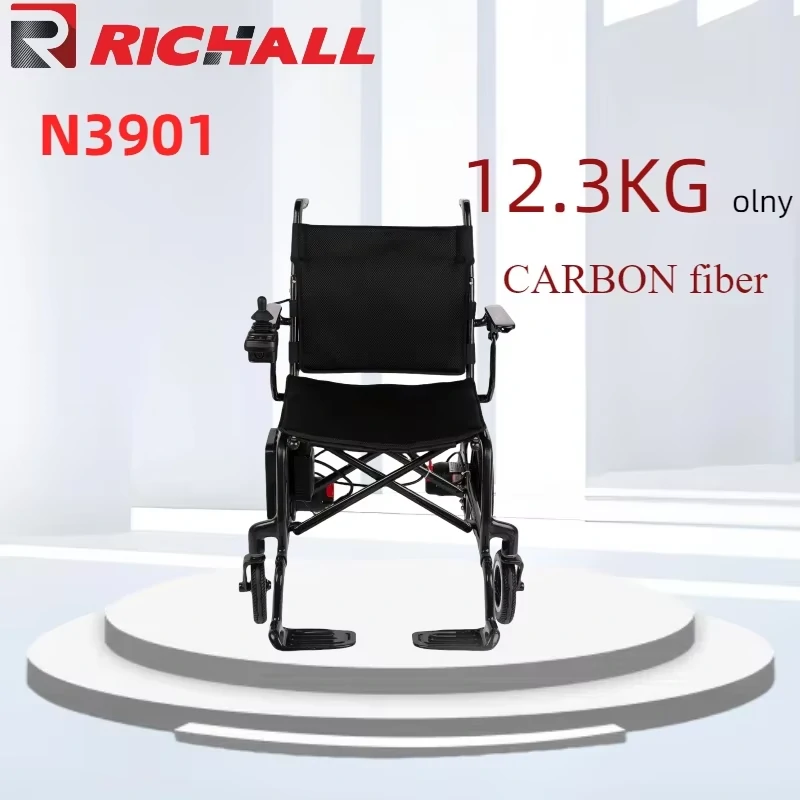
The principles of carbon fiber construction are perfectly embodied in new models for 2026, such as those found in Richall’s pioneering carbon fiber wheelchair designs. Consider a model like the conceptual CF-EW01, which weighs in at a mere 38 pounds (approximately 17 kg) without its battery. For comparison, traditional electric wheelchairs can easily exceed 100 pounds (45 kg).
What does this weight reduction mean in human terms?
- Independence: A user who is strong enough to transfer their body may now also be strong enough to fold and lift their own chair into a vehicle.
- Caregiver Well-being: An aging spouse or a family member is less likely to suffer injury from repeatedly lifting a heavy device. The risk of musculoskeletal disorders among caregivers is a serious concern that lightweight design directly addresses (Grasa et al., 2021).
- Expanded Horizons: Air travel becomes far less daunting. A lighter, more compact chair is easier for baggage handlers to manage and more likely to meet airline requirements for cabin or hold storage.
Comparing Carbon Fiber and Traditional Materials
To place these advancements in context, a direct comparison of the primary materials used in wheelchair construction is illuminating.
| Merkmal | Stahl | Aluminium-Legierung | Kohlefaser-Verbundwerkstoff |
|---|---|---|---|
| Gewicht | Hoch | Medium | Sehr niedrig |
| Verhältnis Stärke/Gewicht | Niedrig | Medium | Sehr hoch |
| Kosten | Niedrig | Medium | Hoch |
| Korrosionsbeständigkeit | Low (requires coating) | Hoch | Sehr hoch |
| Ermüdungswiderstand | Gut | Fair to Good | Ausgezeichnet |
| Design Flexibility | Limited | Mäßig | Hoch |
This table clarifies that while carbon fiber commands a higher price point, it offers unparalleled performance in every other metric relevant to a portable mobility device. It’s a choice for those who prioritize weight, durability, and freedom above all else.
Innovation 2: The Robust and Redefined Aluminum Alloy Wheelchair
While carbon fiber represents the cutting edge of lightweight performance, aluminum alloy remains a cornerstone of the mobility industry for excellent reasons. It occupies a crucial middle ground, offering a significant weight advantage over steel without the premium cost of carbon fiber. The innovation here is not in the invention of the material itself, but in the refinement of its use—smarter designs, better alloys, and more efficient manufacturing that push the boundaries of what a cost-effective wheelchair can be.
The Enduring Appeal of Aluminum: Strength Meets Affordability
Aluminum’s primary appeal is its exceptional balance of properties. It is a material that democratizes lightweight technology. Think of it as the workhorse of the modern wheelchair frame. It is corrosion-resistant, meaning it can stand up to rain and humidity without rusting. It is also highly formable, allowing for hydroforming and complex tube shapes that can increase strength without adding excess material.
For many users and their families, the financial aspect of acquiring a mobility device is a major consideration. The ability to purchase a durable, relatively lightweight, and reliable electric wheelchair at a more accessible price point can be the deciding factor in whether someone achieves mobility independence or not. Aluminum makes this possible. It ensures that the benefits of modern engineering are not reserved solely for the highest end of the market.
Introducing the Richall N3502: Durability for Everyday Adventures
A model like the conceptual Richall N3502 serves as a perfect example of modern aluminum alloy design. While it may be heavier than a carbon fiber counterpart, its frame is engineered for maximum durability. It is designed to withstand the rigors of daily use—bumpy sidewalks, repeated transfers, and the general wear and tear of an active life.
These chairs often feature reinforced frames and robust components that prioritize longevity. They are an excellent choice for users who may not need to lift the chair frequently but require a dependable device for daily commutes, shopping, and navigating their community. The focus is on robust construction and reliable performance, ensuring that the user has a trusted partner for their everyday mobility needs.
Aluminum vs. Carbon Fiber: A User-Centric Comparison
Choosing between aluminum and carbon fiber is not about which is “better” in an absolute sense, but which is better for you. The decision rests on a careful consideration of your personal priorities, lifestyle, and budget. Let’s frame the choice through a series of user scenarios.
| Priority | Best Choice | Why? |
|---|---|---|
| Frequent Travel / Lifting | Kohlefaser | The dramatic weight savings (often 10-20 kg lighter) is the single most important factor for portability and ease of handling. |
| Budget Consciousness | Aluminium-Legierung | Offers many benefits of modern design (lightweight, rust-proof) at a significantly more accessible price point. |
| Maximum Durability / Rugged Use | Aluminium-Legierung | Often designed with slightly thicker, more robust frames that can be more forgiving of rough handling and impacts. |
| Performance / Ride Quality | Kohlefaser | The material’s vibration-damping properties can lead to a smoother, less jarring ride over uneven surfaces. |
| Long-Term Investment | Kohlefaser | Excellent fatigue and corrosion resistance mean the frame can have an exceptionally long lifespan, potentially offsetting the higher initial cost over time. |
This user-centric approach shifts the question from “What is this chair made of?” to “What can this chair do for me?”. It is an exercise in empathy, placing the lived experience of the user at the center of the decision-making process.
Innovation 3: Seamless Indoor-Outdoor Transitions
One of the most persistent challenges in wheelchair design has been the indoor-outdoor dilemma. A chair optimized for the tight corners and smooth floors of a home is often ill-equipped for the curbs, slopes, and uneven textures of the outside world. Conversely, a rugged outdoor chair can feel bulky and restrictive inside a small apartment or a crowded café. The third major innovation in the 2026 product line is the focus on hybrid designs that refuse to accept this compromise, creating a new class of versatile indoor and outdoor electric wheelchairs.
The Challenge of Versatility: One Chair for All Environments
Let’s consider the competing demands. For indoor use, you need a small turning radius to navigate hallways and doorways. You need non-marking tires to protect floors. A compact frame is paramount. For outdoor use, you need larger, more robust wheels to handle cracks and small obstacles. You need a more powerful motor to tackle inclines and a suspension system to absorb shocks for a comfortable ride.
Historically, users might have been forced to own two separate devices—a small power chair for the home and a larger scooter or outdoor wheelchair for excursions. This is not only financially burdensome but also logistically complex. The goal of modern design is to create a single, elegant solution that can adapt to these varied environments with grace and competence.
The Hybrid Design Philosophy: Richall’s New Outdoor Electric Wheelchair
The new generation of electric wheelchairs from a wholesale carbon fiber electric wheelchair manufacturer like Richall tackles this challenge through a multi-faceted design philosophy.
- Intelligent Wheel Configuration: This involves using a mid-wheel drive system, which places the largest (drive) wheel directly under the user’s center of gravity. This allows the chair to spin on its own axis, providing the tight turning radius needed for indoor spaces. At the same time, the front and rear caster wheels provide stability for outdoor terrain.
- Advanced Suspension Systems: It’s no longer enough to just have large tires. The new models incorporate independent suspension on the wheels, much like a modern car. This allows each wheel to absorb bumps without transferring the shock to the user, dramatically improving comfort on sidewalks, cobblestones, or park trails.
- Scalable Power: The motors and control systems are now smarter. They can deliver gentle, precise power for slow-speed indoor maneuvering but also have the reserve torque needed to confidently climb a ramp or a grassy slope. The joystick controls are often programmable, allowing the user or a therapist to set different profiles for “indoor mode” and “outdoor mode,” adjusting speed and responsiveness with the touch of a button.
Navigating Urban vs. Rural Terrains: What to Consider
The choice of an indoor-outdoor chair also requires a personal assessment of your primary environment. Think about your typical week.
- Urban Dweller: If you live in a city, you might prioritize a tight turning radius for navigating shops and public transit, along with a good suspension for handling dropped curbs and uneven pavement. Battery range in a dense environment might be less of a concern than maneuverability.
- Suburban/Rural Resident: If you live in an area with more open space, longer distances between destinations, and potentially unpaved paths, your priorities might shift. A longer battery range, larger wheels, and a more powerful motor become more important. The overall footprint of the chair is less of a constraint.
The beauty of the new hybrid designs is their ability to cater to both scenarios effectively. They represent a move away from specialized, single-purpose devices toward a more holistic and adaptable approach to personal mobility.
Innovation 4: The Art of the Fold: Advanced Folding Mechanisms
For any wheelchair user who travels, the process of folding and stowing the chair is a moment of truth. It can be a source of frustration and delay, or it can be a seamless, almost effortless action. The fourth innovation in the 2026 lineup is a relentless focus on the engineering of portability, transforming the act of folding a wheelchair from a multi-step chore into an intuitive, often single-action, process.
From Clunky to Compact: The Engineering of Portability
Early folding wheelchairs, while functional, were often cumbersome. They required removing parts, operating multiple latches, and a fair amount of physical strength and dexterity. The folded result was often still bulky and awkward to lift. The goal of modern engineering is to create a chair that collapses into the smallest and most manageable shape possible, with the least amount of effort.
Engineers now use advanced computer-aided design (CAD) to simulate folding pathways, identifying how to make components nest together perfectly. They use materials like aluminum and carbon fiber not just for the frame’s strength when open, but for the lightness of its individual parts during the folding process. The geometry of the frame is meticulously planned so that the chair collapses in on itself in a logical, predictable sequence.
One-Click Folding Technology in the 2026 Lineup
The pinnacle of this design philosophy is the emergence of “one-click” or automated folding systems in many new foldable electric wheelchairs. While this might sound like a minor convenience, its impact on a user’s quality of life can be immense.
Imagine a user arriving at their car. Instead of having to bend, unlatch, and wrestle with the chair, they can simply press a button or pull a single lever. The chair then collapses electronically or through a clever series of mechanical linkages. Some models can even be folded using a remote control, allowing a user to get into their car first and then fold the chair and have it ready for a caregiver to lift.
This innovation is particularly beneficial for:
- Users with Limited Strength or Dexterity: Conditions like arthritis or muscular weakness can make operating traditional latches difficult. A one-click system removes this barrier.
- Caregivers: It speeds up the process of getting in and out of vehicles, reducing stress and physical strain.
- Public Transport Users: Quickly and easily folding a chair on a bus or train platform makes public transit a much more viable and less stressful option.
Travel and Transportation: A New Era of Convenience
The combination of lightweight materials and advanced folding mechanisms ushers in a new era of travel freedom. A chair that folds into a compact, suitcase-like shape can be easily stored in the trunk of a small car, a train’s luggage rack, or a cruise ship cabin.
This has a profound psychological effect. The world feels more accessible. A spontaneous weekend trip is no longer a major logistical operation. Visiting family and friends becomes simpler. The wheelchair ceases to be an anchor and becomes a passport. The focus of the journey shifts from the process of managing the equipment to the experience of the destination. This enhancement of spontaneous, joyful participation in life is perhaps the most significant achievement of modern portable wheelchair design.
Innovation 5: Smart Power and Battery Management
The engine of any electric wheelchair is its battery system. For years, users were tethered to heavy, inefficient sealed lead-acid (SLA) batteries that offered limited range and required long charging times. The fifth innovation, and arguably one of the most critical, is the complete shift to lightweight, high-capacity lithium-ion (Li-ion) batteries, coupled with intelligent power management systems. This has revolutionized the range, performance, and travel-readiness of modern electric wheelchairs.
Extending Range and Lifespan: The Science of Modern Batteries
Lithium-ion technology offers a much higher energy density than older battery types. In simple terms, a Li-ion battery can store significantly more power in a much smaller and lighter package. A typical SLA battery for a wheelchair might weigh 30-50 pounds (14-23 kg), while a Li-ion battery with the same or greater capacity can weigh as little as 5-10 pounds (2-5 kg).
This weight saving on the battery alone contributes to the overall lightness of the chair, but its primary benefit is performance. Because the motors have less total weight to move, the energy from the battery is used more efficiently, translating directly into longer travel distances on a single charge. It’s not uncommon for modern lightweight chairs to offer a range of 15-25 km (9-15 miles) or more, a significant increase from older models. Furthermore, Li-ion batteries can handle more charge cycles before their capacity degrades, meaning they have a longer overall lifespan, making them a better long-term investment (Pinto, 2021).
Richall’s Airline-Approved Lithium-Ion Innovations
One of the biggest hurdles for travelers with electric wheelchairs has been navigating airline regulations for batteries. Most airlines have strict rules, based on International Air Transport Association (IATA) guidelines, regarding the size and transport of lithium-ion batteries due to safety concerns.
Recognizing this, a leading electric carbon aluminium alloy wheelchair manufacturer expands product line features to include batteries specifically designed for air travel. This involves several key features:
- Capacity Limits: The batteries are designed to fall under the 300 Watt-hour (Wh) limit for a single battery, which is the standard for carriage on passenger aircraft. Many models use two smaller batteries (e.g., under 160 Wh each) to provide the total range.
- Easy Removal: The batteries are designed to be quickly and easily removed from the wheelchair without tools. Airline policy requires that the user carry the removed batteries into the cabin with them.
- Durable Casing and Certifications: The batteries are housed in tough, protective casings and come with the necessary UN 38.3 certification documents that prove they have been tested for safety during transport.
This thoughtful design removes a major point of anxiety for travelers. It transforms the check-in process from a potential confrontation into a smooth, predictable procedure.
Understanding Battery Metrics: Volts, Amps, and Your Daily Needs
When looking at specifications, you’ll often see numbers for Volts (V), Amp-hours (Ah), and Watt-hours (Wh). What do they mean for you?
- Volts (V): Think of this as the “pressure” of the electrical system. Most modern wheelchairs run on a 24V system. It’s a standard measure of the system’s power.
- Amp-hours (Ah): This is the “fuel tank.” It measures the battery’s capacity—how much current it can provide over time. A higher Ah number generally means a longer range. For example, a 10 Ah battery can provide 1 amp of current for 10 hours.
- Watt-hours (Wh): This is the total amount of energy stored in the battery. It’s calculated by multiplying Volts by Amp-hours (24V x 10Ah = 240Wh). This is the number that airlines are most interested in.
When choosing a chair, don’t just look for the biggest battery. Consider your needs. If you primarily use your chair for short trips, a smaller, lighter battery might be preferable for easier handling. If you need to cover long distances, then a higher Ah capacity will be your priority. The 2026 models offer this choice, allowing you to tailor the power system to your life.
Innovation 6: The Ergonomic Renaissance in Manual Wheelchairs
While much of the focus is on powered mobility, the manual wheelchair remains an essential tool for millions. The sixth innovation is a renewed focus on the science of ergonomics and human-centered design in manual wheelchairs. The modern manual chair is no longer a one-size-fits-all piece of equipment; it is a highly refined, customized extension of the user’s body, designed to maximize propulsion efficiency and minimize long-term health risks.
Rethinking Manual Propulsion: Efficiency and User Health
Propelling a manual wheelchair is a physically demanding activity. Poorly designed chairs can lead to significant strain on the shoulders, wrists, and back, increasing the risk of repetitive strain injuries and chronic pain (Boninger et al., 2005). The ergonomic renaissance addresses this by examining every aspect of the user-chair interface.
- Weight and Materials: Just as with electric chairs, lightweight materials like aluminum and even carbon fiber are now used in high-performance manual wheelchairs. A lighter chair requires less force to start, stop, and turn, reducing the cumulative strain on the user’s body over thousands of propulsions each day.
- Axle Position: The position of the rear wheel axle relative to the user’s center of gravity is perhaps the single most important adjustment. Moving the axle forward makes the chair more “tippy” but also dramatically easier to push, as more of the user’s weight is on the large drive wheels. A properly configured chair allows for long, smooth strokes rather than short, choppy ones, improving efficiency and reducing stress on the shoulder joint.
- Seat Slope and “Dump”: The angle of the seat, often referred to as “seat dump,” is another critical adjustment. A slight downward slope from front to back helps to hold the user securely in the chair, improving posture and providing a more stable base for propulsion.
Customization and Fit: The New Standard in Manual Chair Design
The biggest shift in manual wheelchair philosophy is the move towards custom fitting. An off-the-shelf, standard-sized chair is now seen as a starting point, not a final solution. A proper fitting, often conducted by a physical or occupational therapist, will consider:
- Seat Width and Depth: A seat that is too wide fails to provide proper support and makes the wheels harder to reach. A seat that is too narrow can cause pressure sores.
- Höhe und Neigung der Rückenlehne: A lower backrest allows for more freedom of movement for the torso and shoulders, facilitating a more efficient push stroke for active users. A higher, more supportive backrest may be needed for users with less trunk control.
- Footrest and Leg Length: The length from the seat to the footplate must be set correctly to ensure proper thigh support and pelvic positioning.
These are not minor tweaks. They are fundamental to the user’s health, comfort, and ability to use the chair effectively. The 2026 line of manual wheelchairs is built with this high degree of adjustability in mind, recognizing that the chair must be tailored to the unique geometry of the individual.
When Manual is the Right Choice: Scenarios and Benefits
In an age of advanced electric chairs, why would someone choose a manual wheelchair? There are many compelling reasons.
- Physical Fitness: For many, propelling a manual wheelchair is a form of daily exercise that helps maintain cardiovascular health and upper body strength.
- Simplicity and Reliability: Manual chairs have no motors or electronics to fail. They are mechanically simple and incredibly reliable.
- Ultimate Portability: Even the lightest electric chair cannot compete with the portability of a rigid-frame, ultra-lightweight manual wheelchair, which can weigh as little as 15-20 pounds (7-9 kg).
- User Control and Connection: Some users prefer the direct, tactile connection to their environment that a manual chair provides. They feel more in control and more engaged with the act of moving.
The innovation here is the recognition that manual and electric wheelchairs are not in competition. They are different tools for different needs, and both deserve the highest level of engineering and design excellence.
Innovation 7: The Rise of the Intelligent Rollator Walker
The final innovation in the expanded product line addresses the needs of individuals who may not require a wheelchair but still need support for balance and stability. The traditional walker, a simple aluminum frame, is being reimagined. The intelligent rollator walker of 2026 is a sophisticated mobility aid that integrates advanced materials and smart features to provide a new level of safety and confidence.
More Than Just Support: Integrating Technology into Walkers
A rollator walker, with its wheels and handbrakes, has always been a step up from a basic walker. The latest innovations take this concept much further. The goal is no longer just to prevent falls, but to actively encourage a more natural and confident gait.
Some of the technological integrations we are beginning to see include:
- Braking Systems: Beyond simple cable-pull brakes, some models are exploring automated braking systems. Using sensors, the rollator can detect if the user is moving too fast (especially downhill) and apply gentle resistance to maintain a safe speed.
- Gait Monitoring: Integrated sensors can potentially provide feedback on a user’s walking pattern, alerting them or a caregiver to changes that might indicate a problem.
- Ergonomisches Design: Handles are no longer simple grips. They are ergonomically shaped to reduce pressure on the wrists and are highly adjustable to match the user’s height and posture perfectly. This encourages an upright posture rather than a stooped one.
Richall’s All-Carbon Walker: A Glimpse into the Future
Just as in wheelchairs, carbon fiber is making its way into rollator design. A model like Richall’s 1901 All-Carbon Walker is a prime example. The use of carbon fiber makes the rollator incredibly light, often less than 12 pounds (5.5 kg).
What is the benefit of a lightweight rollator?
- Easy Lifting: It can be lifted over a curb or into a car with minimal effort, which is crucial for users who may have limited strength.
- Improved Maneuverability: A lighter frame is easier to turn and navigate in tight spaces. It feels less like pushing a piece of equipment and more like a natural extension of the body.
- Reduced Fatigue: Over the course of a day, the cumulative effort of maneuvering a heavier walker can be fatiguing. A lighter rollator conserves the user’s energy for the activity itself, not for managing the aid.
The Psychological Impact of Enhanced Stability and Confidence
Perhaps the most important benefit of a well-designed rollator walker is psychological. The fear of falling can be debilitating, causing individuals to reduce their activity levels, leading to social isolation and physical decline (Scheffer et al., 2008). A stable, reliable, and easy-to-use walker can break this cycle.
When a person feels confident that their walker will support them, that the brakes will hold, and that they can manage it easily, they are more likely to leave the house, walk to the shops, or visit a friend. The device becomes an enabler of life, not a symbol of disability. This boost in confidence and the resulting increase in activity can have profound positive effects on both mental and physical health. The intelligent rollator is not just a piece of metal and plastic; it is a tool for re-engagement with the world.
Choosing Your Mobility Partner: A Guide for Users in Europe, Australia, and the US
Selecting the right mobility device is a deeply personal decision, one that goes far beyond comparing technical specifications. It’s about finding a partner that fits your body, your lifestyle, and your aspirations. For customers in diverse markets like Europe, Australia, and the United States, there are also practical considerations regarding healthcare systems and local environments.
Navigating Healthcare Systems and Funding
The process of acquiring a wheelchair or walker varies significantly across regions.
- In parts of Europe: Many countries have national health services or robust social insurance systems that may cover all or part of the cost of a prescribed mobility device. The process typically involves an assessment by a physician and an occupational or physical therapist.
- In the United States: Funding is a complex patchwork of Medicare, Medicaid, and private insurance. Coverage for lightweight, premium materials like carbon fiber can be challenging to obtain and may require significant documentation to prove medical necessity. Many users may opt for private purchase to get the exact model they want.
- In Australia: The National Disability Insurance Scheme (NDIS) provides funding for Australians with a permanent and significant disability. Participants work with planners to get funding for “assistive technology” that helps them achieve their goals.
Regardless of your location, it’s wise to start by consulting with a healthcare professional. They can provide the necessary medical justification and help you navigate the specific funding pathways available to you.
Assessing Personal Needs: Lifestyle, Environment, and Physical Condition
Before you start looking at models, take some time for introspection. Think of yourself as the lead consultant on this project. Ask yourself some key questions:
- Your Environment: Where will you use this device 90% of the time? Is your home full of tight corners? Do you live in a hilly area? Are the sidewalks in your town well-maintained?
- Your Transportation: How will you transport the device? Do you drive a small car? Do you rely on family members or caregivers to lift it? Do you use public transport?
- Your Physical Condition: What is your upper body strength and endurance? Do you have any pain in your shoulders or wrists? What is your ability to transfer in and out of the chair?
- Your Lifestyle: Are you a frequent flyer? Do you enjoy spending time outdoors on varied terrain? Or is your social life centered around indoor activities?
Being honest about these factors will guide you toward the right category of device, whether it’s an ultra-lightweight carbon fiber chair for travel, a robust aluminum model for daily reliability, or a highly maneuverable manual chair for fitness and simplicity.
The Importance of After-Sales Support and Community
Your relationship with a mobility device doesn’t end on the day of purchase. It’s a long-term partnership. Therefore, the quality of the manufacturer’s after-sales support is a critical factor in your decision. Look for companies that offer:
- Clear Warranties: Understand what is covered (frame, electronics, motors) and for how long.
- Accessible Technical Support: Can you easily contact someone if you have a problem? Do they offer online resources, videos, and manuals?
- Verfügbarkeit der Teile: All wheelchairs will eventually need maintenance, like new tires or batteries. Ensure that spare parts are readily available in your region.
Companies like Richall Medical understand this, providing comprehensive support systems to ensure user satisfaction long after the initial sale. This commitment to the user’s entire journey is the hallmark of a true mobility partner.
Häufig gestellte Fragen (FAQ)
Was ist der Hauptvorteil eines Elektrorollstuhls aus Kohlefaser gegenüber einem Aluminiumrollstuhl? The primary advantage is a significant reduction in weight. Carbon fiber chairs are much lighter, making them easier to lift, transport, and handle, which is ideal for travel and for users or caregivers with limited strength. They also offer superior vibration damping for a smoother ride.
Are the lithium-ion batteries in new electric wheelchairs safe for air travel in 2026? Yes, reputable manufacturers design their battery systems to comply with air travel regulations. This typically means the batteries are under the 300Wh limit (or two batteries under 160Wh each), are easily removable, and have the required UN 38.3 safety certification. You must remove the batteries and carry them in the cabin.
How do I decide between an indoor and an outdoor electric wheelchair? Consider your primary use. If you need maximum maneuverability in tight spaces, a dedicated indoor chair with a small turning radius is best. If you face varied terrain, an outdoor chair with larger wheels and better suspension is necessary. For many, a modern hybrid model that combines a tight turning radius with good suspension offers the best of both worlds.
Is a more expensive wheelchair always better? Not necessarily. The “best” wheelchair is the one that best fits your specific needs, lifestyle, and budget. A more expensive carbon fiber model is superior for travel, but a robust, more affordable aluminum model might be a better and more durable choice for a user who doesn’t need to lift the chair often.
How important is a professional fitting for a manual wheelchair? It is absolutely essential. A proper fitting by an occupational or physical therapist ensures the chair is configured to your body’s specific dimensions. This maximizes your propulsion efficiency, improves comfort and posture, and significantly reduces the long-term risk of repetitive strain injuries to your shoulders and wrists.
Can a rollator walker really help improve my confidence? Yes, significantly. The fear of falling can lead to a cycle of inactivity and isolation. A modern, lightweight, and stable rollator with effective brakes provides the physical and psychological support needed to break that cycle, encouraging users to walk more and re-engage with their communities, which is proven to boost mental and physical well-being.
Schlussfolgerung
The journey toward greater personal freedom is paved with innovations born from empathy and engineering. The expansion of mobility solutions in 2026 demonstrates a profound shift in how we approach assistive technology. It is no longer about simply compensating for a limitation; it is about empowering a life. The thoughtful application of materials like carbon fiber and refined aluminum alloys, the clever engineering of folding mechanisms and hybrid drive systems, and the ergonomic focus on user health all point to a future where mobility aids are less like medical equipment and more like personal vehicles for exploration and engagement.
Choosing a device is a dialogue between your needs and the possibilities of technology. Whether it is the featherlight portability of a carbon fiber frame that opens up the world of travel, the steadfast reliability of an aluminum chair for daily life, or the confidence-inspiring stability of an intelligent walker, the right choice is the one that removes barriers and allows the human spirit to move freely. This evolution in design is a testament to the idea that true mobility is not just about the movement of the body, but about the liberation of one’s potential.
Referenzen
Boninger, M. L., Souza, A. L., Cooper, R. A., Fitzgerald, S. G., Koontz, A. M., & Fay, B. T. (2005). Propulsion patterns and pushrim biomechanics in manual wheelchair propulsion. Archives of Physical Medicine and Rehabilitation, 86(4), 718–723.
Das, T. K., Ghosh, P., & Das, N. C. (2016). Preparation, development, outcomes, and application of carbon fiber. In M. F. A. (Ed.), Advanced High-Strength Natural/Synthetic Polymer Composites. IntechOpen. https://doi.org/10.5772/64293
Grasa, J., Orús, C., de la O, L., & López-de-Celis, C. (2021). Caregivers’ health condition and their relation with the level of dependence in wheelchair users. International Journal of Environmental Research and Public Health, 18(16), 8443. https://doi.org/10.3390/ijerph18168443
Pinto, J. (2021). Li-ion battery technology for electric vehicles. In A. F. Z. (Ed.), Electric Vehicles. IntechOpen. https://doi.org/10.5772/intechopen.97349
Scheffer, A. C., Schuurmans, M. J., van Dijk, N., van der Hooft, T., & de Rooij, S. E. (2008). Fear of falling: measurement strategy, prevalence, risk factors and consequences among older persons. Age and Ageing, 37(1), 19–24. https://doi.org/10.1093/ageing/afm169
World Health Organization. (2022). Ageing and health. WHO.