.png)
.png)
Die 5-Punkte-Checkliste eines Experten: Wie Hochleistungs-Elektrorollstühle aus Kohlefaser die moderne Mobilität im Jahr 2026 neu definieren
Dezember 31, 2025
Abstrakt
Die Landschaft der persönlichen Mobilität befindet sich in einem bedeutenden Wandel, der durch Fortschritte in der Materialwissenschaft vorangetrieben wird. Diese Analyse untersucht das Aufkommen von Hochleistungs-Elektrorollstühlen aus Kohlenstofffasern als eine entscheidende Innovation, die die Standards für Unabhängigkeit und Funktionalität für die Nutzer neu definiert. Durch die Nutzung des außergewöhnlichen Verhältnisses zwischen Festigkeit und Gewicht von Kohlefaserverbundwerkstoffen können die Hersteller Geräte entwickeln, die nicht nur bemerkenswert leicht und tragbar, sondern auch robust und langlebig sind. Dieses Dokument befasst sich mit den vielfältigen Vorteilen dieser modernen Mobilitätshilfen, von verbesserter Batterieeffizienz und Leistung bis hin zu überlegener Ergonomie und Reisefreundlichkeit. Es untersucht die zugrundeliegenden technischen Prinzipien, die Qualitätsindikatoren für die Herstellung und die benutzerorientierten Designphilosophien, die diese Stühle von ihren traditionellen Gegenstücken unterscheiden. Ziel ist es, ein umfassendes Verständnis dafür zu vermitteln, wie die einzigartigen Eigenschaften von Kohlenstofffasern systematisch die seit langem bestehenden Herausforderungen in der Hilfstechnologie angehen und dadurch eine größere Autonomie und eine verbesserte Lebensqualität für Menschen mit Mobilitätseinschränkungen im Jahr 2026 fördern.
Wichtigste Erkenntnisse
- Kohlefaser bietet ein hervorragendes Verhältnis von Festigkeit zu Gewicht, so dass sich die Stühle leichter heben und transportieren lassen.
- Ein leichterer Rahmen verbessert die Akkuleistung und erhöht die Reichweite mit einer einzigen Ladung.
- Die modernen Modelle lassen sich mit einem Klick zusammenklappen und sind mit flugtauglichen Batterien ausgestattet, so dass sie problemlos reisen können.
- Ergonomische Designs mit besserer Federung verringern Ermüdungserscheinungen und verbessern den Benutzerkomfort über lange Zeiträume hinweg.
- Berücksichtigen Sie Herstellerzertifizierungen, um sicherzustellen, dass Ihr Hochleistungs-Elektrorollstuhl aus Kohlefaser sicher und zuverlässig ist.
- Die Korrosions- und Ermüdungsbeständigkeit des Materials gewährleistet eine längere Lebensdauer und einen besseren Langzeitwert.
- Achten Sie auf bürstenlose Motoren und intelligente Steuerungen für eine leisere, schnellere und effizientere Fahrt.
Inhaltsübersicht
- Die materialwissenschaftliche Revolution in der persönlichen Mobilität
- Checkliste Punkt 1: Auspacken des Stärke-Gewicht-Verhältnisses
- Checkliste Punkt 2: Prüfung von Leistung, Performance und Reichweite
- Checkliste Punkt 3: Bewertung der Tragbarkeit und Reisefreundlichkeit
- Checkliste Punkt 4: Bewertung der Ergonomie und des benutzerzentrierten Designs
- Checkliste Punkt 5: Verständnis von Fertigungsqualität und langfristigem Wert
- FAQ
- Ein neues Paradigma der Freiheit und Befähigung
- Referenzen
Die materialwissenschaftliche Revolution in der persönlichen Mobilität
Die Geschichte der menschlichen Mobilität ist eine Geschichte ständiger Innovation, ein unermüdliches Streben nach Hilfsmitteln, die unsere Fähigkeit, uns in der Welt zurechtzufinden, erweitern. Für Menschen, die auf Rollstühle angewiesen sind, ist diese Geschichte sehr persönlich. Das Gerät ist nicht nur ein Accessoire, sondern eine Erweiterung des Selbst, ein primärer Vermittler zwischen einer Person und ihrer Umgebung. Jahrzehntelang erfolgte die Entwicklung des Rollstuhls schrittweise und wurde durch die physikalischen Eigenschaften herkömmlicher Materialien eingeschränkt. Die Geschichte begann oft mit Stahl - stark, ja, aber erdrückend schwer. Ein Stahlrollstuhl stellt einen Kompromiss dar: Seine Haltbarkeit wird mit einer immensen körperlichen Anstrengung erkauft, sowohl für den Benutzer als auch für die Hilfspersonen. Einen 25 Kilogramm schweren Stahlrollstuhl in den Kofferraum eines Autos zu heben, ist nicht nur lästig, sondern kann ein Hindernis für die Teilhabe sein, ein Grund, zu Hause zu bleiben.
Die Einführung von Aluminium bedeutete eine willkommene Erleichterung. Dieses leichtere Metall machte die Rollstühle handlicher, verringerte die körperliche Belastung und eröffnete neue Möglichkeiten für Spontaneität. Doch Aluminium ist zwar leichter als Stahl, hat aber nach wie vor seine Grenzen in Bezug auf Festigkeit und Ermüdungsfestigkeit. Die Suche nach etwas Besserem, etwas, das keinen Kompromiss zwischen Festigkeit und Gewicht erfordert, ging weiter. Diese hartnäckige Suche hat uns zum aktuellen Zeitpunkt geführt, einem echten Wendepunkt in der Geschichte der Hilfstechnologie, der durch die Einführung von Karbonfasern definiert wurde. Der Übergang zu Hochleistungs-Elektrorollstühlen aus Kohlefaser ist nicht nur ein weiterer Schritt in dieser Entwicklung, sondern stellt ein grundlegendes Überdenken dessen dar, was ein Mobilitätsgerät sein kann und sollte. Es ist ein Wechsel von einem Paradigma des Umgangs mit Einschränkungen zu einem Paradigma, das aktiv Fähigkeiten ermöglicht.
Vom Stahl zur Kohlefaser: Ein Evolutionssprung
Um die Bedeutung der Kohlefaser zu verstehen, muss man sie zunächst in ihren historischen Kontext einordnen. Stellen Sie sich die allerersten Rollstühle vor. Sie waren zwar funktional, aber ihre Konstruktion aus Holz und Eisen machte sie eher zu Möbeln als zu den dynamischen Werkzeugen des modernen Lebens, die wir heute kennen. Das 20. Jahrhundert brachte das Zeitalter des Stahls, ein Material, das die Massenproduktion und eine größere strukturelle Integrität ermöglichte. Stahlrahmen sind unglaublich robust und können erheblichen Belastungen und Stößen standhalten. Ihr Nachteil war jedoch schon immer ihre Masse. Das schiere Gewicht eines Elektrorollstuhls aus Stahl macht den unabhängigen Transport für viele Benutzer fast unmöglich. Sie sind auf spezielle Hebebühnen oder die Hilfe anderer angewiesen, wodurch die Autonomie, die das Gerät eigentlich bieten soll, auf subtile Weise beeinträchtigt wird.
Dann kam Aluminium, ein Material, das in der Luft- und Raumfahrtindustrie für sein günstiges Verhältnis von Gewicht und Festigkeit bekannt ist. Rollstühle aus Aluminiumlegierungen boten eine erhebliche Gewichtsreduzierung, oft um 30-40% im Vergleich zu ihren Pendants aus Stahl. Dies war eine Art Befreiung. Plötzlich war es für einen größeren Personenkreis möglich, einen Stuhl zusammenzufalten und in einem Fahrzeug zu transportieren. Diese Entwicklung war entscheidend für das Wachstum der faltbaren Elektrorollstühle, da der leichtere Rahmen das gesamte Paket, einschließlich Motoren und Batterien, handlicher machte.
Doch auch bei Aluminium blieb ein Kompromiss bestehen. Um die erforderliche Festigkeit zu erreichen, müssen Aluminiumrahmen aus dickeren Rohren gefertigt werden, was einen Teil des eingesparten Gewichts wieder zunichte macht. Außerdem sind sie anfälliger für Dellen, Beulen und - über viele Belastungszyklen hinweg - für Metallermüdung. Damit sind wir in der heutigen Zeit angelangt, die von den Versprechungen und der Realität der Kohlefaser dominiert wird. Hochleistungs-Elektrorollstühle aus Kohlefaser sind nicht nur leichter, sondern bestehen aus einem Material, das grundlegend andere und bessere Eigenschaften besitzt. Das Verhältnis von Festigkeit zu Gewicht ist bei Carbonfasern so extrem, dass sie Konstruktionen ermöglichen, die bisher nicht möglich waren, und ein Leistungsniveau bieten, das das gesamte Benutzererlebnis neu definiert.
Verständnis von Kohlenstofffaser-Verbundwerkstoffen
Was genau ist das für ein Material, das den alten Regeln zu trotzen scheint? Wenn wir von einem Kohlefaserrahmen sprechen, meinen wir nicht ein massives Stück Kohlefaser. Wir sprechen von einem "Verbundwerkstoff". Dies ist ein Schlüsselbegriff. Stellen Sie sich vor, es handelt sich um ein Team von Materialien, die zusammenarbeiten, wobei die Kombination weitaus größer ist als die Summe ihrer Teile.
Der wichtigste Akteur ist die Kohlenstofffaser selbst. Stellen Sie sich Fäden aus reinem Kohlenstoff vor, die so gesponnen sind, dass sie unglaublich dünn sind - oft nur 5 bis 10 Mikrometer im Durchmesser, das ist ein Vielfaches dünner als ein menschliches Haar. Diese einzelnen Fasern sind für ihre Größe erstaunlich stark und auch sehr steif. Wie jeder Faden sind sie jedoch stark unter Spannung (wenn man an ihnen zieht), haben aber für sich genommen nur eine geringe strukturelle Integrität.
Um diese Fäden in eine feste, starre Struktur zu verwandeln, werden sie zu einer stoffähnlichen Matte verwoben. Diese Matte wird dann in eine Form gelegt, die wie ein Teil des Rollstuhlrahmens geformt ist. Hier kommt der zweite Akteur ins Spiel: ein Polymerharz, häufig ein Epoxidharz. Dieses flüssige Harz wird in die Kohlefasermatte eingegossen und füllt alle mikroskopisch kleinen Lücken zwischen den Fasern. Der gesamte Aufbau wird dann unter starker Hitze und Druck ausgehärtet. Das Harz härtet aus und fungiert als bindende Matrix, die die Fasern in ihrer genauen Ausrichtung hält.
Das Ergebnis ist ein kohlenstofffaserverstärktes Polymer (CFRP). Die Kohlenstofffasern sorgen für die Festigkeit und Steifigkeit, während das gehärtete Harz die Fasern schützt, die Last zwischen ihnen überträgt und dem Teil seine endgültige Form verleiht. Diese Verbundstruktur macht Hochleistungs-Elektrorollstühle aus Kohlefaser sowohl unglaublich stark als auch unglaublich leicht. Sie ist ein Beweis für die hochentwickelte Materialwissenschaft, die aus der Welt des Formel-1-Rennsports und der fortschrittlichen Luft- und Raumfahrt in den Bereich der persönlichen Mobilität vordringt.
Checkliste Punkt 1: Auspacken des Stärke-Gewicht-Verhältnisses
Der am häufigsten genannte Vorteil von Hochleistungs-Elektrorollstühlen aus Kohlefaser ist ihr bemerkenswertes Verhältnis von Stärke zu Gewicht. Dieser Begriff klingt zwar technisch, ist aber der Schlüssel zum Verständnis der praktischen, gelebten Erfahrung bei der Nutzung eines dieser Geräte. Es ist die physikalische Eigenschaft, die sich direkt in größerer Freiheit, geringerer körperlicher Belastung und erweiterten Möglichkeiten für den Benutzer niederschlägt. Es geht nicht mehr nur um abstrakte materielle Eigenschaften, sondern um greifbare Vorteile, die das tägliche Leben eines Menschen prägen. Die Analyse dieses Verhältnisses erfordert mehr als nur die Betrachtung einer einzelnen Zahl; sie erfordert ein vergleichendes Verständnis der Leistung verschiedener Materialien und eine tiefere Wertschätzung der Haltbarkeit, die über die einfache Festigkeit hinausgeht.
Die Definition von "Leichtgewicht": Eine vergleichende Analyse
Das Wort "Leichtgewicht" wird im Rollstuhlmarketing schon seit Jahren verwendet, aber mit der Kohlefaser hat sich seine Bedeutung völlig neu geordnet. Während ein Aluminium-Elektrorollstuhl mit 25 kg (ca. 55 Pfund) als leicht gelten kann, wiegen einige fortschrittliche Kohlefasermodelle nur noch 15 kg (ca. 33 Pfund), einschließlich der Batterie. Ein Modell wie der Richall CF-Mini wiegt beispielsweise nur 34 Pfund (ca. 15,4 kg), eine Zahl, die noch vor einem Jahrzehnt für ein elektrisches Gerät undenkbar war (Richall Medical, 2025).
Betrachten wir das Ganze einmal aus einer klareren Perspektive. Stellen Sie sich vor, Sie planen einen Tagesausflug. Mit einem herkömmlichen, schwereren Stuhl wäre der erste Gedanke vielleicht: "Wer kann mir helfen, den Stuhl ins Auto zu bringen?" Bei einem modernen Elektro-Rollstuhl aus Karbonfaser lautet der erste Gedanke: "Wo will ich heute hin?" Der Unterschied im Gewicht ist der Unterschied zwischen Abhängigkeit und Unabhängigkeit. Es ist die Fähigkeit einer durchschnittlich starken Person oder einer älteren Pflegeperson, den Rollstuhl zusammenzufalten und zu heben, ohne Verletzungen oder Erschöpfung zu riskieren. Um diesen Unterschied wirklich zu begreifen, ist ein direkter Vergleich hilfreich.
| Material | Typische Dichte (g/cm³) | Relative Stärke | Beispiel Rahmen Gewicht (kg) | Praktische Implikationen |
|---|---|---|---|---|
| Stahl | 7.85 | Hoch | 18 - 25 kg | Sehr haltbar, aber extrem schwer; schwer zu heben und ohne Hilfe zu transportieren. |
| Aluminium-Legierung | 2.70 | Mittel | 12 - 18 kg | Leichter und handlicher, aber weniger stabil als Stahl und anfällig für Beulen. |
| Kohlefaser | 1.80 | Sehr hoch | 7 - 12 kg | Extrem leicht und stabil; leicht zu heben, ideal für Reisen und den unabhängigen Gebrauch. |
Diese Tabelle veranschaulicht den krassen Gegensatz. Der Rahmen eines Hochleistungs-Elektrorollstuhls aus Kohlefaser kann weniger als die Hälfte des Gewichts eines Stahlrahmens haben, während er eine vergleichbare oder sogar höhere Festigkeit aufweist. Diese Gewichtsreduzierung ist nicht nur eine geringfügige Verbesserung, sondern eine Veränderung, die sich direkt auf die Lebensqualität des Benutzers auswirkt, indem sie spontane Reisen und die aktive Teilnahme am gesellschaftlichen Leben zu einer weitaus zugänglicheren Realität macht.
Langlebigkeit jenseits der Zahlen: Korrosions- und Ermüdungsbeständigkeit
Während das geringe Gewicht von Carbonfasern für Schlagzeilen sorgt, ist die Langlebigkeit ein ebenso überzeugender Teil der Geschichte. Ein Rollstuhl ist kein statisches Objekt, sondern ein dynamisches Werkzeug, das ständigen Belastungen, Vibrationen und Witterungseinflüssen ausgesetzt ist. Zwei Eigenschaften von Kohlefaserverbundwerkstoffen sind hier besonders wichtig: Korrosionsbeständigkeit und Ermüdungsfestigkeit.
Betrachten wir zunächst die Korrosion. Metallrahmen, insbesondere Stahl, sind rostanfällig, vor allem in feuchtem Klima oder wenn die Farbe oder Beschichtung zerkratzt wird. Aluminium ist widerstandsfähiger, kann aber dennoch oxidieren, was zu Lochfraß und einer Verschlechterung der Oberflächenbeschaffenheit führt. Kohlefaser hingegen ist ein Polymerverbundstoff. Sie rosten und korrodieren nicht. Sie ist inert gegenüber Wasser, Salzen und den meisten Chemikalien. Das bedeutet, dass ein Hochleistungs-Elektrorollstuhl aus Kohlefaser seine strukturelle Integrität und sein ästhetisches Erscheinungsbild viel länger beibehält, selbst wenn er Regen, Schnee oder der Küstenluft ausgesetzt ist.
Zweitens, und aus technischer Sicht vielleicht noch wichtiger, ist die Ermüdungsfestigkeit. Metallermüdung ist die Schwächung eines Materials durch wiederholte Belastung. Stellen Sie sich vor, Sie biegen eine Büroklammer hin und her. Irgendwann bricht sie, und zwar nicht, weil Sie ihre Festigkeit bei einer einzigen Biegung überschritten haben, sondern aufgrund der akkumulierten Belastung durch viele Zyklen. Rollstuhlrahmen sind dieser Belastung ständig ausgesetzt - jeder Stoß, jede Drehung, jeder Transfer in den und aus dem Stuhl ist ein Belastungszyklus. Kohlefaser hat eine außergewöhnlich hohe Ermüdungsfestigkeit. Sie kann einer viel größeren Anzahl von Belastungszyklen standhalten als Aluminium, bevor es zu einem Leistungsabfall kommt (Rezaei et al., 2021). Dies führt zu einer längeren, sichereren und zuverlässigeren Lebensdauer des Rollstuhls. Es ist eine Investition in ein Gerät, das nicht nur für ein paar Jahre, sondern für viele Jahre aktiven Gebrauchs gebaut ist.
Checkliste Punkt 2: Prüfung von Leistung, Performance und Reichweite
Der Rahmen eines Rollstuhls bildet das Fundament, aber sein Herz und seine Seele liegen in der Kraft und Leistung seiner elektrischen Systeme. Die Einführung von Kohlefaser hat einen tiefgreifenden und synergetischen Effekt auf diesen Aspekt des Rollstuhldesigns gehabt. Ein leichterer Rahmen macht den Rollstuhl nicht nur leichter zu heben, sondern verändert auch die Gleichung für Motoren, Batterien und die Gesamteffizienz grundlegend. Bei der Bewertung von Hochleistungs-Elektrorollstühlen aus Kohlefaser ist es wichtig, über das Material selbst hinauszuschauen und die Komponenten zu untersuchen, die für den "Antrieb" sorgen. Dazu gehört ein Verständnis des Verhältnisses zwischen Gewicht und Energie, der Technologie hinter den Motoren und der praktischen Fähigkeit des Rollstuhls, die Herausforderungen der realen Welt zu meistern.
Die Symbiose aus leichtem Rahmen und effizienter Batterie
Der Zusammenhang zwischen einem leichten Rahmen und der Akkuleistung wird durch ein grundlegendes physikalisches Prinzip bestimmt, das durch das zweite Newtonsche Bewegungsgesetz elegant beschrieben wird. Vereinfacht ausgedrückt, braucht man weniger Energie, um ein leichteres Objekt zu bewegen als ein schwereres. Dieses Prinzip hat dramatische Konsequenzen für elektrische Rollstühle. Wenn das Gesamtgewicht des Rollstuhls durch einen Kohlefaserrahmen erheblich reduziert wird, müssen die Motoren nicht so hart arbeiten, um den Benutzer anzutreiben.
Diese Effizienzdividende kann auf zwei Arten "ausgegeben" werden. Erstens kann ein Hersteller eine kleinere, leichtere Batterie verwenden, um eine Standardreichweite (z. B. 15-20 km) zu erzielen. Dadurch wird das Gesamtgewicht des Stuhls weiter reduziert, wodurch die Vorteile des Kohlefaserrahmens noch verstärkt werden und ein ultraleichtes Paket entsteht, das sich hervorragend transportieren lässt. Zweitens kann ein Hersteller eine Batterie in Standardgröße verwenden und eine viel größere Reichweite erzielen. Ein Stuhl, der mit einem Aluminiumrahmen 20 km weit fahren kann, könnte mit einem Kohlefaserrahmen 25 km oder mehr zurücklegen, und zwar mit genau demselben Akku- und Motorsystem.
Diese größere Reichweite ist keine triviale Angelegenheit. Sie macht den Unterschied zwischen der sorgfältigen Planung jeder Fahrt, um in der Nähe einer Ladestation zu bleiben, und der Freiheit, einen spontanen Tagesausflug ohne "Reichweitenangst" zu unternehmen. Das bedeutet, mit einer einzigen Ladung ein Museum zu besuchen, zu Mittag zu essen und Besorgungen zu machen. Viele moderne Hochleistungs-Elektrorollstühle aus Kohlefaser sind mit leistungsfähigen Lithium-Ionen-Akkus ausgestattet - der gleichen Technologie, die auch Smartphones und Elektroautos antreibt -, die eine hervorragende Leistung und eine lange Lebensdauer bieten. Zum Beispiel sind einige Modelle führender Hersteller wie Carbonfaser-Elektrorollstuhl Marke bieten eine Reichweite von 20 km oder mehr und geben den Nutzern die Gewissheit, dass sie ihren Tag ohne Einschränkungen bewältigen können (electricwheelchair.en.made-in-china.com, n.d.).
Motoren und Steuerungssysteme: Das Gehirn und die Muskeln
Die von den Batterien erzeugte Energie wird von Elektromotoren auf die Räder übertragen. Im Bereich der Hochleistungs-Carbonfaser-Elektrorollstühle ist der bürstenlose Gleichstrommotor der Goldstandard. Um zu verstehen, warum das so ist, sollten wir sie kurz mit älteren, bürstenbehafteten Motoren vergleichen. Bürstenmotoren arbeiten mit kleinen Kohleblöcken ("Bürsten"), die den elektrischen Strom auf den rotierenden Teil des Motors übertragen. Diese Bürsten nutzen sich im Laufe der Zeit ab, wodurch Staub entsteht und sie schließlich ersetzt werden müssen. Außerdem erzeugen sie Reibung und Wärme, was Energieverschwendung bedeutet.
Bürstenlose Motoren haben, wie der Name schon sagt, keine solchen Bürsten. Sie verwenden eine elektronische Steuerung, um die Stromrichtung zu ändern und so die Magnetfelder zu erzeugen, die den Motor drehen. Diese Konstruktion hat mehrere entscheidende Vorteile. Sie sind wesentlich effizienter, was bedeutet, dass mehr Energie aus der Batterie in Bewegung umgewandelt wird, was wiederum zu einer größeren Reichweite beiträgt. Außerdem sind sie im Betrieb viel leiser, ein unauffälliger, aber wichtiger Faktor für den Benutzerkomfort. Da keine Bürsten verschleißen, sind sie praktisch wartungsfrei, was zur langfristigen Zuverlässigkeit und den niedrigen Betriebskosten des Rollstuhls beiträgt.
Das "Gehirn" der Bedienung ist der Controller, in der Regel ein intuitiver Joystick. Moderne Steuerungen bieten eine 360-Grad-Manövrierfähigkeit, die eine präzise Navigation in engen Räumen wie überfüllten Cafés oder engen Gängen ermöglicht. Sie verfügen über einstellbare Geschwindigkeitsstufen, eine klare Batteriestandsanzeige und eine Hupe für die Sicherheit. Einige High-End-Modelle bieten sogar fortschrittliche Funktionen wie LCD-Bildschirme mit Diagnoseinformationen oder optionale Fernbedienungen, mit denen eine Pflegekraft den Stuhl fahren oder der Benutzer ihn automatisch zusammenklappen kann. Die nahtlose Integration dieser leistungsstarken Motoren und intelligenten Steuerungen verleiht den Hochleistungs-Elektrorollstühlen aus Kohlefaser ihre sanfte, reaktionsschnelle und vertrauenserweckende Fahrt.
Navigieren in der realen Welt: Neigung und Geländegängigkeit
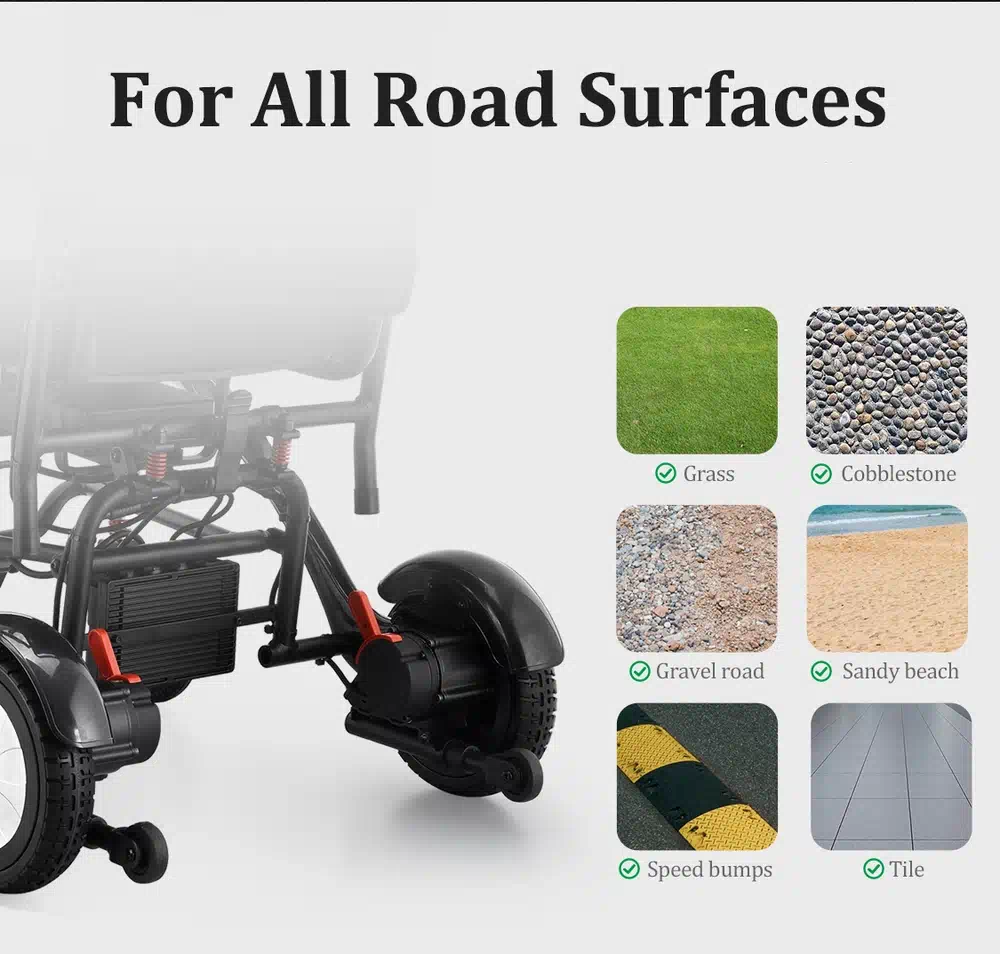
Die Nützlichkeit eines Rollstuhls kann nicht nur auf einer glatten, ebenen Fläche beurteilt werden. Das Leben ist voll von Steigungen, Schwellen und unterschiedlichem Terrain, vom Teppich im Wohnzimmer bis zum Gras in einem Park oder dem Kies eines Weges. Die Leistung eines Rollstuhls unter diesen realen Bedingungen ist ein entscheidender Test für sein Design. Durch die Kombination eines leistungsstarken bürstenlosen Motorsystems mit einem steifen, stabilen Kohlefaserrahmen sind diese Stühle in der Lage, solche Herausforderungen mit Leichtigkeit zu meistern.
Die Angabe "maximale Steigung" gibt an, welche Steigung der Rollstuhl sicher bewältigen kann. Viele Hochleistungs-Elektrorollstühle aus Kohlefaser sind für Steigungen von bis zu 10 oder 12 Grad ausgelegt, was für die meisten Standardzugangsrampen und städtischen Hügel ausreichend ist. Das sofortige Drehmoment der bürstenlosen Motoren sorgt dafür, dass der Rollstuhl diese Steigungen bewältigen kann, ohne ins Stocken zu geraten oder sich zu quälen.
Außerdem spielt die Eigensteifigkeit des Kohlefaserrahmens eine entscheidende Rolle. Beim Überqueren von unebenem Boden kann sich ein weniger steifer Rahmen verbiegen und verdrehen, was zu einem Verlust der Traktion und einem instabilen Fahrgefühl führt. Ein Kohlefaserrahmen behält seine Form bei und sorgt dafür, dass die Räder fest mit dem Boden in Kontakt bleiben und die Kraft der Motoren effizient übertragen wird. Die soliden, pannensicheren Reifen vieler Modelle tragen ebenfalls zu ihrer Vielseitigkeit bei, so dass man sich keine Sorgen mehr um einen platten Reifen machen muss, wenn man sich abseits perfekt befestigter Straßen bewegt. Diese robuste Allround-Performance sorgt dafür, dass die Welt des Benutzers nicht auf glatte Bürgersteige beschränkt ist, sondern dass er ein breiteres Spektrum von Umgebungen erkunden kann.
Checkliste Punkt 3: Bewertung der Tragbarkeit und Reisefreundlichkeit
Für viele Rollstuhlfahrer besteht der Traum nicht nur in der Mobilität zu Hause oder in der Nachbarschaft, sondern auch in der Freiheit zu reisen, die Familie im ganzen Land zu besuchen oder neue Ziele in der Welt zu erkunden. In der Vergangenheit war dies eine große Herausforderung, da schwere, sperrige Elektrorollstühle große logistische Hürden darstellten. Mit dem Aufkommen von Hochleistungs-Elektrorollstühlen aus Kohlefaser hat sich diese Situation radikal verändert. Ihre Designphilosophie ist auf Tragbarkeit ausgerichtet und macht das Reisen von einem komplexen Vorgang zu einer einfachen, unkomplizierten Aktivität. Um die Reisefreundlichkeit eines Rollstuhls zu beurteilen, muss man seinen Faltmechanismus, seine Abmessungen im zusammengeklappten Zustand und vor allem seine Übereinstimmung mit den Vorschriften für den Flugverkehr untersuchen.
Die Kunst des Faltens: Mechanismen und Kompaktheit
Die Fähigkeit, einen Rollstuhl schnell und kompakt zusammenzufalten, ist für die Portabilität von größter Bedeutung. Nur so passt der Rollstuhl in den Kofferraum eines normalen Autos, kann in einem Schrank verstaut oder im Zug mitgenommen werden. Die Hersteller von Hochleistungs-Elektrorollstühlen aus Kohlefaser haben viel in die Entwicklung ausgeklügelter und dennoch einfacher Faltmechanismen investiert.
Viele Modelle verfügen über ein "Ein-Klick"- oder "Ein-Zug"-System. Ein einziger Hebel oder Griff löst den Verriegelungsmechanismus, und der Stuhl klappt in Sekundenschnelle in sich zusammen. Der Vorgang ist intuitiv und erfordert nur wenig Kraft. Einige der fortschrittlichsten Modelle, wie z. B. die der Premiumklasse, lassen sich automatisch über eine Fernbedienung zusammenklappen. Ein Knopfdruck genügt, und der Stuhl faltet oder entfaltet sich von selbst - eine Funktion, die vor allem für Benutzer mit eingeschränkter Rumpfkraft oder Geschicklichkeit einen unvergleichlichen Komfort bietet.
Genauso wichtig wie der Mechanismus ist die endgültige Form und Größe des gefalteten Rollstuhls. Ein gut konzipierter faltbarer Elektrorollstuhl lässt sich in eine kompakte, rechteckige Form zusammenfalten, die leicht zu handhaben und zu verstauen ist. Die Spezifikationen einiger Modelle weisen beispielsweise eine gefaltete Größe von etwa 62 x 34 x 72 cm auf, ein Volumen, das mit dem eines großen Gepäckstücks vergleichbar ist (electricwheelchair.de.made-in-china.com, n.d.). Diese kompakte Grundfläche ist ein direktes Ergebnis der Designfreiheit, die Kohlefaser bietet, die schlanke, nicht sperrige Rahmenkomponenten ermöglicht. Wenn Sie einen Reisestuhl in Erwägung ziehen, ist es immer ratsam, den Kofferraum Ihres Fahrzeugs auszumessen und ihn mit den gefalteten Abmessungen des Rollstuhls zu vergleichen, um eine gute Passform sicherzustellen.
Einhaltung der Vorschriften bei Flugreisen: Entmystifizierung der Batterievorschriften
Flugreisen sind der ultimative Test für Portabilität, und bei elektrischen Rollstühlen ist die Batterie das Hauptproblem. Luftfahrtbehörden wie die Federal Aviation Administration (FAA) in den Vereinigten Staaten und die International Air Transport Association (IATA) haben strenge Vorschriften für den Transport von Lithium-Ionen-Batterien aufgrund ihres potenziellen Brandrisikos. Das Verständnis dieser Vorschriften ist entscheidend für eine stressfreie Reise.
Der wichtigste Unterschied ist der zwischen Handgepäck und aufgegebenem Gepäck. Im Allgemeinen müssen Lithium-Ionen-Batterien als Handgepäck in der Kabine transportiert werden. Der Rollstuhlrahmen selbst wird normalerweise am Flugsteig kontrolliert. Die Vorschriften beruhen auf der Energiekapazität der Batterie, die in Wattstunden (Wh) gemessen wird.
- Akkus unter 100 Wh: Diese sind im Allgemeinen ohne vorherige Genehmigung der Fluggesellschaft im Handgepäck erlaubt. Die meisten für Reisen konzipierten Hochleistungs-Elektrorollstühle aus Kohlefaser sind mit einer oder zwei Batterien ausgestattet, die in diese Kategorie fallen.
- Akkus zwischen 100 Wh und 160 Wh: Ein Passagier kann in der Regel bis zu zwei dieser größeren Batterien mit sich führen, aber sie müssen von der Fluggesellschaft im Voraus genehmigt werden.
- Batterien über 160 Wh: Diese sind in Passagierflugzeugen generell verboten.
Seriöse Hersteller berücksichtigen bei der Entwicklung ihrer reisegeeigneten Rollstühle diese Regeln. Sie verwenden abnehmbare, flugsichere Batterien und stellen die erforderlichen Unterlagen zur Verfügung, z. B. ein Materialsicherheitsdatenblatt (MSDS), das das Personal der Fluggesellschaft möglicherweise sehen möchte (FAA, 2024). Beim Kauf eines Rollstuhls ist es wichtig, sich zu vergewissern, dass die Batterien den Vorschriften entsprechen, und die Fluggesellschaft vor dem Flug zu kontaktieren, um sie darüber zu informieren, dass Sie mit einer persönlichen Mobilitätshilfe reisen werden. Diese proaktive Kommunikation gewährleistet einen reibungslosen Ablauf am Flughafen.
Ein vergleichender Blick auf die Portabilitätsmerkmale
Um diese Punkte zusammenzufassen, vergleichen wir einige repräsentative Typen von Elektrorollstühlen aus Kohlefaser und heben dabei die Merkmale hervor, die für die Tragbarkeit und das Reisen am wichtigsten sind. Dies ermöglicht ein klareres Verständnis der verfügbaren Optionen auf einen Blick.
| Merkmal | Stadtpendler-Modell (z. B. CF-Mini) | Allrounder-Modell (z. B. CF-EW01) | Modell Langstreckenreisender |
|---|---|---|---|
| Gesamtgewicht | ~15 kg / 33 lbs | ~18 kg / 39 lbs | ~20 kg / 44 lbs |
| Mechanismus zum Falten | Manuell One-Pull | Manuell Ein-Klick | Fernsteuerung Automatisch |
| Zusammengeklappt Abmessungen | Ultrakompakt (z.B. 60x30x70cm) | Kompakt (z. B. 62x34x72cm) | Standard Kompakt (z.B. 65x35x75cm) |
| Batterie-System | Einfach, abnehmbar (<100 Wh) | Doppelt, abnehmbar (jeweils <100 Wh) | Doppelt, abnehmbar (jeweils 100-160 Wh) |
| Flugreisen | Ideal, keine Genehmigung erforderlich | Ideal, keine Genehmigung erforderlich | Ausgezeichnet, erfordert die Zustimmung der Fluggesellschaft |
| Primärer Anwendungsfall | Tägliche Besorgungen, enge Räume, Autofahrten | Alltäglicher Gebrauch, vielseitig, Auto- und Flugreisen | Ausgedehnte Ausflüge, häufige Flugreisen |
Dieser Vergleich verdeutlicht die Kompromisse. Der ultraleichte "Urban Commuter" ist auf maximale Mobilität für Autofahrten und den täglichen Gebrauch optimiert, während der "Long-Range Traveler" zwar etwas schwerer ist, dafür aber den Komfort des automatischen Zusammenklappens und eine größere Akkukapazität für ausgedehnte Abenteuer bietet, wenn auch mit dem zusätzlichen Schritt der Benachrichtigung der Fluggesellschaft. Der "All-Rounder" schafft ein Gleichgewicht und ist daher eine beliebte Wahl für Nutzer, die eine vielseitige Lösung für den Alltag und gelegentliche Reisen benötigen. Die Wahl des richtigen Modells hängt von einer ehrlichen Einschätzung des individuellen Lebensstils und der Reisegewohnheiten ab.
Checkliste Punkt 4: Bewertung der Ergonomie und des benutzerzentrierten Designs
Ein wirklich leistungsstarker Elektro-Rollstuhl aus Kohlefaser definiert sich nicht nur durch seine Materialwissenschaft und seine technischen Spezifikationen. Er muss auch ein Ort des Komforts und der Unterstützung sein, eine Schnittstelle, die sich intuitiv anfühlt und auf den Körper und die Absichten des Benutzers eingeht. Dies ist der Bereich der Ergonomie und des benutzerzentrierten Designs. Eine Person kann viele Stunden am Tag in ihrem Rollstuhl verbringen, und ein Design, das den Komfort vernachlässigt, kann zu Ermüdung, Unbehagen und sogar zu druckbedingten Gesundheitsproblemen führen. Ein durchdachter Designansatz berücksichtigt den menschlichen Körper in all seiner Komplexität und zielt darauf ab, eine nahtlose und unterstützende Verbindung zwischen Mensch und Maschine zu schaffen. Dazu gehört eine genaue Prüfung des Sitzsystems, der Möglichkeiten zur individuellen Anpassung und der intuitiven Bedienbarkeit.
Mehr als nur der Rahmen: Sitze, Federung und Komfort
Der Sitz ist der wichtigste Kontaktpunkt zwischen dem Benutzer und dem Rollstuhl. Ein schlecht konstruierter Sitz kann Druckstellen verursachen, die Blutzirkulation einschränken und im Laufe eines Tages zu erheblichen Beschwerden führen. Führende Hersteller von Hochleistungs-Elektrorollstühlen aus Kohlefaser haben dies erkannt und investieren in fortschrittliche Sitzlösungen. Viele Modelle sind mit Polstern aus hochdichtem oder Memory-Schaumstoff ausgestattet, die sich dem Körper des Benutzers anpassen und den Druck gleichmäßig verteilen. Die Polsterung besteht häufig aus atmungsaktivem, netzartigem Stoff, der die Luftzirkulation ermöglicht und so Wärme- und Feuchtigkeitsstau reduziert, was besonders in wärmeren Klimazonen wichtig ist.
Neben dem Kissen selbst ist auch die Gesamtgestaltung des Sitzbereichs entscheidend. Ein ergonomischer Sitz stützt das Becken und den unteren Rücken und fördert eine gute Körperhaltung. Bei einigen Stühlen lässt sich die Spannung der Rückenlehne verstellen, so dass der Benutzer den Grad der Unterstützung genau einstellen kann.
Eine weitere wichtige Komponente des Komforts ist das Federungssystem. Während der Kohlefaserrahmen selbst schon einige natürliche schwingungsdämpfende Eigenschaften hat, bringt ein spezielles Federungssystem den Komfort auf die nächste Stufe. Viele Stühle sind mit Stoßdämpfern ausgestattet, oft an den Hinterrädern, die die Stöße von Rissen im Straßenbelag, Schwellen und Bodenunebenheiten absorbieren. Dadurch werden die auf den Benutzer übertragenen Ganzkörper-Vibrationen reduziert, die nachweislich zu Ermüdung und Rückenschmerzen beitragen (Wolf et al., 2007). Eine sanftere Fahrt ist nicht nur ein Luxus, sondern ein Gesundheits- und Wohlfühlfaktor, der sich erheblich auf das Gesamterlebnis und die Ausdauer des Fahrers auswirkt.
Individuelle Anpassung und Anpassungsfähigkeit für individuelle Bedürfnisse
Der menschliche Körper ist keine Einheitsgröße, und ein Mobilitätsgerät sollte dies widerspiegeln. Die Möglichkeit, einen Rollstuhl an die spezifischen Maße und Vorlieben einer Person anzupassen, ist ein Markenzeichen einer benutzerzentrierten Designphilosophie. Leistungsstarke Elektrorollstühle aus Kohlefaser bieten oft eine Reihe von einstellbaren und optionalen Komponenten, die eine individuelle Anpassung ermöglichen.
Eine der einfachsten, aber wichtigsten Einstellungen ist die Platzierung des Joystick-Controllers. Bei den meisten hochwertigen Stühlen kann der Controller entweder an der rechten oder an der linken Armlehne angebracht werden, um der Händigkeit des Benutzers Rechnung zu tragen. Auch die Länge der Controller-Halterung kann oft angepasst werden, so dass sie für eine optimale Armhaltung näher oder weiter entfernt ist.
Über den Controller hinaus kann die Funktionalität des Stuhls durch eine breite Palette von Zubehör erweitert werden. Optionale Kopfstützen bieten entscheidende Unterstützung für Benutzer mit eingeschränkter Nackenstärke. Aufsteckbare Taschen und Körbe bieten praktischen Stauraum für persönliche Gegenstände. Weitere gängige Zubehörteile sind Becherhalter, Telefonhalter und sogar in die Steuerung integrierte USB-Ladeanschlüsse, mit denen der Benutzer sein Telefon über den Akku des Stuhls aufladen kann. Durch diesen Grad an Individualisierung wird der Rollstuhl von einem generischen Produkt zu einem personalisierten Hilfsmittel, das perfekt an den individuellen Lebensstil und die Bedürfnisse des Benutzers angepasst ist. Erkundung einer ganzen Reihe von Optionen für Elektrorollstühle aus Kohlefaser kann das Ausmaß der verfügbaren Anpassungen aufzeigen.
Die Benutzeroberfläche: Intuitive Bedienelemente für nahtlose Bedienung
Die Benutzerschnittstelle - in erster Linie der Joystick - ist die Kommunikationsbrücke zwischen der Absicht des Benutzers und der Aktion des Rollstuhls. Eine gut gestaltete Schnittstelle fühlt sich wie eine natürliche Erweiterung des Körpers an und erfordert nur minimale bewusste Gedanken zur Bedienung. Moderne Joysticks sind sehr reaktionsschnell und nutzen Sensoren, um subtile Bewegungen der Hand in präzise Befehle für die Motoren umzusetzen. Dies ermöglicht eine fließende Beschleunigung, ein sanftes Abbremsen und die Fähigkeit, sich blitzschnell zu drehen.
Das Layout des Controllers ist ebenfalls ein wichtiger Aspekt des Designs. Die Tasten für die Stromversorgung, die Geschwindigkeitsauswahl und die Hupe sind in der Regel in einem logischen, leicht zu erreichenden Muster angeordnet. Die Batterieanzeige ist groß und übersichtlich und verwendet oft ein einfaches farbkodiertes LED-System (grün, gelb, rot), um die verbleibende Ladung auf einen Blick zu erkennen. Ziel ist es, die kognitive Belastung des Benutzers so gering wie möglich zu halten, damit er sich auf sein Ziel und seine Umgebung konzentrieren kann, anstatt sich mit der Bedienung des Stuhls zu beschäftigen.
Für manche Benutzer ist ein Standard-Joystick nicht die ideale Lösung. Für diese Fälle bieten einige Hersteller alternative Steuerungssysteme an, wie z. B. Head Arrays oder Sip-and-Puff-Systeme, die allerdings eher bei komplexen Reha-Stühlen zum Einsatz kommen. Der Grundsatz bleibt jedoch derselbe: Die Technik sollte sich dem Benutzer anpassen, nicht umgekehrt. Die intuitive Beschaffenheit der Standard-Bedienelemente der meisten Hochleistungs-Elektrorollstühle aus Karbonfasern sorgt für eine kurze Lernkurve und fördert das Gefühl des Vertrauens und der Beherrschung für neue und erfahrene Benutzer gleichermaßen.
Checkliste Punkt 5: Verständnis von Fertigungsqualität und langfristigem Wert
Die Anschaffung eines Hochleistungs-Elektrorollstuhls aus Kohlefaser ist eine bedeutende Investition in die eigene Mobilität und Lebensqualität. Wie bei jeder wichtigen Anschaffung ist es ratsam, nicht nur auf die oberflächlichen Merkmale zu achten, sondern auch auf die Qualität der Fertigung und den langfristigen Wertbeitrag. Ein schön gestalteter Stuhl nützt wenig, wenn er nicht langlebig ist oder wenn er bei Bedarf keine Unterstützung bietet. Ein anspruchsvoller Käufer wird sich über den Ruf des Herstellers informieren, die Bedeutung von Sicherheitszertifizierungen verstehen und die Garantie und den Kundendienst bewerten. Dieser umfassende Ansatz stellt sicher, dass das gewählte Gerät nicht nur eine vorübergehende Lösung ist, sondern ein zuverlässiger, langfristiger Partner in Sachen Mobilität.
Das Zeichen eines seriösen Herstellers
Wie kann man in einem wachsenden Markt einen hochwertigen Hersteller von einem weniger zuverlässigen unterscheiden? Es gibt mehrere wichtige Indikatoren für Qualität und Vertrauenswürdigkeit. Suchen Sie zunächst nach etablierten Unternehmen mit einer nachgewiesenen Erfolgsbilanz und viel Erfahrung in der Branche. Ein Hersteller wie Zhejiang Richall Medical Technology Co., Ltd. verweist beispielsweise auf zwei Jahrzehnte Forschungs- und Entwicklungserfahrung seines Teams im Bereich der Kohlefaser-Rollstühle, was auf ein tiefes Fachwissen in diesem Bereich hindeutet (electricwheelchair.en.made-in-china.com, n.d.).
Zweitens, und das ist entscheidend, sind die Zertifizierungen. Dabei handelt es sich nicht nur um Logos auf einer Verpackung, sondern um unabhängige Nachweise, dass das Produkt strenge Sicherheits-, Qualitäts- und Leistungsstandards erfüllt. Zu den wichtigsten Zertifizierungen, auf die Sie achten sollten, gehören:
- CE-Kennzeichnung: Damit wird die Konformität mit den Gesundheits-, Sicherheits- und Umweltschutznormen für Produkte angezeigt, die im Europäischen Wirtschaftsraum (EWR) verkauft werden.
- FDA-Registrierung/Freigabe: In den Vereinigten Staaten werden medizinische Geräte wie Rollstühle von der Food and Drug Administration reguliert. Eine 510(k)-Zulassung der FDA bedeutet beispielsweise, dass das Gerät mindestens so sicher und wirksam ist wie ein legal vermarktetes Gerät, das nicht der Vorabgenehmigung unterliegt.
- UKCA-Kennzeichnung: Dies ist das Äquivalent zum CE-Zeichen für Produkte, die in Großbritannien in Verkehr gebracht werden.
- ISO-Zertifizierung (z. B. ISO 13485): Diese internationale Norm legt die Anforderungen an ein Qualitätsmanagementsystem fest, mit dem eine Organisation nachweisen muss, dass sie in der Lage ist, Medizinprodukte und damit zusammenhängende Dienstleistungen bereitzustellen, die durchgängig den Anforderungen der Kunden und der geltenden Vorschriften entsprechen.
Ein Hersteller, der die Zeit und die Ressourcen investiert hat, um diese Zertifizierungen zu erhalten, beweist damit sein ernsthaftes Engagement für Qualität und Sicherheit. Es gibt dem Verbraucher die Gewissheit, dass der Hochleistungs-Elektrorollstuhl aus Kohlefaser streng getestet und nach einem anerkannten internationalen Standard gebaut wurde.
Garantie, Kundendienst und Ersatzteile
Die Beziehung zu einem Hersteller sollte nicht am Verkaufsort enden. Ein Rollstuhl kann, wie jedes komplexe mechanische Gerät, irgendwann Service oder Ersatzteile benötigen. Ein seriöses Unternehmen steht mit einer klaren und umfassenden Garantie und einem soliden Kundendienstsystem hinter seinem Produkt.
Prüfen Sie vor dem Kauf sorgfältig die Garantiebedingungen. Wie lange dauert die Garantie, und welche Komponenten deckt sie ab? In der Regel gilt für den Rahmen eine längere Garantie (z. B. 2-3 Jahre) als für die elektronischen Komponenten und Batterien (z. B. 1 Jahr). Wenn Sie diese Bedingungen im Voraus verstehen, können Sie zukünftige Missverständnisse vermeiden.
Genauso wichtig ist die Verfügbarkeit des Kundendienstes. Verfügt das Unternehmen über eine reaktionsschnelle Kundendienstabteilung, die Probleme diagnostizieren und die Benutzer bei der Fehlerbehebung unterstützen kann? Können sie Ersatzteile rechtzeitig liefern? In den Suchergebnissen für Richall wird beispielsweise ein klarer Kundendienstprozess beschrieben, der Optionen für die Online-Diagnose per Videoanruf oder die Vereinbarung von Technikerbesuchen sowie eine Verpflichtung zur Bereitstellung von Ersatzteilen umfasst (richallmed.com, n.d.). Die langfristige Zuverlässigkeit eines Rollstuhls hängt stark von dieser Support-Infrastruktur ab. Ein Rollstuhl von einem Unternehmen mit einem starken Servicenetz ist eine viel sicherere Investition als ein Stuhl von einem Verkäufer, der nach dem Kauf möglicherweise nicht mehr erreichbar ist.
Berechnung der Gesamtbetriebskosten (TCO)
Der Anschaffungspreis eines Hochleistungs-Elektrorollstuhls aus Kohlefaser ist höher als der eines Standardmodells aus Aluminium oder Stahl. Dies kann für einige Käufer ein Grund zum Zögern sein. Eine aufschlussreichere Finanzanalyse berücksichtigt jedoch die "Gesamtbetriebskosten" über die Lebensdauer des Geräts. Unter diesem Gesichtspunkt erweist sich der teurere Stuhl oft als die wirtschaftlichere Wahl.
Bedenken Sie die Faktoren, die dazu beitragen. Die überragende Haltbarkeit und Ermüdungsbeständigkeit von Kohlenstofffasern bedeutet, dass der Rahmen wahrscheinlich viel länger hält, wodurch die Wahrscheinlichkeit eines kompletten Austauschs verringert wird. Die Korrosionsbeständigkeit spart potenzielle Wartungs- und Lackierkosten. Durch die Verwendung hochwertiger, wartungsfreier bürstenloser Motoren entfällt die Notwendigkeit, die Bürsten zu ersetzen.
Darüber hinaus gibt es auch indirekte finanzielle Vorteile. Das geringe Gewicht des Stuhls kann den Kauf und die Installation einer kostspieligen Hebebühne überflüssig machen. Seine Tragbarkeit kann die Abhängigkeit von teuren barrierefreien Taxidiensten verringern. Diese Vorteile sind zwar schwieriger zu quantifizieren, aber sie sind ein echter Bestandteil der Wertgleichung. Wenn Sie einen Hochleistungs-Elektrorollstuhl aus Kohlefaser von einem Qualitätshersteller kaufen, kaufen Sie nicht einfach nur ein Produkt, sondern Sie investieren in ein langlebiges, zuverlässiges und hochleistungsfähiges Stück Technologie, das so konzipiert ist, dass es viele Jahre lang mit minimalen Zusatzkosten funktioniert. Dieser langfristige Wert ist ein Eckpfeiler des Arguments für die Wahl von Qualität gegenüber einem niedrigeren Anfangspreis.
FAQ
Was macht Kohlefaser für einen Rollstuhl besser als Aluminium?
Der Hauptvorteil von Carbonfasern gegenüber Aluminium ist ihr hervorragendes Verhältnis von Festigkeit zu Gewicht. Ein Kohlefaserrahmen kann genauso stark oder sogar stärker als ein Aluminiumrahmen sein, während er deutlich leichter ist, manchmal bis zu 40%. Dadurch lässt sich der Rollstuhl viel leichter heben, transportieren und antreiben. Außerdem hat Kohlefaser eine bessere Ermüdungsfestigkeit, d. h. sie kann mehr Belastungszyklen aushalten, ohne zu schwächeln, und ist im Gegensatz zu Aluminium, das oxidieren kann, völlig korrosionsbeständig.
Sind Elektrorollstühle aus Karbonfasern haltbar genug für den täglichen Gebrauch?
Ganz genau. Die Materialien und die Technik, die in Hochleistungs-Elektrorollstühlen aus Kohlefaser verwendet werden, stammen häufig aus der Luft- und Raumfahrt sowie aus dem Motorsport. Der Verbundwerkstoff ist unglaublich widerstandsfähig gegenüber Stößen, Vibrationen und Belastungen im täglichen Gebrauch. Dank seiner hohen Ermüdungsfestigkeit und seiner Widerstandsfähigkeit gegen Umwelteinflüsse wie Feuchtigkeit und Salz ist es nicht nur für den täglichen Gebrauch geeignet, sondern oft auch haltbarer und langlebiger als seine Gegenstücke aus Metall.
Wie pflege ich die Batterie für optimale Leistung und Langlebigkeit?
Um die Lebensdauer der in diesen Rollstühlen verwendeten Lithium-Ionen-Batterien zu verlängern, sollten Sie einige einfache Richtlinien befolgen. Vermeiden Sie es, den Akku regelmäßig vollständig zu entladen; es ist besser, ihn nach jedem Tag mit intensiver Nutzung aufzuladen. Lagern Sie den Akku nicht über längere Zeit in voll geladenem oder voll entladenem Zustand; eine Lagerladung von etwa 50-60% ist ideal. Verwenden Sie immer das vom Hersteller gelieferte Ladegerät, da es mit Sicherheitsfunktionen wie dem Überladeschutz ausgestattet ist, der die Stromversorgung automatisch unterbricht, wenn der Akku voll ist.
Kann ich mit einem Carbonfaser-Elektrorollstuhl international reisen?
Ja, die meisten Hochleistungs-Elektrorollstühle aus Kohlefaser sind für internationale Reisen konzipiert. Der Schlüssel dazu ist die Batterie. Die Hersteller verwenden in der Regel abnehmbare Lithium-Ionen-Akkus mit einer Kapazität von weniger als 100 Wh, die im Allgemeinen von den Fluggesellschaften weltweit ohne vorherige Genehmigung im Handgepäck mitgeführt werden dürfen. Setzen Sie sich unbedingt vor dem Flug mit Ihrer Fluggesellschaft in Verbindung, um sie über Ihr Gerät zu informieren und die spezifischen Verfahren zu bestätigen.
Wie hoch ist die typische Tragfähigkeit dieser leichten Rollstühle?
Trotz ihres geringen Eigengewichts sind diese Rollstühle sehr stabil. Die typische Tragfähigkeit der meisten Hochleistungs-Elektrorollstühle aus Kohlefaser liegt zwischen 120 und 136 kg. Diese robuste Kapazität stellt sicher, dass sie eine Vielzahl von erwachsenen Nutzern sicher und effektiv unterbringen können.
Ist es schwierig, zwischen elektrischem und manuellem Betrieb zu wechseln?
Nein, der Vorgang ist sehr einfach gestaltet. Bei den meisten Modellen befindet sich an jeder der hinteren Motornaben ein kleiner Hebel oder eine Kupplung. Durch Umlegen dieser Hebel (die zur besseren Sichtbarkeit oft rot gefärbt sind) kuppeln Sie die Motoren von den Rädern ab. Dadurch können sich die Räder frei drehen, und der Rollstuhl kann von einer Begleitperson manuell geschoben werden. Um den Elektromodus wieder zu aktivieren, klappen Sie die Hebel einfach wieder in ihre ursprüngliche Position zurück.
Ein neues Paradigma der Freiheit und Befähigung
Die Entwicklung von Hochleistungs-Elektrorollstühlen aus Kohlefaser markiert einen tiefgreifenden Wandel in der Philosophie der persönlichen Mobilität. Sie geht über das einfache Ziel der Fortbewegung hinaus und zielt stattdessen darauf ab, eine ganzheitliche Erfahrung von Freiheit, Leistungsfähigkeit und Integration in das tägliche Leben zu bieten. Die sorgfältige Konstruktion, von der molekularen Struktur des Verbundstoffrahmens bis zum geräuschlosen Wirkungsgrad der bürstenlosen Motoren, zielt auf ein einziges, starkes Ergebnis ab: den Abbau von Barrieren.
Das Gewicht des Geräts ist nicht mehr das Haupthindernis für den Transport. Die Reichweite der Batterie ist kein ständiger Grund zur Sorge mehr. Die Herausforderung der Flugreise ist kein unüberwindbares Hindernis mehr. Durch die systematische Beseitigung dieser seit langem bestehenden Probleme ermöglicht diese neue Generation von Mobilitätshilfen den Nutzern, die Grenzen ihrer eigenen Welt neu zu definieren. Sie fördert eine Denkweise, bei der die Frage nicht lautet "Kann ich das?", sondern "Was will ich als nächstes tun?". Dies ist mehr als ein technologischer Fortschritt; es ist ein Katalysator für ein aktiveres, spontaneres und engagierteres Leben und läutet eine Zukunft ein, in der die Mobilitätstechnologie ein echter und nahtloser Wegbereiter für das menschliche Potenzial ist.
Referenzen
Bundesluftfahrtbehörde (FAA). (2024). Sicher verpacken: Rollstühle und Mobilitätshilfen. U.S. Department of Transportation.
Rezaei, F., Hojjati, M., & Vassilopoulos, A. P. (2021). Ermüdung von Verbundwerkstoffen. In S. T. Pinho & P. P. Camanho (Eds.), Woven-fabric composites (pp. 305-341). Elsevier.
Richall Medical. (n.d.-a). Bester Carbonfaser-Faltrollstuhl für die Reise. Richall Med. Abgerufen am 26. November 2025,
Richall Medical. (n.d.-b). Top 5 der leichtesten elektrischen Rollstühle unter 50 Pfund. Richall Med. Abgerufen am 26. November 2025,
Richall Medical. (n.d.-c). Führender Anbieter von elektrischen Rollstühlen aus Kohlefaser. Richall Med. Abgerufen am 26. November 2025, von https://www.richallmed.com/
Wolf, E. J., Cooper, R. A., Pearlman, J. L., Fitzgerald, S. G., & Kelleher, A. (2007). Ganzkörper-Vibrationsbelastungen bei manuellen und elektrischen Rollstuhlfahrern. Journal of Rehabilitation Research & Development, 44(5), 683-690.
Zhejiang Ruichuan Medical Technology Co., Ltd. (n.d.-a). Richall automatisch faltbarer, leichter Elektrorollstuhl mit Fernbedienung aus Kohlefaser. Made-in-China.com. Abgerufen am 26. November 2025, von https://electricwheelchair.en.made-in-china.com/product/OdofkxVvLlGs/China-Richall-Automatic-Folding-Lightweight-Power-Wheelchair-Remote-Control-Carbon-Fibre-Electric-Wheelchair.html
Zhejiang Ruichuan Medical Technology Co., Ltd. (n.d.-b). Elektrorollstuhl, Rollstuhl, Elektrorollstuhl aus Kohlefaser. Made-in-China.com. Abgerufen am 26. November 2025, von https://electricwheelchair.en.made-in-china.com/

.png)
