.png)
.png)

What is the Best Brand for Electric Wheelchairs: A Data-Backed Comparison of 5 Key Factors for 2026
januar 6, 2026
Abstrakt
Determining the single best brand for electric wheelchairs in 2026 requires a nuanced analysis beyond mere brand reputation. This examination posits that the optimal choice is contingent upon a multi-faceted evaluation of individual user needs, lifestyle, and specific environmental demands. The investigation focuses on five pivotal factors: the material composition of the frame, particularly comparing carbon fiber with aluminum; the degree of portability and its implications for travel; the capacity and technology of the battery system, which dictates operational range; the power and type of motor, which governs performance across varied terrains; and the alignment of the chair’s design with the user’s specific lifestyle. By deconstructing these elements, this article provides a comprehensive framework for prospective users to make an informed decision. It analyzes how manufacturers like RICHALL Medical are innovating within these domains, especially through the development of lightweight, foldable carbon fiber models, thereby shifting the paradigm from a one-size-fits-all approach to one of personalized mobility solutions. The conclusion drawn is that the “best” brand is the one that achieves the most harmonious synthesis of these five factors for a particular individual.
Vigtige pointer
- The ideal wheelchair brand depends on personal needs, not a universal ranking.
- Carbon fiber offers superior strength-to-weight, enhancing portability over aluminum.
- Assess battery range and motor power against your daily travel and terrain.
- Finding the best brand for electric wheelchairs involves matching features to your lifestyle.
- Foldable, travel-friendly designs are liberating for active users.
- Prioritize brands that offer robust customization and after-sales support.
- Look for models with airline-compliant batteries for unrestricted travel.
Indholdsfortegnelse
- Understanding the Quest for the “Best”
- Factor 1: The Foundation – A Deep Dive into Frame Materials
- Factor 2: The Freedom of Movement – Portability and Travel-Friendliness
- Factor 3: The Heart of the Machine – Battery Technology and Endurance
- Factor 4: The Driving Force – Motor Power and Performance Dynamics
- Factor 5: The Human Element – Aligning a Wheelchair with Your Lifestyle
- Ofte stillede spørgsmål (FAQ)
- A Concluding Thought on Personal Empowerment
- Referencer
Understanding the Quest for the “Best”
The question, “What is the best brand for electric wheelchairs?” is one I encounter frequently. It is a question laden with hope, anxiety, and the profound desire for a tool that can restore or enhance personal freedom. Yet, to offer a single name would be a disservice to the complexity of human needs and the incredible diversity within mobility technology today. The “best” brand does not exist as an objective, universal truth. Instead, the “best” is a subjective quality, a perfect alignment between a machine’s capabilities and a person’s unique life. It is a relationship, a partnership between user and device.
Think of it not as shopping for an appliance, but as choosing a companion for your journey through the world. Would a single type of companion be suitable for every person on earth? Of course not. Some require a rugged adventurer, capable of tackling outdoor trails; others need a nimble and discreet partner for navigating tight indoor spaces. The pursuit, therefore, should not be for the “best brand” in the abstract, but for the brand and model that are best for you.
This guide is structured to empower you in that personal quest. We will move beyond marketing claims and delve into the core engineering, material science, and design philosophies that differentiate the offerings in 2026. We will dissect the five fundamental pillars that support a truly great electric wheelchair: the frame material, its portability, the battery’s endurance, the motor’s strength, and its overall suitability for your lifestyle. Through this detailed exploration, you will gain the knowledge and the critical framework necessary to assess your own needs with clarity and to recognize the features that will genuinely enrich your life. The goal is to transform you from a passive consumer into an expert on your own mobility requirements.
Factor 1: The Foundation – A Deep Dive into Frame Materials
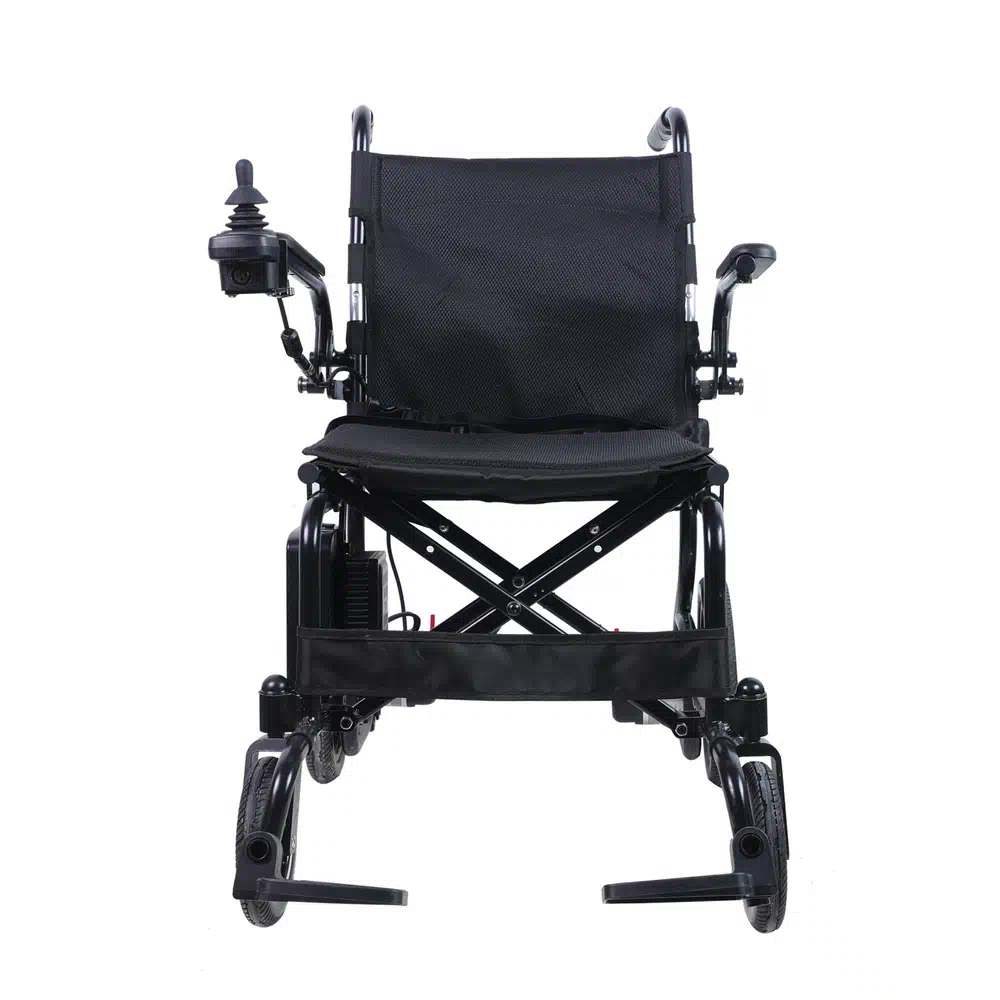
The very skeleton of an electric wheelchair, its frame, dictates its most fundamental characteristics: its weight, its strength, its durability, and even its responsiveness to your command. The choice of material is not a trivial detail; it is the cornerstone upon which the entire user experience is built. For decades, steel and later aluminum have been the mainstays of wheelchair construction. However, the last decade has seen a revolutionary shift with the introduction of carbon fiber, a material born from the aerospace and high-performance racing industries. Let’s explore the two dominant materials in the 2026 market: aluminum and carbon fiber.
The Tale of Two Materials: Aluminum vs. Carbon Fiber
To understand the significance of this choice, it helps to visualize the materials themselves. Aluminum is a familiar metal—light for a metal, certainly, and resistant to rust. It is relatively easy to work with, which helps keep manufacturing costs down. Carbon fiber, on the other hand, is a composite. It is not a metal but a fabric of woven carbon atoms, which is then set in a hard epoxy resin. Imagine threads ten times thinner than a human hair, woven together and then baked into a solid form. This process is more complex and costly, but the result is a material with an extraordinary strength-to-weight ratio.
| Funktion | Aluminum Alloy Frame | Carbon Fiber Frame |
|---|---|---|
| Vægt | Lighter than steel, but significantly heavier than carbon fiber. | Exceptionally lightweight, often reducing total chair weight by 30-50%. |
| Strength & Durability | Strong and durable for everyday use, but can bend or dent on severe impact. | Higher tensile strength than steel; resists fatigue and impact without denting. |
| Dæmpning af vibrationer | Transmits more vibration from the ground to the user, can cause fatigue. | Naturally absorbs and dampens vibrations, providing a much smoother ride. |
| Modstandsdygtighed over for korrosion | Highly resistant to corrosion. | Completely immune to corrosion and rust. |
| Manufacturing Cost | Lower cost to produce, resulting in a more affordable end product. | Higher material and labor costs, leading to a premium price point. |
| Aesthetic & Design | Typically involves welded tubes, which can limit design flexibility. | Can be molded into complex, ergonomic shapes for a sleek, modern look. |
Why Weight is More Than Just a Number
A few kilograms of difference on a spec sheet might seem abstract, but in the lived reality of a wheelchair user, they are monumental. Consider the act of transporting the chair. A heavier aluminum chair might require two people to lift into the trunk of a car, or it might necessitate the installation of a costly vehicle lift. This creates a barrier, a dependence on others or on specialized equipment just to leave the house.
Now, picture a lightweight carbon fiber electric wheelchair. Its reduced weight, often bringing it into the 15-20 kg range (without batteries), can mean the difference between dependence and independence. It can be the difference between asking for help and confidently managing your own mobility. A user or their partner might be able to fold it and lift it into a car unassisted. This single factor dramatically expands the scope of spontaneous travel. The psychological weight that is lifted is often just as significant as the physical one. The world feels more accessible, the horizon broader.
Strength, Durability, and the Smoothness of the Ride
One might assume that a lighter material must be weaker, but this is where the science of carbon fiber is so impressive. Its woven structure distributes stress forces with incredible efficiency. While aluminum will bend or dent under a sharp impact, carbon fiber is more likely to flex and return to its shape. This resilience translates to a product that can better withstand the rigors of daily use and travel (Bansal & Lam, 2021).
There is another, more subtle benefit: vibration damping. Every surface you travel over, from a cobblestone street to a tiled floor, generates vibrations. In an aluminum frame, these vibrations travel up through the frame and into your body. Over the course of a day, this can lead to discomfort and fatigue. Carbon fiber’s composite nature allows it to absorb and dissipate these vibrations, much like the suspension on a high-end car. The result is a noticeably smoother and more comfortable ride, reducing the physical toll of getting around. It is a qualitative difference that is hard to appreciate until you experience it firsthand. The reduction in constant, jarring feedback from the ground can make a long outing a pleasure rather than an ordeal.
Factor 2: The Freedom of Movement – Portability and Travel-Friendliness
A powered mobility device should be a tool of liberation, not a tether. If your electric wheelchair is too cumbersome to take with you, its utility is severely limited. Portability is not just a feature; it is a philosophy of design that prioritizes the user’s freedom to move through the world on their own terms. This factor is about more than just weight; it encompasses the folding mechanism, the folded dimensions, and the crucial considerations for air travel.
The Art of the Fold: Engineering for Simplicity
The process of collapsing a wheelchair for transport should be intuitive and require minimal effort. The best designs on the market in 2026 have moved far beyond the complex, multi-step procedures of the past. Look for chairs that can be folded in a single, fluid motion. Some models collapse sideways like a traditional manual chair, while others fold down into a compact, suitcase-like shape.
Consider the practical implications. Are you in a busy airport, trying to get the chair ready for gate check? Are you at a restaurant, needing to tuck the chair away beside the table? In these moments, a simple, quick-folding mechanism is invaluable. It avoids creating a spectacle and allows you to manage your device with dignity and ease. The engineering behind these mechanisms often involves clever latches and joints designed to be both secure when open and easy to release when closing. Brands that invest in this aspect of design demonstrate a deep understanding of the user’s daily reality. A truly Sammenklappelig elektrisk kørestol should feel less like assembling a puzzle and more like closing a book.
Dimensions and Transport: Will it Fit?
Once folded, where does the chair go? The folded dimensions are just as important as the weight. Before choosing a model, it is a wise mental exercise to measure the trunk of your car, the closets in your home, and even the space on a typical train or bus. A chair that folds into a neat, rectangular block is often far easier to store and transport than one that collapses into an awkward, irregular shape.
This is another area where material choice has a cascading effect. Because carbon fiber can be molded into more integrated and streamlined shapes, designers can create more compact folding geometries compared to the constraints of welding aluminum tubes. The goal is to minimize the chair’s footprint when not in use, making it an unobtrusive companion in your car, home, or hotel room.
Navigating the Skies: Air Travel Compliance
For many, the ultimate expression of freedom is the ability to travel by air. This is where electric wheelchair users often face their biggest hurdles. Navigating airline regulations, particularly concerning batteries, can be a daunting process. However, the best brands for electric wheelchairs have proactively designed their products to make this as seamless as possible.
The key lies in the battery. The International Air Transport Association (IATA) sets the guidelines that most airlines follow. In general, lithium-ion batteries are the focus of these regulations due to their high energy density (IATA, 2024). Here is a simplified breakdown of the current rules:
- Carry-On Batteries: You must be able to remove the battery (or batteries) from the wheelchair. These batteries must then be carried with you into the aircraft cabin.
- Capacity Limits: Typically, you can carry on one battery up to 300 Watt-hours (Wh) or two batteries up to 160 Wh each.
- Protection: The removed batteries must be protected from short circuits. This usually means keeping them in their original retail packaging, a protective pouch, or by taping over the terminals.
A travel-friendly brand will provide batteries that fall within these limits and will offer clear documentation stating the Watt-hour rating. They may even provide a protective travel case for the batteries. When you check in for your flight, the airline staff will ask to see this documentation. Having it ready, along with a chair that is easy to fold and a battery that is simple to remove, transforms a potentially stressful experience into a routine procedure. You simply drive your chair to the gate, remove the battery to take on board, and the airline staff takes the folded frame to be stored as luggage.
Factor 3: The Heart of the Machine – Battery Technology and Endurance
If the frame is the skeleton of an electric wheelchair, the battery is its heart. It is the source of power that determines how far you can go and how long you can be active before needing to recharge. Understanding battery technology is crucial for choosing a device that will not leave you stranded. The conversation in 2026 is dominated by one chemistry: Lithium-ion.
The Lithium-ion Revolution
For years, electric wheelchairs were powered by heavy, cumbersome Sealed Lead-Acid (SLA) batteries. While reliable, they had significant drawbacks: they were extremely heavy, had a limited “cycle life” (the number of times they could be charged and discharged), and suffered from a “memory effect” if not fully discharged before charging.
Lithium-ion (Li-ion) batteries have changed everything. They are the same technology that powers your smartphone and your laptop, and their advantages are profound:
- High Energy Density: A Li-ion battery can store significantly more energy than an SLA battery of the same size and weight. This means a lighter battery can provide a longer range.
- Lighter Weight: This is a huge factor. A Li-ion battery pack for a wheelchair can be less than half the weight of an equivalent SLA pack, contributing directly to the overall portability of the chair.
- Longer Cycle Life: A well-maintained Li-ion battery can last for many more charge-discharge cycles than an SLA battery, making it a better long-term investment.
- No Memory Effect: You can top up a Li-ion battery at any time without damaging its long-term capacity.
- Faster Charging: Li-ion batteries can generally be charged much faster than their SLA counterparts.
Given these overwhelming benefits, any brand positioning itself as a top contender in 2026 should be exclusively using high-quality, certified Li-ion batteries.
Understanding Range: More Than Just a Number
Manufacturers will advertise a maximum range for their wheelchairs, such as “up to 20 km on a single charge.” It is vital to understand that this number is an ideal-case scenario. The actual range you experience will depend on a multitude of real-world factors. Thinking critically about these variables will help you choose a chair with an appropriate battery capacity for your needs.
| Factor Influencing Range | Impact on Battery Life | Real-World Example |
|---|---|---|
| User Weight | Higher weight requires more energy to move, reducing range. | A 100 kg user will get less range than a 60 kg user on the same chair. |
| Terrain | Hills, ramps, and soft surfaces (grass, carpet) demand more power. | Constantly driving on plush carpeting will drain the battery faster than on a smooth tile floor. |
| Hastighed | Driving at top speed continuously consumes more energy than a moderate pace. | Similar to a car, cruising at a steady, medium speed is more efficient. |
| Tire Pressure | Under-inflated tires increase rolling resistance, draining the battery. | Regularly checking and maintaining proper tire pressure is like a free range boost. |
| Temperature | Extreme cold or heat can temporarily reduce a battery’s effective capacity. | On a very cold winter day, you might notice your total range is slightly less than usual. |
| Stop-and-Go Driving | Frequent starting and stopping uses more power than continuous movement. | Navigating a crowded store requires more energy than a long, straight sidewalk. |
So, how do you use this information? Do not just accept the advertised range. Consider your own life. Do you live in a hilly area? Do you plan to use the chair on grass at the park? Are your days filled with long-distance travel or short trips around the house? Be realistic about your usage patterns and choose a model with a battery capacity that gives you a comfortable buffer, so you are not left with “range anxiety” at the end of the day. Some brands offer the option of a larger battery or the ability to easily carry a spare, which can be an excellent solution for power users.
Battery Management and Safety
A quality battery is more than just a collection of cells. It includes a sophisticated electronic brain called a Battery Management System (BMS). The BMS is a crucial safety and longevity feature. It constantly monitors the battery, protecting it from:
- Over-charging: Preventing damage from being left on the charger too long.
- Over-discharging: Cutting off power before the battery is drained to a level that would cause permanent damage.
- Over-current: Protecting against short circuits.
- Over-heating: Monitoring temperature to prevent dangerous conditions.
When evaluating the best brand for electric wheelchairs, ask about the BMS. A reputable manufacturer like kulfiber elektrisk kørestol mærke will use certified batteries with advanced BMS circuits. This is not a corner that should ever be cut. It is a fundamental component of a safe, reliable, and long-lasting mobility device (Li et al., 2018).
Factor 4: The Driving Force – Motor Power and Performance Dynamics
The motors are the muscles of your electric wheelchair. They translate the battery’s stored energy into motion. The type, power, and configuration of the motors will define how the chair feels to drive—its responsiveness, its climbing ability, and its maneuverability in tight spaces.
The Heart of the Drive: Brushed vs. Brushless Motors
The motor technology inside your wheelchair has a significant impact on performance and maintenance. The two main types are brushed and brushless DC motors.
- Brushed Motors: This is an older, simpler technology. They use physical carbon “brushes” to make contact with the motor’s commutator to create rotation. They are less expensive to manufacture but have several disadvantages. The brushes wear down over time and need to be replaced, creating a maintenance requirement. They are also less efficient, meaning some of the battery’s energy is lost as heat instead of being converted into motion.
- Børsteløse motorer: This is the modern standard for high-performance electric wheelchairs. Instead of physical brushes, they use an electronic controller to switch the direction of the magnetic field. This design is more complex but offers major benefits. They are significantly more efficient (often over 85-90% efficient), which translates to a longer range from the same battery. They have a much longer lifespan with virtually no maintenance, as there are no brushes to wear out. They also offer a better power-to-weight ratio and can produce higher torque, especially at low speeds.
For a premium, reliable experience in 2026, a brushless motor system is the clear choice. Any brand vying for the title of “best” will have made this technology a standard feature in their products. The increased efficiency and lack of maintenance are simply too important to ignore.
Power, Torque, and What They Mean for You
Motor power is often rated in Watts (W). You might see models with two motors, each rated at 180W, 200W, or 250W. While a higher wattage generally means a more powerful chair, the number itself does not tell the whole story. You also need to consider torque.
Think of it this way:
- Power (Watts) is related to the chair’s top speed. A higher wattage can help the chair maintain speed, especially when going uphill.
- Torque is the rotational force of the motor. It is what gets you moving from a standstill and what gives you the “oomph” to climb a ramp or navigate over an obstacle like a small threshold or a grassy lawn.
A well-designed wheelchair has a good balance of both. Brushless motors are particularly good at delivering high torque even at very low speeds, which is exactly what you need for controlled maneuvering and climbing. When you are trying to navigate a steep accessibility ramp, it is torque, not top speed, that matters most. A brand that understands this will pair their motors with a gearbox that is optimized for real-world conditions, prioritizing strong, steady climbing power and responsive low-speed control over an impractically high top speed.
The Brains of the Operation: The Controller
The joystick and its associated controller are your interface with the chair. This is where the machine translates your intention into action. A high-quality controller offers a smooth and intuitive driving experience.
- Proportional Control: The chair’s speed and turn rate should be proportional to how far you push the joystick. A small push should result in a slow, gentle movement, perfect for navigating a crowded room. A full push should deliver maximum speed.
- Programmability: Advanced controllers allow for customization. A technician can adjust parameters like the maximum speed, acceleration rate, and joystick sensitivity to perfectly match the user’s physical abilities and preferences. This is a critical feature for users with specific motor control challenges.
- Responsiveness: There should be no perceptible lag between your command and the chair’s response. The electromagnetic brakes should engage smoothly and automatically the moment you let go of the joystick, holding you securely in place, even on a slope.
When you test-drive a wheelchair, pay close attention to how the controller feels. Does it feel natural? Can you easily make small, precise adjustments? The quality of the controller is a hallmark of a top-tier brand. It shows an attention to detail that extends beyond the major components to the subtleties of the user interface.
Factor 5: The Human Element – Aligning a Wheelchair with Your Lifestyle
We have now examined the hardware: the frame, the battery, and the motors. But a wheelchair is more than the sum of its parts. The final, and arguably most important, factor is how the entire package integrates with the fabric of your life. The best brand for electric wheelchairs is the one that has thought most deeply about the human being who will be using their product. This involves creating different models for different lives and offering the customization needed to achieve a perfect fit.
What is Your Mobility Profile?
Before you can choose the right chair, you must first understand your own needs. It can be helpful to think in terms of “mobility profiles.” Which of these sounds most like you?
- The Indoor Navigator: Your primary use will be within your home, an office, or a shopping center. Your priorities are a tight turning radius for navigating narrow hallways and doorways, non-marking tires, and a compact frame. High top speed and long-range are less important than supreme maneuverability. An indoor electric wheelchair with a small footprint would be ideal.
- The Urban Explorer: You live in a city and want a chair that can handle a full day of activity: commuting on public transport, navigating sidewalks and curb cuts, and visiting shops and cafes. Your priorities are a balance of good range, a reasonably compact and foldable design for getting into taxis or restaurants, and a smooth ride to handle varied pavement surfaces.
- The Suburban Adventurer: You need a versatile chair that is equally at home on a trip to the grocery store, a walk with the family in the park, or a day out at a festival. You need a robust build, decent power for grassy areas or gravel paths, and a good battery range. Portability for fitting it into a car is essential.
- The Global Traveler: Your passion is travel, and you need a chair that is your reliable passport to the world. Your absolute top priorities are a lightweight, easily foldable design, and airline-compliant batteries. Durability to withstand the handling of baggage crews is also a major consideration. A state-of-the-art carbon fiber folding wheelchair is almost certainly the best choice for this profile.
By identifying your primary profile, you can begin to prioritize the features we have discussed. The Global Traveler will place the highest value on Factor 1 (lightweight material) and Factor 2 (portability), while the Indoor Navigator will focus more on motor control and turning radius (Factor 4).
The Importance of a Proper Fit: Seating and Ergonomics
You will be spending many hours in your wheelchair, and proper seating is not a luxury—it is a medical necessity. A poor fit can lead to pressure sores, postural problems, and chronic pain. A top-tier brand understands this and offers a range of options to ensure a correct ergonomic fit.
Look for adjustability in these key areas:
- Seat Width and Depth: The seat should be wide enough to be comfortable but not so wide that you lack support. The depth should support your thighs without pressing into the back of your knees.
- Backrest Height and Angle: The backrest should provide adequate support for your torso. Some users may need a higher backrest, while others prefer a lower one for greater freedom of movement. The ability to recline the backrest can also significantly improve comfort.
- Armrest Height and Position: Armrests should be set at a height that allows your shoulders to be relaxed. They should not force your shoulders up or let them slump down.
- Footplate Height: Your feet should be flat on the footplate with your thighs approximately parallel to the ground. Dangling feet or knees pushed up too high can cause discomfort and circulation issues.
Beyond adjustability, consider the cushion itself. The quality of the foam or gel in the cushion is critical for comfort and pressure distribution. Many of the best brands partner with specialized seating companies to offer high-quality, medical-grade cushions as options. Investing in proper seating is one of the most important things you can do for your long-term health and comfort (Stockton & Minkel, 2021).
Customization and After-Sales Support
Your needs may change over time, and your wheelchair should be able to adapt. A great brand offers a range of accessories that allow you to tailor the chair to your specific activities. This could include things like a cup holder, a phone mount, a storage bag, an attendant control bracket (allowing a caregiver to drive the chair from behind), or specialized joystick handles.
Finally, consider the relationship with the brand after the purchase. What does their warranty cover? How easy is it to get replacement parts like tires or batteries? Do they have a responsive customer service team that can answer your questions? A company’s commitment to after-sales support is a strong indicator of their confidence in their product and their dedication to their customers. A wheelchair is a significant investment, and you want to partner with a company that will be there to support you for the life of the product.
Ofte stillede spørgsmål (FAQ)
1. How much does a good electric wheelchair cost in 2026? The price varies widely based on materials and features. A basic aluminum frame model might start around $2,000-$3,500. High-performance, lightweight carbon fiber models, known for their portability and durability, typically range from $4,000 to $7,000 or more, reflecting the advanced materials and engineering involved.
2. Is a carbon fiber wheelchair really worth the extra cost? For many users, yes. If portability, ease of transport, and independent travel are high priorities, the significant weight reduction and enhanced durability of carbon fiber can be life-changing. The smoother ride and reduced fatigue from vibration damping are also major benefits. It is an investment in independence and comfort.
3. How long should an electric wheelchair battery last before needing replacement? A high-quality Lithium-ion battery, if properly cared for, should last between 3 to 5 years or approximately 500-1000 full charge cycles. To maximize its lifespan, avoid deep discharges, store it in a temperature-controlled environment, and follow the manufacturer’s charging guidelines.
4. Can I take my electric wheelchair on a bus or train? In most developed countries, public transit systems like buses and trains are designed to be accessible. Most foldable electric wheelchairs will fit within the designated spaces. It is always a good idea to check the specific accessibility guidelines of your local transit authority, but modern, compact chairs are designed with public transport in mind.
5. What is the most important feature to look for when choosing the best brand for electric wheelchairs? There is no single “most important” feature for everyone. The most critical step is to honestly assess your own lifestyle and physical needs (your “Mobility Profile”). This self-knowledge will guide you to prioritize the right factors, whether that is ultra-lightweight portability for travel, a powerful motor for outdoor terrain, or a tight turning radius for home use. The best brand is the one that best matches your personal priorities.
A Concluding Thought on Personal Empowerment
The journey to find the right electric wheelchair is a deeply personal one. It is a process of introspection and education. By understanding the core principles of what makes a mobility device truly effective—its material science, its engineering, its power source, and its ergonomic design—you arm yourself with the ability to see past marketing and make a choice rooted in knowledge.
There is no single “best brand for electric wheelchairs” that can be named, because the true measure of a brand’s worth is how well its product empowers a specific individual. The best chair for your neighbor may not be the best chair for you. Your life, your environment, your ambitions, and your body are the criteria that matter. The ultimate goal is to find a device that fades into the background, a silent and reliable partner that enables you to live the life you choose, with greater freedom, dignity, and joy. This guide has aimed to give you the framework for that search. The final decision rests with you, the expert on your own life.
Referencer
Bansal, G., & Lam, T. (2021). Materials for lightweighting applications in the transportation industry. In S. Rana & R. Fangueiro (Eds.), Advanced composite materials for aerospace engineering (pp. 305-324). Woodhead Publishing.
International Air Transport Association. (2024). Dangerous goods regulations (DGR). IATA.
Li, W., Muneer, T., & Hadžikadić, M. (2018). Battery energy storage systems: Technology, integration, and market aspects. In The-Business-of-Clean-Energy (pp. 145-171).
Stockton, L., & Minkel, J. L. (2021). Seating and mobility for people with physical disabilities. In D. Dirette & S. Gutman (Eds.), Occupational therapy for physical dysfunction (8th ed., pp. 496-527). F.A. Davis Company.
Note: Some sources may require a subscription or purchase to access the full text.