.png)
.png)

An Expert Guide to the 2025 Carbon Fiber Wheelchair for Sale: 7 Things You Must Check
December 18, 2025
Abstract
The proliferation of carbon fiber composite materials has instigated a paradigm shift within the assistive technology sector, particularly concerning personal mobility devices. This analysis examines the contemporary market for carbon fiber wheelchairs, focusing on the critical factors that prospective users and purchasers must evaluate. It moves beyond a superficial appreciation of the material’s lauded properties—its exceptional strength-to-weight ratio and durability—to a more nuanced exploration of its application in wheelchair design and manufacturing. The investigation delineates the distinctions between material grades, construction methodologies, and their subsequent impact on performance, longevity, and cost. Furthermore, it considers the symbiotic relationship between the user and the device, emphasizing the profound importance of ergonomic customization and precise fit in facilitating human capability and flourishing. By dissecting aspects from frame configuration and portability to the intricacies of power components and after-sales support, this guide provides a comprehensive framework for making an informed and empowering decision when considering a carbon fiber wheelchair for sale in 2025.
Key Takeaways
- Assess the carbon fiber grade and frame construction to ensure optimal durability and performance.
- Prioritize a professional fitting; a custom-fit chair prevents injury and maximizes function.
- Differentiate between total weight and transport weight to match your daily lifting capacity.
- For electric models, compare brushless motors and lithium battery specifications for efficiency.
- When reviewing a carbon fiber wheelchair for sale, scrutinize the warranty and after-sales support.
- Always test drive a potential wheelchair in environments you frequent daily.
Table of Contents
- Deconstructing the Frame: Material Quality and Manufacturing Process
- The Ergonomics of Freedom: Customization and Fit
- Portability Reimagined: Weight, Folding Mechanisms, and Transport
- The Power Component: Motors, Batteries, and Control Systems (For Electric Models)
- Performance and Ride Quality: Wheels, Suspension, and Components
- The Investment: Navigating Price, Warranty, and After-Sales Support
- The Final Check: Test Drives, User Reviews, and Professional Consultation
- Frequently Asked Questions (FAQ)
- Conclusion
- References
Deconstructing the Frame: Material Quality and Manufacturing Process
The decision to acquire a new wheelchair represents a significant juncture in a person’s life, a moment where technology and human aspiration intersect. When the material in question is carbon fiber, the conversation often becomes animated by terms like “lightweight” and “strong.” Yet, these descriptors, while accurate, only skim the surface of a much deeper reality. To truly understand the value proposition of a modern carbon fiber wheelchair, one must adopt the perspective of a craftsman or an engineer, looking past the glossy finish to the very essence of the material and the methods used to shape it. It is in this granular detail that the true potential for enhanced mobility and personal freedom is unlocked.
The Essence of Carbon Fiber: Why It Matters
At its core, what we call “carbon fiber” is more accurately termed a carbon fiber reinforced polymer (CFRP). Imagine incredibly thin, yet immensely strong, crystalline filaments of carbon—thousands of them, each thinner than a human hair. These filaments are twisted together to form a yarn, which is then woven into a fabric-like sheet. This fabric is the soul of the structure, but it cannot function alone. It requires a body, a matrix to hold it together. This is provided by a polymer resin, typically epoxy, which is impregnated into the carbon fabric. The combined material is then cured under intense heat and pressure, solidifying into a unified, rigid component.
The result of this intricate process is a material with a property profile that seems almost paradoxical. It possesses a tensile strength that can be five times that of steel, meaning it can withstand immense pulling forces before breaking. Simultaneously, it boasts a stiffness, or modulus, that ensures the frame does not flex or bend inefficiently under the user’s weight and propulsive force. Every push of the handrims translates more directly into forward motion, without energy being wasted in frame deformation. This is a stark contrast to some aluminum or steel frames, where a certain amount of “whip” or flex is palpable, representing lost energy.
Yet, its most celebrated quality is its low density. A carbon fiber frame can be up to 50% lighter than an equivalent aluminum frame and dramatically lighter than steel. This reduction in mass is not merely a convenience; it is a profound change in the user’s relationship with their environment. It means less energy expended per push, leading to reduced fatigue over a day. It means the chair is easier to lift into a car, to carry up a flight of stairs, or to navigate over challenging obstacles. It transforms a daily struggle against inertia into a more fluid and manageable experience. The search for a carbon fiber wheelchair for sale is, in essence, a search for this liberation from weight.
Not All Carbon Fiber is Created Equal: Understanding Grades and Weaves
To assume all carbon fiber is the same is akin to believing all steel or all wood is identical. The performance characteristics of a carbon fiber frame are determined by two primary factors: the grade of the carbon fibers themselves and the pattern in which they are woven.
Carbon fibers are categorized into grades based on their tensile modulus (stiffness) and tensile strength. For wheelchair applications, the most common are Standard Modulus (SM) and Intermediate Modulus (IM). While higher grades like High Modulus (HM) exist, they often become too brittle for the dynamic stresses a wheelchair endures.
| Material | Density (g/cm³) | Tensile Strength (MPa) | Tensile Modulus (GPa) | Key Characteristic |
|---|---|---|---|---|
| Steel (4130) | 7.85 | 900 | 205 | High strength, but very heavy |
| Aluminum (6061) | 2.70 | 310 | 69 | Good balance, but less strong |
| Carbon Fiber (Standard) | 1.78 | 3,500 | 230 | Very high strength, lightweight |
| Carbon Fiber (Intermediate) | 1.80 | 5,500 | 290 | Exceptionally strong and stiff |
As the table illustrates, even standard-grade carbon fiber dramatically outperforms traditional metals. A manufacturer’s choice of fiber grade directly influences the final product’s weight, rigidity, and, importantly, its cost. Premium chairs may utilize higher-grade, more expensive fibers in critical areas to maximize stiffness without adding weight.
The weave pattern also plays a vital role. The two most common weaves are the “plain” weave, with its simple over-under checkerboard pattern, and the “twill” weave, which has a diagonal pattern. A twill weave is generally more pliable and conformable, making it easier to use in complex molds. It is also slightly more resistant to tearing. A plain weave provides excellent stability. Often, you will see a combination of different weaves and even unidirectional (non-woven) fibers layered in specific orientations within a single frame. This layup schedule is a closely guarded secret of manufacturers, as it is the “recipe” that dictates how the frame handles forces, providing stiffness where needed (like along the base) and a small degree of compliance elsewhere for comfort. When you see a beautiful, intricate weave pattern on a high-end carbon fiber wheelchair for sale, you are not just looking at an aesthetic choice; you are looking at a visible manifestation of its underlying engineering philosophy.
The Art of Manufacturing: Monocoque vs. Tube-to-Tube Construction
The final piece of the frame puzzle is how these carefully selected materials are brought together. In the world of high-performance carbon fiber, two dominant methods prevail: monocoque and tube-to-tube.
Monocoque construction, borrowed from aerospace and Formula 1 racing, involves creating the frame as a single, hollow piece within a mold. Layers of carbon fiber pre-impregnated with resin (known as “pre-preg”) are meticulously placed into the mold. An inflatable bladder is placed inside, and the mold is sealed and heated. The bladder inflates, pressing the carbon layers against the mold’s inner surface, squeezing out any excess resin and eliminating voids. This process creates an incredibly light and stiff structure with no joints, which are potential points of weakness or flex. The flowing, organic shapes of many modern carbon fiber chairs are a direct result of this molding process. However, it is an expensive and labor-intensive method, as a unique and costly mold is required for each frame size.
Tube-to-tube construction is more analogous to traditional frame building. Individual carbon fiber tubes are molded separately and then precisely cut, mitered, and bonded together, often using carbon fiber wraps at the joints. This method allows for a much greater degree of customization, as frame geometry can be altered without creating an entirely new mold. It can be more cost-effective for bespoke or small-batch production. While a well-executed tube-to-tube frame can be exceptionally strong and light, the joints can introduce a minuscule amount of flex compared to a true monocoque design.
When examining a carbon fiber wheelchair for sale, understanding its construction method provides insight into its design priorities. A monocoque frame, like those offered by some premium manufacturers, prioritizes ultimate lightweight rigidity and aesthetic integration. A tube-to-tube frame may signal a focus on customizability and tailored geometry. Neither is inherently superior; they simply represent different approaches to achieving the same goal of a high-performance mobility tool.
The Ergonomics of Freedom: Customization and Fit
The allure of a carbon fiber wheelchair often begins with its material properties, but its true value is only realized when the frame becomes a seamless extension of the user’s body. The relationship between a person and their wheelchair is one of profound intimacy, a daily partnership in navigating the world. A poorly configured chair is not just uncomfortable; it is an impediment, a source of secondary health complications and a barrier to the full expression of one’s capabilities. In contrast, a meticulously fitted and customized chair becomes an enabler, a tool that fades into the background, allowing the user to focus not on the act of moving, but on the destination and the experience. This principle resonates with the capabilities approach championed by philosopher Martha Nussbaum, which posits that a just society enables each individual to achieve their potential for a flourishing life. A well-designed wheelchair is a fundamental tool for such flourishing.
The Fallacy of “One-Size-Fits-All”
In the context of complex rehabilitation technology, the concept of “one-size-fits-all” is not merely a fallacy; it is a danger. The human body is a landscape of unique contours, proportions, and functional needs. Forcing it into a standardized piece of equipment can have a cascade of negative consequences. A seat that is too wide fails to provide adequate pelvic support, leading to postural instability and inefficient propulsion. A seat that is too narrow creates pressure points, increasing the risk of skin breakdown and pressure sores, a serious and potentially life-threatening complication (Sprigle et al., 2003).
Similarly, incorrect seat depth can place undue pressure on the back of the knees, impeding circulation, or fail to support the femurs, leading to a slouched posture. An inappropriate backrest height or angle can cause back pain, fatigue, and even long-term spinal deformity. The repetitive act of propelling a poorly configured chair can lead to repetitive strain injuries in the wrists, elbows, and shoulders, a common ailment among manual wheelchair users that can severely compromise their independence. The pursuit of a custom-fit chair when searching for a carbon fiber wheelchair for sale is not a luxury; it is a medical necessity and a prerequisite for long-term health and function.
Key Measurements for a Perfect Union
Achieving this perfect union between user and chair begins with a series of precise measurements. While this process should ideally be guided by a qualified seating specialist, such as an occupational or physical therapist, understanding the key dimensions empowers the user to be an active participant in their own fitting.
- Seat Width: Measured at the widest point of the user’s hips or thighs while seated, with an additional one to two inches of space to accommodate clothing and slight position changes. The goal is a snug fit that provides lateral support without constriction.
- Seat Depth: Measured from the back of the user’s pelvis to the back of their knee, and then subtracting about two inches. This prevents the front edge of the seat from pressing into the popliteal fossa (the sensitive area behind the knee).
- Seat-to-Floor Height: This is a multi-faceted measurement. For foot-propellers, it must be low enough to allow the feet to comfortably reach the ground. For those who primarily use handrims, the height influences the position of the shoulders relative to the rear axle, impacting pushing efficiency. It also determines the ability to get under tables and desks.
- Backrest Height: This depends heavily on the user’s level of trunk control and functional needs. A lower backrest allows for greater freedom of movement for the upper body, essential for active users. A higher backrest provides more support for individuals with reduced trunk stability.
- Footrest Length / Hanger Angle: This determines the position of the feet and lower legs. The length must support the foot without causing the knee to be pushed up too high. The hanger angle (the angle of the front rigging) affects the chair’s overall footprint and maneuverability. Tighter angles create a more compact, maneuverable chair.
These are just the foundational measurements. A comprehensive evaluation will also consider seat slope (or “dump”), which is the difference in height between the front and rear of the seat, affecting pelvic stability, and the specific needs for cushions and other positioning aids.
Adjustability as an Extension of Self
While initial measurements are vital, a truly great wheelchair offers a degree of adjustability that allows it to evolve with the user. Needs can change over time due to changes in body weight, functional ability, or even the types of activities being pursued. Adjustability ensures the chair remains an optimal tool throughout these changes.
The single most important point of adjustment on a high-performance manual wheelchair is the rear axle position, which determines the chair’s center of gravity (COG). Moving the axle forward makes the chair more “tippy” but dramatically easier to push and to pop a wheelie over obstacles. It reduces the rolling resistance and the amount of weight on the front casters. Moving it backward increases stability but requires more effort to propel. Finding the sweet spot—the most forward position the user can safely manage—is a transformative process. It is the key to unlocking the effortless, responsive ride that active users seek. When looking at any carbon fiber wheelchair for sale, the range and precision of its COG adjustment should be a primary point of inquiry.
Other critical points of adjustability include backrest angle and tension. Tension-adjustable upholstery allows the backrest to be contoured to the user’s spine, providing customized support where it is needed most. Adjustable armrests, side guards, and footplates further refine the fit, ensuring the chair supports the user in a healthy, functional posture for any activity they wish to undertake. This capacity for fine-tuning is what elevates a wheelchair from a mere piece of durable medical equipment to a personalized instrument of empowerment.
Portability Reimagined: Weight, Folding Mechanisms, and Transport
The concept of portability is central to the appeal of a carbon fiber wheelchair. It speaks to a desire for spontaneity, for the ability to go where you want, when you want, without the logistical burden that so often accompanies mobility equipment. Portability is not a single feature but a constellation of design choices, from the raw weight of the frame to the elegance of its folding mechanism. For many, the ultimate test of a chair’s portability is the ease with which it can be stowed in a vehicle or taken on a plane, transforming the world from a series of accessibility challenges into a landscape of possibilities.
The Physics of Lightness: Understanding Total vs. Transport Weight
When manufacturers and suppliers list the weight of a wheelchair, it is imperative to understand what is being included in that number. There are typically two key figures to consider: total weight and transport weight.
- Total Weight (or “Configured Weight”) refers to the weight of the entire chair as it is used daily. This includes the frame, rear wheels, casters, footrest, armrests, brakes, and often a standard cushion.
- Transport Weight (or “Frame Weight”) is the weight of the main frame after all easily removable components, such as the rear wheels and cushion, have been taken off. This is the figure that represents the heaviest single piece you will need to lift into a car.
This distinction is far from trivial. On a rigid-frame manual wheelchair, the quick-release rear wheels can account for a significant portion of the total weight. For example, a chair with a total weight of 22 lbs (10 kg) might have a transport weight of only 14 lbs (6.4 kg). That 8 lb difference is the equivalent of a gallon of water—a substantial reduction when lifting an object at an awkward angle into a car trunk. The lightweight nature of carbon fiber has a compounding effect here; not only is the frame lighter, but high-end carbon fiber wheels can also be significantly lighter than their aluminum counterparts, reducing both the total and the lifting weight.
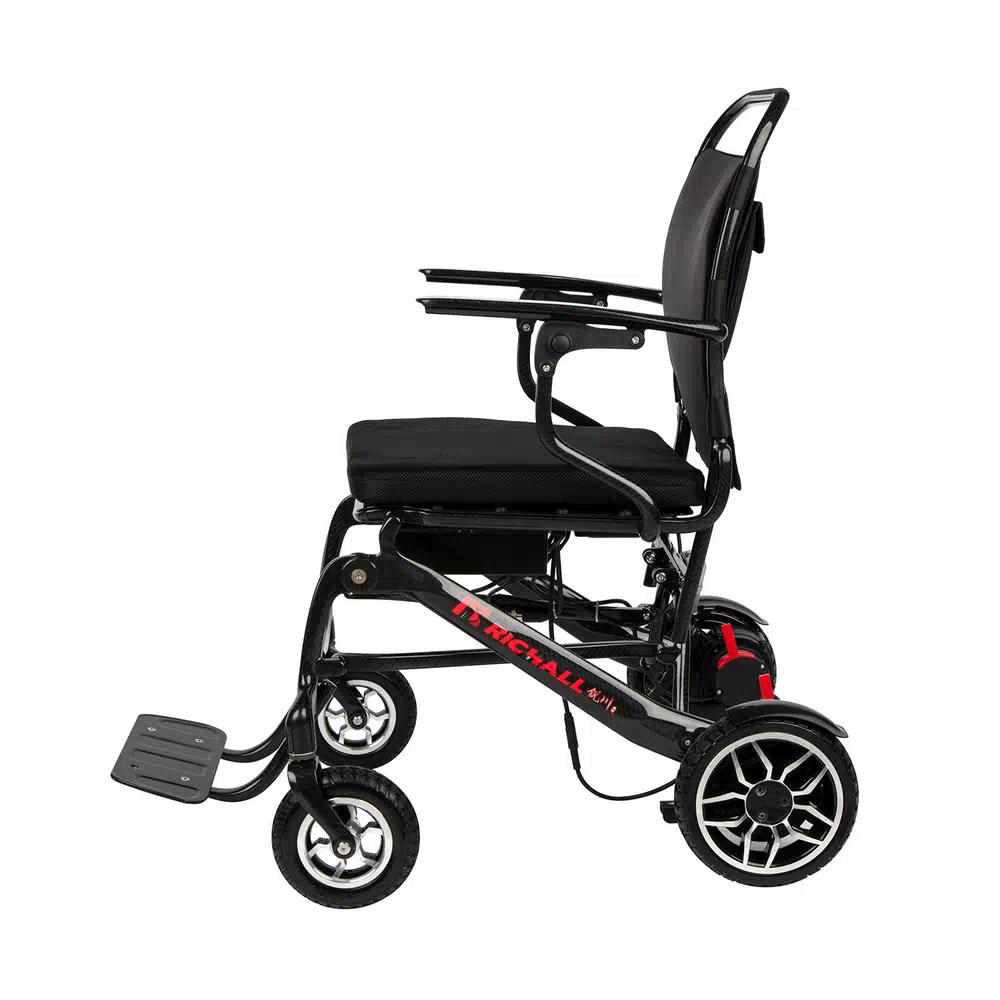
For folding chairs, especially electric models, the difference can be even more critical. A folding carbon fiber wheelchair for sale might weigh 50 lbs (22.7 kg) in total, but if the batteries can be easily removed, the lifting weight might drop to 42 lbs (19 kg). This is where companies like carbon fiber electric wheelchairs supplier focus their design efforts, creating folding electric models where every component is optimized for weight reduction. When evaluating any carbon fiber wheelchair for sale, it is essential to ask for both the total and transport weights to get a realistic picture of the day-to-day lifting requirements.
| Wheelchair Type/Model | Typical Material | Approx. Transport Weight | Approx. Total Weight | Portability Focus |
|---|---|---|---|---|
| Standard Hospital Wheelchair | Steel | ~35 lbs / 16 kg | ~45 lbs / 20.4 kg | Durability over portability |
| Standard Folding Wheelchair | Aluminum | ~25 lbs / 11.3 kg | ~35 lbs / 16 kg | Basic portability |
| Ultralight Rigid Wheelchair | Aluminum | ~12 lbs / 5.4 kg | ~20 lbs / 9.1 kg | Performance and low lift weight |
| Ultralight Rigid Wheelchair | Carbon Fiber | ~9 lbs / 4.1 kg | ~16 lbs / 7.3 kg | Ultimate performance and lightness |
| Folding Electric Wheelchair | Carbon/Aluminum | ~40 lbs / 18.1 kg | ~50 lbs / 22.7 kg | Powered convenience, foldable |
The Mechanics of Folding: Rigid vs. Folding Frames
The choice between a rigid and a folding frame is one of the most fundamental decisions in selecting a manual wheelchair. Each architecture offers a distinct approach to portability.
A rigid frame does not fold side-to-side. Its portability comes from its minimalist construction and the ability to quickly remove components. To store it in a car, the user typically pops off the quick-release rear wheels and folds down the backrest. The resulting L-shaped frame is incredibly compact and light, often easily lifted across the body onto the passenger seat or into the back. The primary benefit of a rigid frame is its efficiency. With no folding mechanism, the frame is stiffer, and virtually 100% of the user’s propulsive energy is transferred to the wheels. This is why rigid frames are the universal choice for high-performance activities and for experienced users who prioritize pushing efficiency above all else.
A folding frame, by contrast, collapses like a clamshell via a cross-brace mechanism under the seat. This is incredibly convenient for storage in tight spaces or for caregivers who assist with transport. However, this convenience traditionally comes at a cost. The cross-brace adds weight and introduces a point of flex into the system, slightly dampening propulsion efficiency. For decades, this trade-off was stark. However, modern engineering and the use of carbon fiber are blurring these lines. Advanced folding mechanisms and the inherent stiffness of carbon fiber have led to the creation of folding chairs that feel nearly as responsive as their rigid counterparts, offering a “best of both worlds” solution for many users. When considering a folding carbon fiber wheelchair for sale, pay close attention to the design of the cross-brace and locking mechanism, as this is where the chair’s rigidity is won or lost.
Beyond the Car Trunk: Air Travel and Accessibility
For many, true freedom of movement means the ability to travel long distances. Air travel with a wheelchair, particularly a powered one, requires careful planning. Airlines have strict regulations regarding lithium-ion batteries, which are classified as dangerous goods.
For manual chairs, the process is relatively straightforward. The chair is typically gate-checked, meaning the user can ride it right up to the door of the aircraft.
For electric wheelchairs, the battery is the key consideration. According to the International Air Transport Association (IATA) guidelines, which most airlines follow, you can typically travel with lithium-ion batteries for mobility devices. If the battery is non-removable, it must be securely attached and the chair’s power switched off. If the batteries are removable, they must be taken off, protected from short circuits (e.g., by taping the terminals), and carried into the cabin. There are also limits on battery capacity, typically up to 300 Watt-hours (Wh) for a single battery or two batteries of up to 160 Wh each. Many manufacturers of folding power wheelchairs, understanding this need, design their products with one or two smaller, easily removable, airline-compliant batteries. The FAQ section from one manufacturer notes that while their products are designed to be plane-friendly, regulations can vary by airline, and consulting with the carrier beforehand is always wise . A travel-friendly design is a hallmark of a well-thought-out portable wheelchair.
The Power Component: Motors, Batteries, and Control Systems (For Electric Models)
While the carbon fiber frame provides the lightweight skeleton, in an electric wheelchair, the power system constitutes its heart and brain. This system—comprising the motors, batteries, and controller—determines the chair’s range, power, responsiveness, and overall user experience. The advent of lighter, more efficient power components has been just as revolutionary as the advances in frame materials, enabling the creation of folding power wheelchairs that are both potent and portable. A deep understanding of these components is crucial when evaluating an electric carbon fiber wheelchair for sale.
The Heart of the Machine: Brushless vs. Brushed Motors
The motors are responsible for converting electrical energy from the batteries into the mechanical force that turns the wheels. For many years, the standard for power wheelchairs was the brushed DC motor. These motors work by using carbon “brushes” to make mechanical contact with a commutator, delivering power to the motor’s windings. While reliable, brushed motors have inherent limitations. The friction of the brushes creates heat, wastes energy, and causes the brushes themselves to wear out over time, requiring periodic replacement.
The modern standard for high-quality electric wheelchairs is the brushless DC motor. As the name implies, these motors do not use brushes. Instead, they use an electronic controller to switch the direction of the current in the windings. This design offers numerous advantages:
- Higher Efficiency: With no energy lost to friction from brushes, brushless motors can be 85-90% efficient, compared to 75-80% for brushed motors. This means more of the battery’s power is converted into motion, resulting in a longer range.
- Longer Lifespan: The absence of brushes, the primary wear component, means brushless motors have a significantly longer operational life and require virtually no maintenance.
- Quieter Operation: The lack of mechanical contact makes brushless motors noticeably quieter, a significant quality-of-life improvement.
- Higher Power-to-Weight Ratio: For a given power output, a brushless motor can be smaller and lighter than a brushed equivalent, which is a critical advantage in designing a lightweight electric wheelchair.
When you see a manufacturer like RICHALL Medical specifying “Double motor (ABLDC Motor)” for their chairs, the “BLDC” stands for Brushless DC carbon fiber electric wheelchairs supplier. This is a clear indicator of a modern, high-performance design. The power of these motors, typically rated in watts (e.g., 200W or 250W per motor), dictates the chair’s ability to tackle challenging terrain like steep ramps, thick carpet, or grassy lawns.
Fueling Your Journey: Lithium-Ion Battery Technology
The battery is the fuel tank of an electric wheelchair. The shift from traditional lead-acid batteries to lithium-ion technology has been the single greatest enabler of the portable power chair. Lead-acid batteries are incredibly heavy, making them unsuitable for a chair that needs to be lifted and transported regularly.
Lithium-ion (Li-ion) batteries, the same technology found in your smartphone and laptop, offer a much higher energy density. This means they can store more energy in a smaller, lighter package. A typical Li-ion battery pack for a folding power chair might weigh only 4-6 lbs (1.8-2.7 kg), while a lead-acid battery with similar capacity could weigh over 30 lbs (13.6 kg).
When evaluating the battery on a carbon fiber wheelchair for sale, there are several key specifications to consider:
- Voltage (V): Most portable power chairs use a 24V system, which provides a good balance of power and efficiency.
- Capacity (Ah): Measured in Amp-hours, this indicates how much charge the battery can hold. A higher Ah rating generally translates to a longer travel range. A typical specification might be 10Ah or 12Ah. Some chairs allow for two batteries to be used simultaneously, doubling the range.
- Range (miles/km): This is the manufacturer’s estimate of how far the chair can travel on a single charge. It’s important to view this as an ideal-condition figure. Actual range will be affected by user weight, terrain, speed, and even temperature.
- Watt-hours (Wh): This figure (Voltage x Amp-hours) is crucial for air travel regulations, as discussed previously.
A critical, though often unstated, component of any good lithium-ion battery pack is the Battery Management System (BMS). This is an intelligent circuit board built into the battery that protects it from overcharging, over-discharging, and overheating. The BMS ensures both the safety and the long-term health of the battery, maximizing its lifespan.
The User Interface: Joystick Controllers and Advanced Features
The joystick controller is the command center of the wheelchair, the primary interface between the user’s intent and the chair’s movement. A high-quality controller provides smooth, proportional control, allowing for precise maneuvering at both very low and high speeds.
Modern controllers, often supplied by specialized manufacturers like PG Drives Technology, offer a range of programmable parameters. A technician can adjust the joystick’s sensitivity, acceleration and deceleration rates, and maximum speed to perfectly match the user’s physical abilities and driving preferences.
Beyond basic directional control, advanced joysticks on today’s premier electric wheelchairs incorporate a host of other features. A clear LCD screen provides at-a-glance information on battery level, current speed, and diagnostic codes. Buttons allow the user to easily switch between different speed profiles—for example, a slow “indoor” mode for navigating tight spaces and a faster “outdoor” mode for covering distance. Some high-end systems even feature Bluetooth connectivity, allowing for diagnostics and programming to be done via a smartphone app. This level of sophisticated control is what makes a modern carbon fiber electric wheelchair not just a mobility device, but a piece of advanced personal technology.
Performance and Ride Quality: Wheels, Suspension, and Components
The overall performance of a wheelchair—how it feels to propel, how it handles different surfaces, how it responds to the user’s commands—is a product of all its parts working in concert. While the frame and power system are foundational, the components that interface with the ground and the user are what define the character of the ride. Wheels, tires, casters, and suspension systems are not afterthoughts; they are critical elements that dictate efficiency, comfort, and capability. When scrutinizing a carbon fiber wheelchair for sale, a discerning eye for these components can reveal much about its intended use and quality.
The Rolling Foundation: Wheels, Tires, and Casters
The wheels are the most direct connection between the chair and the world. Their design and configuration have a profound impact on performance.
Rear Wheels: The large rear wheels on a manual chair are the engine of propulsion. Their size typically ranges from 22 to 26 inches in diameter. A larger wheel rolls over obstacles more easily and can travel further with each push, but it also raises the overall height of the chair. The choice of wheel type is also significant. Spoked wheels, like those on a bicycle, are generally lighter and offer a slightly more forgiving ride, absorbing some minor vibrations. Mag wheels, which are molded from a composite material, are heavier but are maintenance-free, as there are no spokes to true or break. High-end carbon fiber wheels, like those from brands such as Spinergy or X-Core, offer the best of both worlds: they are incredibly lightweight, stiff for maximum energy transfer, and have vibration-damping properties.
Tires: The tire choice represents a classic trade-off between performance, comfort, and maintenance.
- Pneumatic (air-filled) tires offer the most comfortable ride, as the air acts as a natural shock absorber. They also have the lowest rolling resistance on smooth surfaces. However, they require regular inflation and are susceptible to punctures.
- Solid tires, made from rubber or polyurethane, are completely flat-proof and maintenance-free. This provides peace of mind, but they offer a much harsher ride and have higher rolling resistance, requiring more effort to push.
- Foam-filled inserts are a hybrid option, where a pneumatic tire is filled with a lightweight foam core. They mimic the feel of an air-filled tire but cannot go flat. They are heavier and less comfortable than a true pneumatic tire but offer a good compromise for many users.
Casters: The small front wheels, or casters, are responsible for steering and stability. Their size is a critical factor. Larger casters (e.g., 5-6 inches) roll over obstacles like cracks in the pavement and thresholds more easily, making them a good choice for outdoor use. Smaller casters (e.g., 3-4 inches) have less “flutter” at high speeds and offer a smaller turning radius, making the chair more maneuverable indoors. The material of the caster tire, typically a hard polyurethane, also affects the ride quality.
Smoothing the Path: The Role of Suspension
The issue of comfort extends beyond the cushion. Every bump, crack, and uneven surface the wheelchair traverses sends vibrations up through the frame and into the user’s body. Over the course of a day, this “whole-body vibration” can lead to significant fatigue and back pain (Wolf et al., 2007).
To mitigate this, some wheelchair designs incorporate suspension systems. These can range from simple elastomer blocks that absorb shock at the caster attachment point to more complex coil or air-spring systems integrated into the rear of the frame. In the realm of ultralight rigid chairs, suspension is less common, as it adds weight and can compromise the frame’s stiffness, which is prized for propulsion efficiency. Here, vibration damping is often achieved through the material properties of the carbon fiber frame itself, as well as through the use of high-performance wheels and forgiving pneumatic tires.
On folding power chairs and more comfort-oriented models, however, suspension can be a transformative feature. It allows the chair to maintain better traction over uneven ground and provides a dramatically smoother and less fatiguing ride. When considering a carbon fiber wheelchair for sale intended for extensive outdoor use, the presence and quality of a suspension system should be a key point of evaluation.
The Finishing Touches: Brakes, Cushions, and Accessories
The final layer of components is what customizes the chair for safety and daily function.
Brakes: The wheel locks, or brakes, are a critical safety feature. The most common types are “push-to-lock” and “pull-to-lock,” which are mounted on the frame and press a lever against the tire. Scissor locks are a more discreet option that mount under the seat and are often preferred by active users as they don’t get in the way during transfers. For electric chairs, braking is typically electromagnetic. The motors themselves provide resistance to slow the chair, and they automatically engage as a parking brake when the joystick is released or the chair is powered off.
Cushion: The seat cushion is arguably the single most important component for a full-time wheelchair user. It is not merely for comfort. A high-quality cushion, prescribed by a seating specialist, is a sophisticated medical device designed to redistribute pressure, prevent the development of pressure sores, provide pelvic stability, and dampen vibration. Cushions come in a variety of materials, including contoured foam, gel, air cells (like those from ROHO), or a combination thereof. The cost of a wheelchair rarely includes a high-end pressure-relieving cushion, which must be considered as a separate, but absolutely necessary, purchase.
Accessories: Side guards protect clothing from the wheels and provide lateral support. Anti-tippers are small wheels at the back of the chair that prevent it from tipping over backward, a safety feature that is essential when a user is first learning to manage a responsive, active-user chair. A vast ecosystem of other accessories, from bags and cup holders to specialized handrims, allows the user to fully personalize their chair for their specific lifestyle.
The Investment: Navigating Price, Warranty, and After-Sales Support
Acquiring a high-performance carbon fiber wheelchair is a significant financial investment, an act that requires careful consideration not just of the initial purchase price but also of the long-term value and support associated with the device. The price tag reflects a complex equation of research, materials, craftsmanship, and service. Understanding this equation, and looking beyond it to the manufacturer’s commitment to warranty and support, is essential for making a choice that is not only functionally sound but also financially sustainable.
Decoding the Price Tag: What Are You Paying For?
The price of a carbon fiber wheelchair, which can range from around $2,000 for a basic manual model to well over $10,000 for a fully customized, high-end electric chair, can initially seem daunting. Breaking down the cost helps to clarify the value embedded within.
- Research and Development (R&D): A significant portion of the cost is attributable to the extensive R&D required to design and test these advanced devices. This includes computer-aided design (CAD), finite element analysis (FEA) to simulate stress on the frame, and rigorous real-world testing to meet international safety standards like those from the ISO.
- Materials: Carbon fiber itself is an expensive raw material. The cost varies significantly based on the grade of the fiber, with intermediate and high-modulus fibers being substantially more costly than standard grades. The precision-molded components, from the frame to the wheels, all contribute to this cost.
- Manufacturing and Labor: The process of creating a carbon fiber frame, especially a monocoque design, is highly labor-intensive. It requires skilled technicians to meticulously lay up the carbon sheets in the mold. The quality control at each stage of production is exacting, and this expertise is factored into the price.
- Components: A wheelchair is an assembly of many high-quality parts. Brushless motors, advanced joystick controllers, high-performance wheels, and specialized seating components are all sourced from top-tier suppliers and add to the final cost.
- Customization: For a custom-built chair, the price includes the time and expertise of a seating specialist to perform an evaluation and the manufacturing adjustments needed to build a frame to the user’s exact specifications.
- Brand and Distribution: The price also covers the manufacturer’s overhead, marketing, and the distribution network that makes the product available.
When you encounter a carbon fiber wheelchair for sale, its price is a reflection of these combined factors. A lower price might indicate the use of lower-grade carbon fiber, a simpler manufacturing process (e.g., a generic folding frame), or more basic components. A higher price typically corresponds to superior materials, a more refined manufacturing technique, greater customization, and more advanced features.
The Promise of Durability: Understanding the Warranty
A warranty is more than a legal document; it is a manufacturer’s statement of confidence in its own product. It provides a crucial safety net for the user’s investment. When evaluating a wheelchair, it is vital to understand the specifics of its warranty coverage, which is often tiered.
- Frame: The wheelchair frame is typically covered for the longest period, often five years or even a lifetime. This covers defects in materials and workmanship.
- Components: Other components, such as wheels, casters, and upholstery, usually have a shorter warranty, typically one or two years.
- Electronics: For power chairs, the electronic components, including the motors, controller, and charger, will have their own warranty period, commonly one to two years.
- Batteries: Batteries are almost always covered by a separate, shorter warranty, often six months to a year, as their lifespan is highly dependent on use and charging habits.
It is essential to read the fine print. What is excluded from the warranty? Often, “wear and tear” items like tires, handrim coatings, and upholstery are not covered beyond an initial period. Does the warranty cover labor costs for repairs, or only the parts themselves? Understanding these details before purchasing a carbon fiber wheelchair for sale can prevent unexpected expenses down the road. Reputable manufacturers like those found at a comprehensive medical supplier provide clear after-sales service processes, outlining the steps for diagnosis and repair carbon fiber electric wheelchairs supplier.
A Relationship, Not a Transaction: The Value of After-Sales Support
A wheelchair is a dynamic piece of equipment that will inevitably require service, adjustments, and replacement parts over its lifespan. The quality of the after-sales support offered by the manufacturer and their local dealer is, therefore, just as important as the quality of the chair itself.
A good dealer or supplier serves as the user’s long-term partner in mobility. They should have trained technicians who can perform repairs and adjustments, a ready supply of common replacement parts, and the ability to provide loaner chairs if a major repair is needed. Before purchasing, it is wise to inquire about the support network. Where is the nearest authorized service center? How long does it typically take to get replacement parts?
For users who purchase directly or live in areas without a local dealer, the manufacturer’s direct support becomes paramount. Do they have a responsive technical support team that can be reached by phone or email? Can they help diagnose problems remotely and ship parts directly to the user or a local bike shop for installation? A company’s investment in a robust after-sales service infrastructure is a strong indicator of its commitment to its customers’ long-term well-being and satisfaction. This ongoing relationship is a critical, albeit intangible, part of the value proposition when selecting a mobility device.
The Final Check: Test Drives, User Reviews, and Professional Consultation
The journey toward selecting the right carbon fiber wheelchair culminates in a final phase of practical evaluation and expert consultation. After narrowing down the options based on technical specifications and features, the decision shifts from the theoretical to the experiential. How does the chair feel? What do long-term users say about it? What does a clinical expert recommend? Answering these questions is the final, crucial step in ensuring that the chosen device will be a true partner in mobility, perfectly aligned with the user’s body, lifestyle, and aspirations.
“Driving” Before You Buy: The Indispensable Test Drive
One would not typically purchase a car without taking it for a test drive, yet many people acquire a wheelchair—a device with an even more intimate connection to their daily life—based solely on a catalog or website. A test drive, or “test roll,” is an indispensable part of the selection process. It is the only way to experience the chair’s ergonomics, performance, and ride quality firsthand.
Ideally, a test drive should be arranged through a local, reputable dealer who has a demonstration model available. It is important to test the chair in environments that mimic your daily reality.
- Indoors: Navigate through doorways, around tight corners in a hallway, and pull up to a table or desk. Does the chair’s footprint feel manageable?
- Outdoors: Roll over different surfaces like smooth pavement, a grassy park, and uneven sidewalks. How does the chair handle bumps and cracks? Does it feel stable and secure?
- Ramps and Slopes: Push up a standard accessibility ramp. For a power chair, drive up the ramp to test the motors’ torque. How does it feel to traverse a sloped sidewalk?
- Transfers and Transport: Practice transferring in and out of the chair. If it is a manual chair, try taking the wheels off and lifting the frame as you would to put it in a car. If it is a folding chair, practice the folding and unfolding mechanism. Is it intuitive and manageable?
During the test drive, pay attention to the subtle feedback the chair provides. Does the propulsion feel efficient and effortless? Is the seating system supportive? Does the ride feel smooth or jarring? This subjective, tactile information is just as valuable as any technical specification sheet when assessing a carbon fiber wheelchair for sale.
Learning from the Community: Harnessing User Reviews and Forums
While a test drive provides a snapshot, the experiences of long-term users offer a longitudinal view of a wheelchair’s performance and durability. The internet provides unprecedented access to a global community of wheelchair users who openly share their insights, frustrations, and triumphs with their equipment.
Online forums (such as those on sites like Reddit or dedicated disability community platforms) and social media groups are invaluable resources. Here, you can ask specific questions about a model you are considering and receive honest feedback from people who use it every day. They can speak to its long-term durability, the common points of failure, the real-world battery life of a power chair, and their experiences with the manufacturer’s customer service.
When reading reviews, it is important to do so with a critical eye. Look for patterns and consensus rather than being swayed by a single overly positive or negative review. Does a particular issue, like a weak component or poor battery performance, come up repeatedly across different users’ comments? Conversely, is there consistent praise for a chair’s comfort or a company’s excellent support? This collective wisdom can help you anticipate potential issues and validate the marketing claims of a particular carbon fiber wheelchair for sale.
The Expert Opinion: Consulting with a PT/OT
The final and perhaps most crucial piece of guidance should come from a qualified healthcare professional, specifically a physical therapist (PT) or occupational therapist (OT) who specializes in seating and mobility. These clinicians possess a deep understanding of human anatomy, biomechanics, and the landscape of available assistive technology.
A seating evaluation conducted by a PT or OT is a comprehensive process. They will not only take precise body measurements but also assess your posture, muscle strength, range of motion, and skin integrity. They will discuss your lifestyle, your home and work environments, and your personal goals. Based on this holistic assessment, they can recommend the specific type of wheelchair, features, and custom dimensions that will best meet your medical needs and functional aspirations.
Their involvement is also critical for navigating funding and insurance. A therapist’s detailed letter of medical necessity, which justifies why a specific type of chair (like an ultralight carbon fiber model) is required to prevent secondary health complications or to enable essential daily activities, is often the key to securing insurance coverage. They can act as your advocate, ensuring you get the most appropriate technology, not just the cheapest available option. Their expert, objective perspective provides the ultimate seal of approval, transforming the purchase of a wheelchair from a consumer choice into a well-informed therapeutic and life-enhancing decision.
Frequently Asked Questions (FAQ)
Are carbon fiber wheelchairs worth the high cost?
For many users, the answer is a resounding yes. The primary benefit is the significant weight reduction, which lessens daily fatigue, makes the chair easier to self-propel, and simplifies transport and lifting. The material’s stiffness also translates to a more efficient push, as less energy is lost to frame flex. While the initial investment is higher than for an aluminum chair, the long-term benefits in terms of independence, reduced physical strain, and durability can provide immense value.
How do I clean and maintain a carbon fiber frame?
Maintenance is relatively simple. The frame can be cleaned with a soft cloth, water, and mild soap. Avoid using abrasive cleaners or harsh solvents that could damage the resin’s finish. It is good practice to periodically check for any deep scratches or chips that might compromise the carbon layers, although this is rare with normal use. Regular maintenance should also include checking tire pressure (for pneumatic tires), ensuring brakes are functioning correctly, and checking that all nuts and bolts are secure.
Can I get a carbon fiber wheelchair covered by insurance or national health systems?
Coverage varies significantly by country and insurance provider. In many systems, funding is provided for a device that meets the user’s basic medical needs. To get a premium device like a carbon fiber chair covered, a therapist or physician typically needs to provide strong clinical justification. This might argue that the lightweight properties are necessary to prevent shoulder injury, or that specific custom features are required to provide proper postural support. It often requires a detailed application and advocacy process.
What is the typical weight limit for a carbon fiber wheelchair?
Despite being incredibly light, carbon fiber frames are exceptionally strong. Most standard ultralight and folding carbon fiber wheelchairs have a weight capacity of around 250 to 300 pounds (approx. 113 to 136 kg). Bariatric or heavy-duty models are also available that can accommodate higher weights, though they will be heavier themselves. Always check the manufacturer’s specified weight capacity for any model you are considering.
How long does a carbon fiber wheelchair last?
A well-made carbon fiber frame is designed to last for many years. The frame itself is resistant to fatigue and will not rust or corrode. Many manufacturers offer a 5-year or even a lifetime warranty on the frame. The overall lifespan of the wheelchair will depend more on its components—wheels, casters, upholstery, and electronics—which will experience wear and tear and may need to be replaced every few years. With proper care, the core frame can provide a decade or more of reliable service.
Conclusion
The selection of a wheelchair transcends the mere purchase of an object. It is a deeply personal process of choosing a tool that will integrate with one’s body and become a conduit for engaging with the world. The emergence of carbon fiber has introduced a new frontier of possibility in this domain, offering a combination of lightness and strength that can genuinely diminish physical burdens and expand personal horizons. However, as we have explored, the path to finding the right device is paved with nuance. It demands a thoughtful inquiry into the nature of the material, the precision of the fit, the practicality of its design, and the reliability of the support system behind it.
By moving beyond simple marketing claims to a more profound understanding of engineering, ergonomics, and long-term value, prospective users can transform their search for a carbon fiber wheelchair for sale into a journey of empowerment. The ultimate goal is not to acquire the most expensive or most technologically advanced chair, but to find the one that fits so perfectly into the fabric of one’s life that it becomes almost invisible, allowing the user to focus not on the mechanics of mobility, but on the richness of the human experience it makes possible.
References
Richall Medical. (2025). Best carbon fiber folding wheelchair for travel. Richall Medical Blog. https://www.richallmed.com/Best-Carbon-Fiber-Folding-Wheelchair-for-Travel-id46725416.html
Richall Medical. (n.d.-a). RC-W3501 Carbon & aluminum electric wheelchair. https://www.richallmed.com/RC-W3501-Carbon-aluminum-Electric-Wheelchair-pd559069078.html
Richall Medical. (n.d.-b). W3902 All-carbon electric. https://www.richallmed.com/W3902-All-carbon-electric-pd740765188.html
Sprigle, S., Maurer, C., & Sorenblum, S. (2003). A survey of seating and wheeled mobility professionals regarding wheeled mobility and seating. Assistive Technology, 15(2), 161–171.
Sweetrich Mobility. (n.d.). iFold Carbon carbon fiber electric wheelchair. https://www.sweetrichmobility.com/product/portable-power-wheelchair/ifold-carbon-carbon-fiber-electric-wheelchair.html
Wolf, E., Cooper, R. A., Pearlman, J., Fitzgerald, S. G., & Kelleher, A. (2007). Whole-body vibration in manual and power wheelchairs. Journal of Rehabilitation Research and Development, 44(5), 643–652.
Zhejiang Ruichuan Medical Technology Co., Ltd. (n.d.). RC–Richall Walking Aid Carbon Fiber Walkers for Seniors with Seat Foldable W1901. Made-in-China.com. https://electricwheelchair.en.made-in-china.com/product/OaLUpKzDXgVs/China-RC-Richall-Walking-Aid-Carbon-Fiber-Walkers-for-Seniors-with-Seat-Foldable-W1901.html